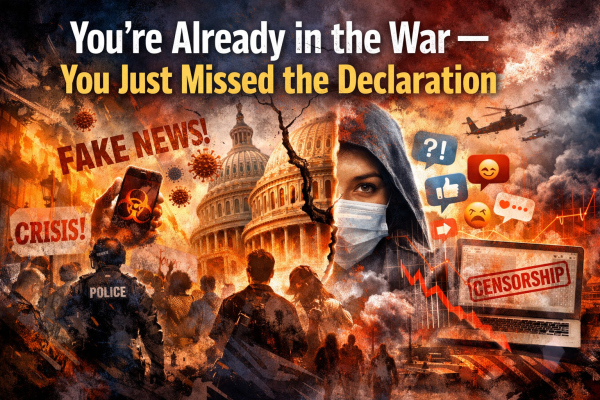
Americans still picture war the same way Hollywood does: tanks rolling, jets screaming overhead, flags planted in rubble. It’s comforting. It means war is somewhere else, fought by someone else, against an enemy you can point to on a map.
That mental model is obsolete.
The wars of the future—and increasingly, the wars of the present—will not announce themselves with bombs and bullets. They will arrive as confusion, contradiction, outrage, and exhaustion. You won’t know when they start. You won’t know who started them. You won’t even agree with your neighbors on whether they’re happening at all.
That’s not a failure of intelligence. It’s the point.
Decades ago, a former Soviet propagandist named Yuri Bezmenov tried to warn the West that modern conflict wouldn’t look like invasion. It would look like demoralization. Institutions hollowed out. Trust dissolved. Citizens arguing with each other instead of defending the system that allowed disagreement in the first place. The enemy wouldn’t need to defeat your army if it could convince your society that nothing was worth defending.
Years later, two Chinese PLA colonels put the same idea on paper in “Unrestricted Warfare.” Their argument was blunt: war is no longer about the battlefield. It’s about systems. Financial systems. Legal systems. Media systems. Cultural systems. Anything that makes a modern society function can be weaponized. Anything that can be disrupted without triggering a military response is fair game.
Different cultures. Same conclusion.
War had changed. The West just didn’t want to admit it.
Traditional warfare targets capability. Destroy the enemy’s factories, armies, and infrastructure, and the war ends. Modern warfare targets coherence. If you can fracture a society’s ability to agree on reality, authority, or legitimacy, you don’t need to destroy anything. The society will do it for you—slowly, legally, and while insisting it’s not under attack.
This is why future wars won’t look like war. They’ll look like a permanent identity crisis.
Instead of sirens, you get contradictory headlines. Instead of rationing, you get algorithmic outrage. Instead of enemy uniforms, you get endless moral emergencies, each framed as existential, each demanding immediate obedience, none ever fully resolved. People stop asking what’s true and start asking what’s survivable. At that point, power belongs to whoever offers certainty—or at least relief.
And here’s the savage truth Americans don’t like hearing: you don’t need foreign troops to destabilize a country full of citizens who distrust their institutions, despise each other, and can’t agree on what’s real. You just need to keep the pressure on long enough.
That’s why this new form of warfare is so dangerous. There’s no declaration. No clear enemy. No treaty that ends it. Everything feels like politics, culture, activism, or “just chaos.” People argue over symptoms instead of causes. Leaders manage optics instead of strategy. Citizens demand order one moment and rebellion the next.
And because no one wants to admit they might be under attack, every response is mis-calibrated.
Governments react by expanding emergency powers. Media reacts by narrowing acceptable narratives. Institutions react by protecting themselves instead of restoring trust. Citizens react by picking sides harder. None of it fixes the underlying problem. All of it accelerates the damage.
In older wars, chaos was collateral damage. In modern warfare, chaos is the weapon. The “fog of war” is the objective.
A society drowning in uncertainty can’t project power abroad. It can’t plan long-term. It can’t deter adversaries. It can’t even tell the difference between an accident, a crisis, and an attack. That ambiguity gives hostile actors exactly what they want: freedom of action without accountability.
And no, this doesn’t require some shadowy puppet master controlling every event. That’s lazy thinking. Modern warfare doesn’t rely on control—it relies on conditions. Shape the environment. Amplify existing fractures. Reward outrage. Suppress nuance. Let people believe they’re acting independently while nudging the system toward paralysis.
The most effective wars are the ones where the target population insists nothing unusual is happening—right up until nothing works anymore.
This is why tanks and bombers still matter, but matter less than they used to. You don’t invade a society that’s busy tearing itself apart. You wait. You watch. You exploit. You apply pressure just below the threshold that would force unity.
And if that sounds unsettling, good. It should.
Because the most dangerous moment in this kind of war isn’t when things explode. It’s when people stop expecting clarity, stop demanding accountability, and accept permanent instability as normal. That’s not resilience. That’s surrender dressed up as adaptation.
Here’s the line Americans need to hear, whether they like it or not:
A society doesn’t lose a modern war when it’s conquered. It loses when it can no longer recognize that it’s in one.
The future of warfare won’t arrive with mushroom clouds or parades. It will arrive with confusion, fatigue, and a creeping sense that nothing makes sense anymore—and that no one is in charge. By the time everyone agrees something is wrong, the damage is already done.
The war didn’t come for your borders. It came for your ability to agree on reality. Maybe it’s already here…
If you enjoyed this article, then please REPOST or SHARE with others; encourage them to follow AFNN. If you’d like to become a citizen contributor for AFNN, contact us at managingeditor@afnn.us Help keep us ad-free by donating here.
Substack: American Free News Network Substack
Truth Social: @AFNN_USA
Facebook: https://m.facebook.com/afnnusa
Telegram: https://t.me/joinchat/2_-GAzcXmIRjODNh
Twitter: https://twitter.com/AfnnUsa
GETTR: https://gettr.com/user/AFNN_USA
CloutHub: @AFNN_USA