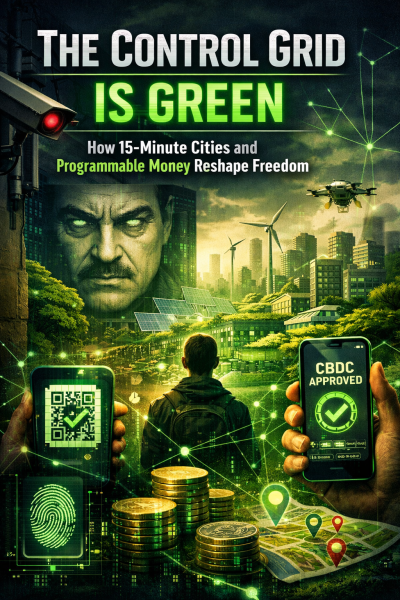
Catherine Austin Fitts has been saying something deeply unfashionable for years: we are quietly building the infrastructure for a digital control grid — not with tanks in the streets, but with “convenience.”
And unlike most internet alarmists, she’s not ranting about reptilian overlords. She’s pointing at plumbing.
Digital ID.
Programmable money.
Smart infrastructure.
AI-driven data fusion.
Individually? Efficient.
Integrated? Potentially Orwellian.
George Orwell didn’t imagine tyranny arriving with solar panels and fiber optic cable. He imagined telescreens and ration cards. But swap telescreens for smart meters and ration cards for CBDCs, and suddenly 1984 doesn’t look retro — it looks beta-tested.
Let’s talk about the architecture.
Central Bank Digital Currencies are openly discussed by central banks. “Programmability” is not a conspiracy term — it’s a design feature. That means money that can be restricted by category, geography, or expiration date. Imagine stimulus funds that must be spent within 30 days. Or welfare funds restricted to approved vendors. That’s not dystopia — that’s already been piloted in limited forms globally.
Now add digital identity. One verified identity tied to banking, health records, tax status, property, travel, utilities. Again, this is not secret. Governments openly discuss digital ID frameworks to reduce fraud and improve service delivery.
Now add smart cities.
The “15-minute city” concept, popular in urban planning circles, is pitched as walkable utopia — everything you need within a short distance. Lower emissions. Less traffic. Healthier lifestyles.
On paper? Lovely.
But when mobility, energy usage, and financial access are digitized and centralized, that same infrastructure can enforce compliance as easily as it encourages convenience.
The difference between “designed for access” and “designed for containment” is who controls the dashboard.
Look at Gaza reconstruction proposals. After devastation, international planners talk about rebuilding with smart grids, integrated data platforms, renewable microgrids, sensor-managed utilities, and digital service systems. Again — modern infrastructure makes sense. No one is suggesting we rebuild with candlelight and donkey carts.
But post-conflict zones have historically been laboratories for governance models. Rebuilding from scratch allows total systems integration. Digital ID embedded from birth. Cashless transactions. Biometric checkpoints. Movement monitored in the name of security.
Security always sounds reasonable.
Until it becomes permanent.
Fitts’ argument isn’t that someone already flipped the “Totalitarian Mode” switch. It’s that we’re building the control panel.
And once the panel exists, power eventually experiments.
You don’t need jackboots if you can simply freeze access. The Canadian trucker protest account freezes weren’t tanks rolling down Ottawa streets. They were backend banking updates. That’s a new kind of enforcement.
Quieter. Cleaner. Harder to protest.
Orwell called it Big Brother. Today it’s called “risk management.”
Smart meters track energy usage. AI monitors transaction patterns. Social media algorithms flag disinformation. ESG scoring influences capital allocation. None of these equal tyranny alone. But integrated? They form a compliance ecosystem.
That’s the grid.
And grids don’t need to shout.
They just hum.
The most dangerous systems in history were not built as evil. They were built as efficient. Surveillance states rarely begin with villains twirling mustaches. They begin with technocrats optimizing systems.
“We just need interoperability.”
“We just need resilience.”
“We just need safety.”
Then one day you discover that access to banking, travel, utilities, and communication is contingent on behavioral alignment.
And you never voted on that part.
The genius of modern control isn’t brutality — it’s conditionality.
In 1984, dissenters were tortured in the Ministry of Love. In the 21st century, they might simply discover their payment app is “temporarily unavailable.”
No blood. No headlines.
Just silence.
Fitts deserves credit because she connects these dots before they fully fuse. She looks at programmable finance, digital identity, smart urban infrastructure, and centralized data aggregation and asks a question that technocrats don’t like:
What safeguards exist if political power shifts?
Because systems built for benevolent management do not magically uninstall when less benevolent actors take control.
History is littered with tools designed for order that were later used for oppression.
So are 15-minute cities inherently evil? No.
Are smart grids sinister by default? No.
Is digital currency automatically dystopian? No.
But when identity, money, mobility, and energy converge under centralized programmable control, the potential for Orwellian governance becomes structurally possible.
And that’s the point.
The danger isn’t today’s leadership.
It’s tomorrow’s.
A free society must design infrastructure that assumes power will someday be abused.
If we build a world where economic existence depends on compliance with a centralized digital system, then Big Brother won’t need to watch you through a telescreen.
He’ll just manage your permissions.
And he’ll call it sustainability.
If you enjoyed this article, then please REPOST or SHARE with others; encourage them to follow AFNN. If you’d like to become a citizen contributor for AFNN, contact us at managingeditor@afnn.us Help keep us ad-free by donating here.
Substack: American Free News Network Substack
Truth Social: @AFNN_USA
Facebook: https://m.facebook.com/afnnusa
Telegram: https://t.me/joinchat/2_-GAzcXmIRjODNh
Twitter: https://twitter.com/AfnnUsa
GETTR: https://gettr.com/user/AFNN_USA
CloutHub: @AFNN_USA