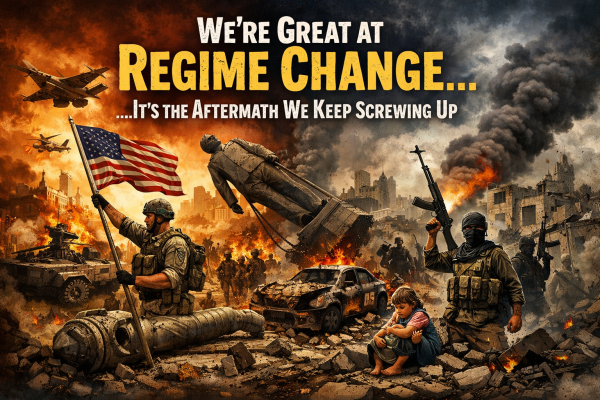
Every time the United States gets involved in a foreign conflict, the opening act is usually impressive. Precision strikes, shock-and-awe, special operations raids, satellites, drones, cyber, carrier groups—the whole high-tech orchestra. When it comes to breaking things, the U.S. military is the undisputed heavyweight champion of the world. Regimes fall, palaces empty, statues get pulled down, and cable news runs dramatic graphics about “the end of an era.”
Then comes Act Two.
That’s the part where the music stops, the cameras leave, and the country we just helped “liberate” starts falling apart like a folding lawn chair. Somehow, the United States has developed a very consistent pattern over the last few decades:
We do a fantastic job at regime change, and a deeply questionable job at what happens after the regime changes.
Iraq. Afghanistan. Libya. Parts of Syria. Even places where we didn’t fully invade, but heavily intervened, have a habit of turning into long, messy, expensive problems that nobody wants to own once the headlines fade.
The uncomfortable truth is that toppling a government is often the easiest part of the whole operation. The hard part is what comes next, and that’s the part we keep acting surprised by, like a guy who pulls the pin on a grenade and then looks shocked when it explodes.
Take Iraq. In 2003, the U.S. military removed Saddam Hussein’s regime in a matter of weeks. The Iraqi Army collapsed, the government disappeared, and the world watched what looked like a textbook example of modern warfare done right. Mission accomplished banners, victory speeches, the whole thing.
Then we made one of the most famous strategic blunders in modern history: we dismantled the existing power structure before we had anything ready to replace it.
The Iraqi Army was disbanded. Baath Party members were purged. Government ministries stopped functioning. Overnight, hundreds of thousands of armed, trained, unemployed men were told, essentially, “Good luck, you’re on your own.”
Shockingly, many of them decided not to become accountants.
What followed wasn’t peace. It was insurgency, sectarian violence, militias, foreign fighters, and eventually the rise of ISIS. The regime was gone, yes—but the stability that had existed, however unpleasant, went with it. The end result was a decade of war, trillions of dollars spent, thousands of American casualties, and a region that is still dealing with the aftershocks.
Afghanistan followed a similar script, just stretched out over twenty years instead of ten. The Taliban were removed quickly in 2001. The hard part was building something that could stand on its own afterward.
We built an army, trained police, funded a government, and poured in money at a rate that would make a lottery winner blush. On paper, everything looked great. In reality, much of the system only worked as long as the United States was standing there holding it up.
Once we left, the whole thing collapsed faster than a lawn chair at a family reunion. The Taliban, the same group we removed at the beginning, walked back into Kabul almost without a fight.
Twenty years, thousands of lives, and trillions of dollars later, the final result looked suspiciously like the starting point.
Libya may be the most honest example of all. We helped remove Muammar Gaddafi, declared victory, and then… left. What followed wasn’t democracy. It was a fractured state, competing militias, human trafficking, and a country that still doesn’t really have a unified government.
It turns out that removing a dictator does not automatically create Switzerland.
This is the lesson that keeps getting relearned every time a new crisis pops up and people start talking about regime change like it’s a software update you can install overnight.
Toppling a government is a military problem.
Replacing one is a political, cultural, tribal, economic, and historical problem all at the same time.
And those are problems that don’t get solved with cruise missiles.
Now, with Iran in the headlines again, the same question is quietly sitting in the background: What happens if the regime actually falls?
Iran is not Iraq. It’s not Afghanistan. It’s bigger, more complex, more educated, more urban, and full of ethnic, religious, and political fault lines that don’t magically disappear just because the current leadership is gone.
If the central government collapses, the most likely outcome isn’t instant democracy. It’s fragmentation. Power struggles. Regional factions. Militias. Outside influence. In other words, the exact kind of chaos that historically drags the United States right back in, this time not to fight a war, but to manage the aftermath of one.
And that’s the part we never seem to plan for with the same enthusiasm we plan the airstrikes.
America is very good at winning the opening round. Tactics win battles. We’re less good at deciding what the fight was supposed to accomplish in the first place. Strategy wins wars.
Regime change makes for great headlines. Civil wars make for long decades.
If there’s one lesson from Iraq, Afghanistan, and Libya, it’s this:
Breaking a country is fast.
Fixing one is slow.
And sometimes, after we leave, it’s worse than when we got there.
If you enjoyed this article, then please REPOST or SHARE with others; encourage them to follow AFNN. If you’d like to become a citizen contributor for AFNN, contact us at managingeditor@afnn.us Help keep us ad-free by donating here.
Substack: American Free News Network Substack
Truth Social: @AFNN_USA
Facebook: https://m.facebook.com/afnnusa
Telegram: https://t.me/joinchat/2_-GAzcXmIRjODNh
Twitter: https://twitter.com/AfnnUsa
GETTR: https://gettr.com/user/AFNN_USA
CloutHub: @AFNN_USA