Nice Toy, Sharp Edges: Iran and the World’s First AI War

We’ve got a new toy. It’s sleek, fast, doesn’t get tired, doesn’t argue, and it can chew through more data in a minute than a staff section could in a week. We bolted it onto the most capable military on earth and told it to help us find targets. Then we dropped it into a live fight in one of the most complex battlespaces on the planet and acted surprised when the results were… mixed. Welcome to the world’s first real AI war.

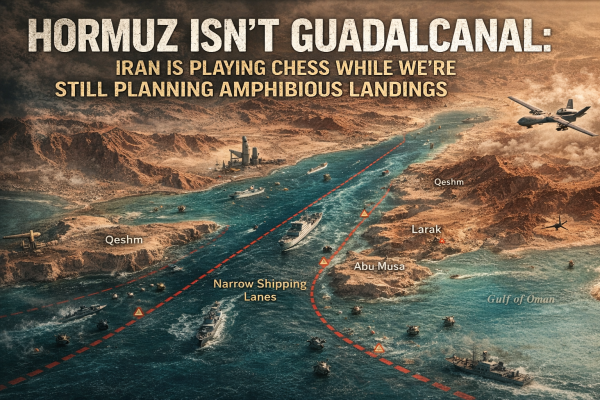
Hormuz Isn’t Guadalcanal: Iran Is Playing Chess While We’re Still Planning Amphibious Landings

Somewhere in the Pentagon filing cabinets sits a 2017 document that reads less like doctrine and more like a warning label we ignored. The Joint Concept for Access and Maneuver in the Global Commons (JAM-GC) laid it out plainly: the United States wins wars because we can show up anywhere on earth, kick in the door, and maneuver freely across air, sea, space, and cyber. That’s our superpower. Not just firepower—access. And the bad guys figured that out.

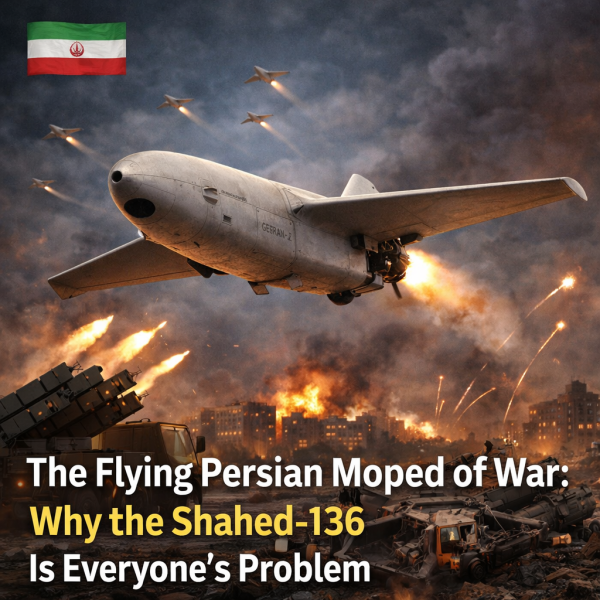
The Flying Persian MoPed of War: Why the Shahed-136 Is Everyone’s Problem

The Shahed-136 is not a masterpiece of engineering. It’s not stealthy, not fast, not elegant, and certainly not impressive in the way a fifth-generation fighter is. It sounds like a weed whacker with anger issues. It flies like a lawn dart with a GPS addiction. And yet—this ugly little flying triangle has exposed a brutal truth about modern warfare: You don’t need to be advanced to be effective. You just need to be cheap, numerous, and good enough.

Hormuz: The Reality TV War and China’s Unfortunate Front-Row Seat

Modern war has acquired an odd new feature. It now comes with graphics, dramatic music, and a nightly highlight reel. Precision bombs streak across the screen. Drones glide in cinematic slow motion. Social media fills with grainy infrared footage of things exploding in the desert while commentators nod gravely and say phrases like “escalation dynamics” and “rules-based order.”

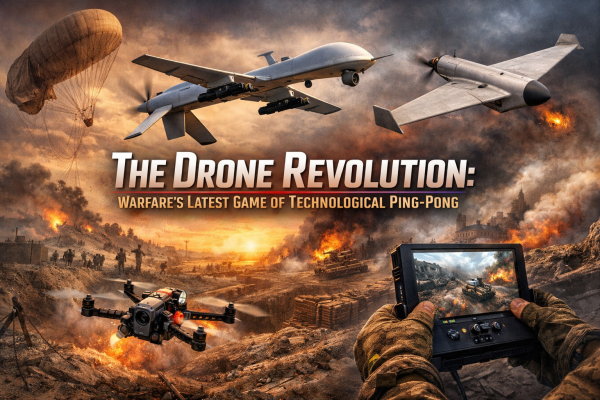
The Drone Revolution: Warfare’s Latest Game of Technological Ping-Pong

The basic idea of unmanned warfare actually dates back more than a century. During World War I, armies experimented with remotely controlled aircraft and explosive “aerial torpedoes.” They were crude and unreliable, but the concept was already there: send a machine instead of a pilot into harm’s way. Through the Cold War the idea matured into reconnaissance drones used primarily for surveillance. The United States began using early UAVs over Vietnam and later refined the concept in the 1990s and early 2000s.

Hormuz: 21 Miles of History Proving Geography Still Rules the Modern World

The modern world likes to believe it has outgrown geography. Satellites circle the planet, data moves at the speed of light, and weapons can strike targets from continents away. Military theorists speak confidently about cyber war, artificial intelligence, and fifth-generation conflict conducted across digital networks and orbital platforms. Yet despite all this technological sophistication, the global economy still depends on an astonishingly simple fact of physical geography: about twenty-one miles of ocean between Iran and Oman control roughly a quarter of the world’s oil and enormous quantities of energy-related commodities such as petrochemical feedstocks and fertilizer inputs.

Clausewitz, Jomini, and DIME-FIL: Why a 200-Year-Old War Theory Still Explains the Iran War

Start with Clausewitz. His most famous line remains the most brutally accurate description of war ever written: war is the continuation of politics by other means. In other words, wars are not random explosions of violence. Nations fight because they want political outcomes—territory, influence, regime survival, deterrence, or control of strategic regions.

Death Rays on a Budget: How the U.S. and Israel Turned Electricity into Air Defense

If you grew up on Austin Powers, you remember the joke. Dr. Evil didn’t want nukes. He didn’t want tanks. He wanted lasers. The audience laughed because lasers were cinematic nonsense. Fast forward to 2026 and Israel is fielding the Iron Beam, and the U.S. military has ship-mounted and vehicle-mounted high-energy laser systems actively burning small threats out of the sky. Turns out Dr. Evil was just early.

Iran: The Revolution That Ate Its Own Children – A Brief History

When Americans think about Iran, the story usually begins in 1979—angry crowds, burning flags, and a stern cleric named Ayatollah Khomeini taking control of the country. But that snapshot hides something important. Iran—historically Persia—is one of the world’s oldest civilizations. Its history stretches back thousands of years, and the country that emerged after 1979 is not the inevitable outcome of Persian history. In many ways, it was a political accident born from revolution, miscalculation, and a brutal consolidation of power.

When Veteran YouTube Geopolitical Talking Heads Start Acting Like Internet Trolls

Now let’s be clear about something. Veterans arguing about foreign policy is not the problem. In fact, it’s healthy. People who have worn the uniform should absolutely debate how American power is used. The military has always produced strong opinions—usually accompanied by horrible coffee and worse briefing slides. But what used to separate professional disagreement from internet drama was something the officer corps once valued deeply: discipline.

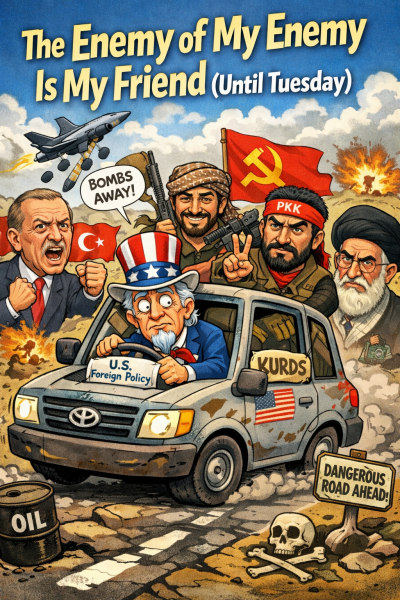
The Kurds – The Enemy of My Enemy Is My Friend (Until Tuesday)

For many Americans, the story is simple. Saddam Hussein gassed the Kurds in the 1980s—most infamously at Halabja. They suffered horribly. When the United States eventually removed Saddam from power in 2003, the Kurds were portrayed as natural allies: brave fighters, pro-Western, reliable partners in a messy region.

Blood, Guts, and Winning Wars: Why Patton Still Makes Modern Leaders Uncomfortable

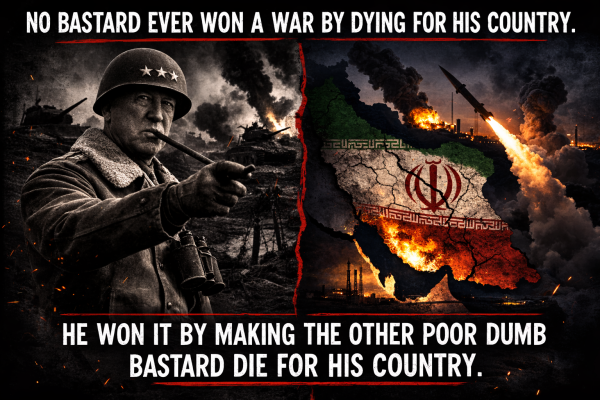
Patton’s most famous line, delivered to the Third Army in 1944, captured his philosophy better than any manual ever written: “No bastard ever won a war by dying for his country. He won it by making the other poor dumb bastard die for his country.” That was not just colorful language. It was a direct rejection of the romantic nonsense that had gotten an entire generation slaughtered in World War I. Patton had seen that war. He had been wounded in it. He understood that modern industrial warfare was not a stage for heroic poetry. It was a contest of logistics, speed, firepower, and will. His job was not to produce martyrs. His job was to produce victory.

The Dollar Isn’t Backed by Gold — It’s Backed by DIME and a Carrier Strike Group

Let’s retire the fairy tales.

The U.S. dollar is not backed by gold. It’s not backed by “faith.” It’s not backed by vibes. It’s backed by power — specifically the kind of power that sails in carrier strike groups, negotiates trade deals, controls sea lanes, writes sanctions law, insures shipping, and can ruin your economy before your stock market even opens.

We’re Great at Regime Change… It’s the Aftermath We Keep Screwing Up

Every time the United States gets involved in a foreign conflict, the opening act is usually impressive. Precision strikes, shock-and-awe, special operations raids, satellites, drones, cyber, carrier groups—the whole high-tech orchestra. When it comes to breaking things, the U.S. military is the undisputed heavyweight champion of the world. Regimes fall, palaces empty, statues get pulled down, and cable news runs dramatic graphics about “the end of an era.”

Quiet Readiness: A Simple Reminder for Concealed Carriers After a Tense Weekend

There has already been at least one geopolitically connected incident reported in Austin, Texas. That doesn’t mean anything is about to happen in your town, and it doesn’t mean you should change your daily routine. What it does mean is that uncertain times are a good moment to make sure your equipment is working the way it should. Calm preparation beats last-minute scrambling every time.

World War III Started With a Virus — Now It’s a Multi-Regional Fight and the U.S. Is Running All Four DIME Tools at Once

The modern battlefield isn’t just military anymore. It’s what the national security crowd calls DIME — Diplomacy, Intelligence, Military, and Economy — and right now the United States is fighting on all four fronts at the same time, in multiple regions, with fewer resources than it had even ten years ago. That’s not a conspiracy theory. That’s just what happens when a superpower tries to hold together a global order that is starting to come apart.

Why Christians Feel Obligated to Defend Israel—and Why the Bible Never Commands It

There is a quiet anxiety baked into much of modern American Christianity: if you don’t support Israel—always, loudly, and without qualification—God might notice. Entire churches treat Israeli foreign policy as a third sacrament. Question a settlement policy or a military response and someone will reach for Genesis 12 like it’s a theological panic button. This fear wears the costume of faith, but it isn’t biblical. It’s superstition with a study Bible.

“The 51st Star We Never Voted On: How Israel Became America’s Problem Child”

Let’s dispense with the polite fiction. The United States has 50 states on paper and one premium subscription state overseas that gets all the benefits with none of the awkward obligations like paying federal taxes or pretending to listen to Washington. Welcome to Israel, America’s unofficial 51st state — the only one close enough to lecture Congress but far enough away that we pretend it’s “just an ally.”