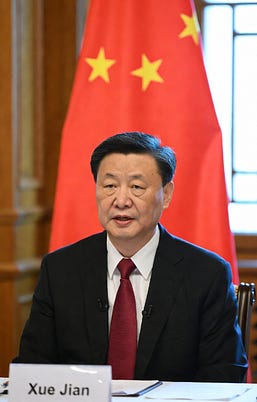
“That filthy neck that barged in on its own — I’ve got no choice but to cut it off without a moment’s hesitation. Are you prepared for that?” – Consul General Xue Jian of the Chinese Consulate General in Osaka, Japan, 9 November
Xue’s protocol-busting remarks on the social media platform X were his response to a statement made by Japanese Prime Minister Sanae Takaichi to a Japanese parliamentary committee on 7 November. At that meeting, she stated that a Chinese blockade of Taiwan would likely create a “survival-threatening situation“ for Japan — an action that could compel Tokyo to deploy its Self-Defense Forces in response.
Xue’s remarks were those of a barbarian, not a seasoned senior diplomat.
Let us examine the issue.
XUE JIAN
Xue Jian (薛剑; age 57) grew up in Huai’an, a prefecture-level city (pop. ~4.5 million) in central Jiangsu Province in Eastern China. A prefecture-level city (地级市) is the most common type of second-level administrative division in mainland China, ranking immediately below the province level in the hierarchy. There are ~333 of these administrative regions in China. He graduated from Beijing Foreign Studies University in 1992 where he earned a Bachelor of Arts degree after majoring in Japanese language and culture. With this foundation, he was subsequently posted to various billets in the Ministry of Foreign Affairs focused almost exclusively on Japan-related diplomacy.
Here is a list of his various assignments (all senior positions) over the past decade:
2014–2018: Minister-Counselor (公使衔参赞), Embassy of the People’s Republic of China in Japan
2018–2019: Counselor (参赞), Department of Asian Affairs, Ministry of Foreign Affairs
2019–2021: Deputy Director-General (副司长), Department of Asian Affairs, Ministry of Foreign Affairs
2021–Present: Ambassador-rank Consul General (大使衔总领事), Consulate General of the People’s Republic of China in Osaka, Japan
In short, Xue is no stranger to Japanese culture, Japanese politics, or Japanese governments. And as a senior diplomat with over 30 years of experience – with 8+ of those years in Japan! – he almost certainly understands standard protocols for virtually all diplomatic corps around the world.
STANDARD DIPLOMATIC PROTOCOL
Rule number one for diplomats is to avoid any direct, public negative statements about other countries, especially directed at the host country when assigned to a billet in that country. It is a core principle of modern diplomacy rooted in the Vienna Convention on Diplomatic Relations (agreed in 1961), customary international law, and practical necessity. Article 41 of that Convention states: “Without prejudice to their privileges and immunities, it is the duty of all persons enjoying such privileges and immunities to respect the laws and regulations of the receiving State. They also have a duty not to interfere in the internal affairs of that State.”
The “practical necessity” part is pretty obvious: a foreign diplomat cannot possibly be effective with and hope to retain the necessary trust of the host country after, for example, personal attacks have been publicly made against the head of state. The proper course of action is to maintain a “constructive relationship” even when there are major policy disagreements between governments by adhering to the concept of “praise in public, criticize in private.” Virtually all members of diplomatic corps around the world never criticize the host country through public statements or the media (including social media).
Xue’s statement that Japanese Prime Minister Takaichi should be beheaded was a flagrant and barbaric departure from protocol, if not a direct personal threat. A similar comment from an overzealous junior staffer could POSSIBLY be written off, but one can only surmise that Xue’s statement was tacitly endorsed by his masters in Zhongnanhai since he has not apparently been recalled (or even disciplined in any known way) to date.
OTHER CHINESE VIOLATIONS OF DIPLOMATIC PROTOCOL
Lest there be any confusion that Xue’s remarks were an isolated occurrence, here are some other examples wherein Chinese diplomats have breached standard protocols (e.g., non-interference in internal affairs, respect for host state laws, and avoidance of threats or harassment) in recent years.
In 2010, a Chinese diplomat was expelled from Canada on grounds of violating non-interference principle for spying allegations that were uncovered as part of counterintelligence efforts by the Canadian Security Intelligence Service.
In 2019, two Chinese embassy officials were “secretly expelled” from the US after they entered a “sensitive” military base in Virginia in violation of diplomatic inviolability and security laws.
In January 2021, Chinese Ambassador to Sweden Gui Congyou threatened journalists with “shotguns” for critical reporting and accused Swedish media of interfering in China’s internal affairs during a public radio interview. The result was a summons from the Swedish Foreign Ministry, and Gui’s remarks were written off as “an astonishing level of assertiveness.”
In March 2021, Chinese Ambassador to France Lu Shaye insulted French academic Antoine Bondaz as a “little rascal” on Twitter/X for criticizing Chinese disinformation. This led to a formal summons to the French Foreign Ministry where he was “encouraged” to express regret and warned that such behavior hindered bilateral relations. Lu apparently was promoted for his remarks, as he was named China’s Representative for European Affairs back in February.
In October 2022 in the UK, Chinese Consulate staffers in Manchester physically assaulted a Hong Kong protester on consulate grounds, violating diplomatic inviolability rules. As a result of the incident, China “removed six officials from Britain” because they refused to waive their diplomatic immunity and undergo questioning by British detectives investigating the case.
In May 2024, Chinese diplomats in the Philippines were accused of wire-tapping and leaking a private phone conversation with a Filipino admiral in an attempt to coerce concessions in the long-running South China Sea dispute between China and the Philippines. Although there were Filipino calls for expulsion, there were expulsions made or even disciplinary actions taken by the Chinese.
In March 2024, Chinese diplomats and intelligence agents in Prague (Czech Republic) physically followed Taiwan’s Vice President Hsiao Bi-khim during her visit there and planned a “kinetic action” (staging a car collision targeting her). No expulsions, declarations of persona non grata, or arrests of the Chinese involved in this incident were made by the Czech Republic although the Chinese ambassador Chinese Ambassador Feng Biao was summoned by the Czech foreign office in protest.
In short, Xue’s public comments were of-a-piece with periodic barbaric actions taken in the recent past by members of the Chinese Ministry of Foreign Affairs when on assignment overseas.
CONCLUDING THOUGHTS
To be “fair” to the Ministry of Foreign Affairs, the words and deeds of their diplomatic corps are entirely consistent with the increasing belligerence of the Chinese government and its key foreign policy instrument, the People’s Liberation Army, as they pursue Chinese strategic and economic interests without regard to international law. Their increased discarding of standard diplomatic protocols in recent years parallels the PLA’s continuing intimidation of China’s neighbors: in the Taiwan Strait, in the South China Sea, in the Senkaku Islands, in the Yellow Sea, in the East Philippine Sea, and elsewhere.
Insofar as Chinese Consul General Xue Jian’s horrible remarks are concerned, George Glass, US Ambassador to Japan, may have said it best – appropriately, in an X post on 9 November:
The mask slips once more. Just a few months ago, China’s Consul General in Osaka, Xue Jian, compared Israel to Nazi Germany. This time, he’s threatening Prime Minister @takaichi_sanae and the Japanese people. The Chinese government repeatedly touts itself as a “good neighbor” like a catchphrase, yet it utterly fails to live up to the reality. Isn’t it about time it started acting the part as its words suggest?
Now THAT is how to deliver a stiletto within the principles of standard diplomatic protocols that skewers barbarism with Chinese characteristics! More, please.
The end.