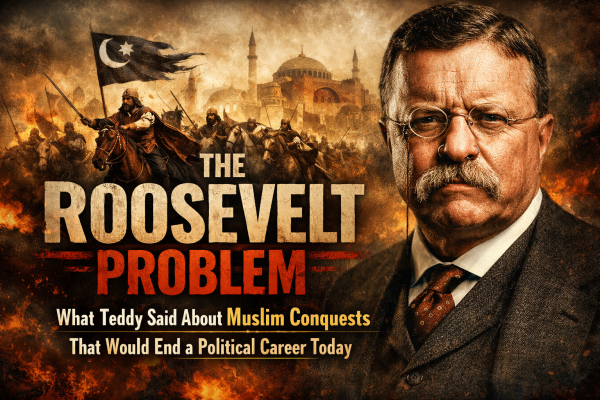
If Theodore Roosevelt were transported into modern America and handed a microphone, the man wouldn’t survive a single news cycle. Not because he was shy, confused, or prone to carefully worded diplomatic statements. Quite the opposite. Roosevelt had a remarkable ability to say exactly what he thought about history, religion, and civilization without the slightest concern for whether it might offend a future diversity committee.
And when Roosevelt wrote about Islam and its historical relationship with the West, he did not mince words.
The quotes are real. They come mostly from his 1916 book “Fear God and Take Your Own Part,” written at a time when Roosevelt was reflecting on world history during the chaos of World War I. What makes them fascinating today isn’t simply what he said, but how completely incompatible his blunt style would be with the politically correct culture that dominates public discourse today.
Here is one of Roosevelt’s most widely cited passages:
“Christianity was saved in Europe solely because the peoples of Europe fought the Mohammedans who invaded them… Had the victorious Moslems advanced farther into Europe, the Christian religion would have been exterminated.”
Roosevelt was referencing events such as the Battle of Tours, where Charles Martel halted the Umayyad advance into Western Europe, and the Battle of Vienna, where John III Sobieski led the charge that broke the Ottoman siege of the city. Roosevelt’s interpretation was straightforward: civilizations survive because they defend themselves.
But Roosevelt didn’t stop there.
In another passage discussing the expansion of Islam, he wrote:
“The Moslem religion is one of the most extraordinary religions the world has ever seen. It spread with a sword and was upheld by the sword.”
If a sitting American president wrote that sentence today, the reaction would likely involve emergency press conferences, congressional hearings, and approximately three thousand think pieces explaining why the republic had entered a constitutional crisis.
Roosevelt also made a comparison that would make modern political consultants break out in cold sweats:
“Wherever the Mohammedan conquest extended, the Christian populations were either exterminated or reduced to a subject condition. Wherever the Christian conquest extended, the Mohammedan faith survived.”
Historians today would debate the accuracy and nuance of that claim, but Roosevelt’s point was not to produce a modern academic analysis of religious demographics. He was emphasizing something he believed deeply: that military power and civilizational survival were historically connected.
That worldview was entirely consistent with Roosevelt’s philosophy of the “strenuous life.” He believed societies became strong through struggle, courage, and the willingness to defend themselves. Weak civilizations, in Roosevelt’s mind, eventually disappeared.
Of course, Roosevelt was writing in a very different world. In 1916 the Ottoman Empire still existed, and Western writers frequently framed world history as a long struggle between Islamic and Christian empires. The language of that era was blunt, direct, and far less concerned with avoiding offense than modern public discourse.
Which brings us to the real reason these quotes are so explosive today.
Modern political culture is built around careful language management. Public figures are trained to speak in layers of carefully engineered ambiguity designed to avoid angering any identifiable voting bloc. Roosevelt had absolutely no patience for that style of communication. His writing reads like a man who assumed readers were adults capable of hearing uncomfortable interpretations of history.
Ironically, Roosevelt’s worldview was not built around modern identity politics at all. He admired courage and strength wherever he saw them. During America’s conflict in the Philippines, Roosevelt praised the fighting ability of Muslim Moro warriors who served with U.S. forces. In Roosevelt’s mind, bravery earned respect regardless of religion.
But nuance rarely survives modern outrage cycles.
What would truly doom Roosevelt today isn’t simply that he criticized aspects of Islamic expansion. Historians debate those topics all the time. What would make him radioactive is that he framed history in terms of civilizational struggle and survival. In a culture that increasingly prefers therapeutic language about coexistence and shared narratives, Roosevelt’s blunt talk about power, conquest, and survival sounds almost prehistoric.
And yet Roosevelt was not writing as a provocateur. He was writing as a historian of his time and a soldier who had personally experienced war. His conclusions were shaped by a worldview that assumed history was often brutal and that societies had to face that reality honestly.
Agree or disagree with Roosevelt’s analysis, one thing is certain: if the twenty-sixth president were alive today, the loudest controversy surrounding him would not be his policies. It would be his refusal to sanitize history.
If you enjoyed this article, then please REPOST or SHARE with others; encourage them to follow AFNN. If you’d like to become a citizen contributor for AFNN, contact us at managingeditor@afnn.us Help keep us ad-free by donating here.
Substack: American Free News Network Substack
Truth Social: @AFNN_USA
Facebook: https://m.facebook.com/afnnusa
Telegram: https://t.me/joinchat/2_-GAzcXmIRjODNh
Twitter: https://twitter.com/AfnnUsa
GETTR: https://gettr.com/user/AFNN_USA
CloutHub: @AFNN_USA