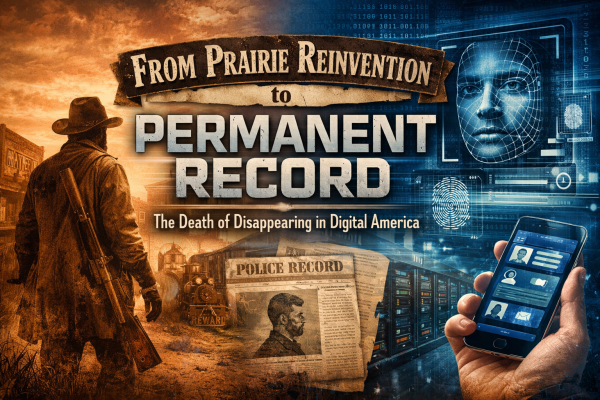
There was a time in America when you could punch your Army captain, skip town, grow a beard, head west, and become “Samuel Whitaker, cattleman and church deacon.”
Today? You can’t change your Instagram handle without a two-factor authentication code, three archived screenshots, and your ex forwarding it to your employer.
We romanticize the 1800s as rough, lawless, and dangerous. And they were. But they were also gloriously anonymous. Identity wasn’t a federal project. It was a handshake and a story. If you said your name was John Carter and no one in Kansas knew you from Ohio, congratulations — you were John Carter.
Try that today and watch your credit report laugh at you.
In the 19th century, there was no Social Security number. No centralized criminal database. No facial recognition. The United States Army kept records, sure — but they were paper, local, slow, and frequently incomplete. If you deserted and made it far enough west, you might never be found unless someone physically recognized you.
That wasn’t because Americans were morally superior or inferior. It was because scale was limited. Communication was slow. Bureaucracy was primitive. Human beings simply couldn’t track each other very well.
Fast forward to 2026.
Your face is a password.
Your phone is a tracking bracelet you voluntarily pay for.
Your car reports telemetry.
Your bank flags “unusual activity” before you even finish being unusual.
And somewhere in a quiet data center, a server farm hums softly, preserving your 2009 Facebook rant about politics like it’s the Dead Sea Scrolls.
We built a civilization that cannot forget.
Once upon a time, a scandal was local. Today it’s searchable. Indexed. Archived. Cached. Screenshot. Backed up. And probably stored on three continents for “redundancy.”
You don’t disappear anymore. You accumulate.
You don’t reinvent yourself. You rebrand — and even then, the old brand remains available with a Google search and a slightly vindictive coworker.
In the 1800s, if you committed a non-capital offense and wanted to start over, you physically moved. America was expanding. Rail lines were spreading. Communities were forming faster than record systems could keep up. Law enforcement was county-based. Before agencies like the Federal Bureau of Investigation existed, coordination across states was slow and inconsistent.
Today? A misdemeanor in Florida can cost you a job in Alaska before you finish unpacking.
Even if you legally change your name — which is still allowed — your digital shadow doesn’t vanish. Court records are public. Databases sync. Credit histories link. Facial recognition doesn’t care what you call yourself. It cares about bone structure.
And that’s the real shift.
In the 1800s, identity was narrative.
In 2026, identity is data.
Narratives can be rewritten.
Data persists.
Now let’s be clear: this isn’t a defense of criminals dodging consequences. Murderers should not get a prairie do-over. But the cultural cost of total traceability is rarely discussed.
We used to believe in redemption arcs. The disgraced soldier who became a rancher. The bankrupt merchant who moved west and rebuilt. The man who made a mess in one town and quietly matured in another.
Today we say we believe in second chances — but we engineered a system that never forgets the first mistake.
The modern world is one giant memory palace. A Tower of Babel made of servers and compliance officers. Every institution, public and private, hoards information not because it makes us better — but because bureaucracies exist first to preserve themselves. Information is leverage. Leverage is control. Control is stability.
Or at least the illusion of it.
We’ve scaled record-keeping beyond what human forgiveness can handle.
The irony? In the 1800s, it was easier to vanish — but harder to fake competence. If you showed up calling yourself a blacksmith and couldn’t shoe a horse, you were exposed by noon. Reputation rebuilt itself through actual skill and conduct.
Today you can curate a flawless LinkedIn persona while your past mistakes sit quietly indexed beneath it. We don’t test character locally anymore; we audit it digitally.
And once digitized, it’s permanent.
You can’t outrun metadata.
You can’t hide from your own biometrics.
You can’t even delete a tweet without someone replying, “Actually…”
We built a civilization obsessed with transparency, and in doing so, we eliminated obscurity — which also eliminated one of the historical mechanisms for renewal.
In 1875, reinvention required courage, labor, and miles.
In 2026, it requires a PR firm and a crisis management consultant.
You don’t disappear anymore. You negotiate with your past.
And maybe that’s the tradeoff of modern scale. Safety, accountability, fraud prevention — all real benefits. But so is the quiet loss of anonymity, the frontier reset button, the ability to close one chapter and physically begin another.
The West is closed. The cloud is open. And it remembers everything.
So if you’re thinking about becoming “Samuel Whitaker, cattleman and church deacon” after torching your current life?
Better check your digital footprint first.
It’s already three steps ahead of you.
If you enjoyed this article, then please REPOST or SHARE with others; encourage them to follow AFNN. If you’d like to become a citizen contributor for AFNN, contact us at managingeditor@afnn.us Help keep us ad-free by donating here.
Substack: American Free News Network Substack
Truth Social: @AFNN_USA
Facebook: https://m.facebook.com/afnnusa
Telegram: https://t.me/joinchat/2_-GAzcXmIRjODNh
Twitter: https://twitter.com/AfnnUsa
GETTR: https://gettr.com/user/AFNN_USA
CloutHub: @AFNN_USA