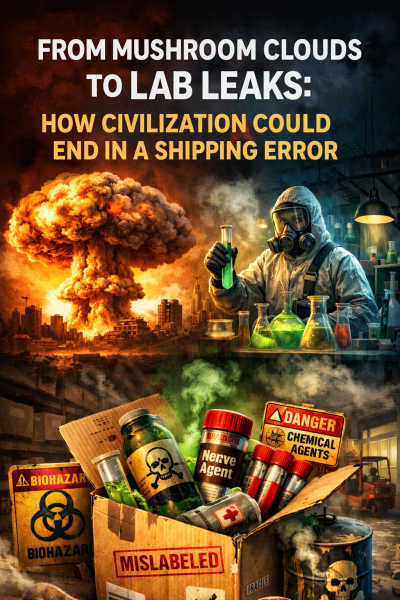
For decades, we feared the mushroom cloud. The big red button. The dramatic speech. The nuclear football. Civilization ending in 30 cinematic minutes.
Turns out, that was adorable.
Today’s extinction event probably doesn’t arrive in a missile silo. It arrives in a mislabeled vial, a shipping manifest error, a warehouse with 1,000 genetically modified mice, or a “harmless research sample” that accidentally skipped customs paperwork.
Progress.
Let’s recap just a few recent greatest hits.
In 2019, a high-containment military lab at Fort Detrick was temporarily shut down over biosafety containment issues. Not evil mastermind stuff — just systems not working properly. The kind of thing you’d prefer not to hear about facilities handling dangerous pathogens.
Fast forward. Reedley, California: an unlicensed warehouse bio lab discovered with thousands of labeled pathogen samples and genetically modified mice. Not a Bond villain lair. Just… sitting there. In a warehouse. As one does.
Then we had multiple University of Michigan cases involving improperly imported biological materials — including a crop-damaging fungus described as a potential agroterror concern. Charges filed. Charges dropped. Diplomatic noise. Everyone assures us it’s fine.
Totally fine.
Early 2026: Las Vegas. Residential property. Suspected unauthorized biological lab. FBI, hazmat teams. No confirmed public threat, we’re told. Which is exactly the phrase you want to hear when someone finds “unknown liquid samples” in a house.
And just this week in Irvine, California, a home science lab fire triggers a federal investigation into suspicious chemicals, with early reporting mentioning possible nerve agent indicators. Unconfirmed. Under analysis. No public danger.
That’s comforting.
Notice the pattern? It’s not supervillains. It’s not evil empires cackling over maps. It’s sloppy containment, illegal labs, improper imports, regulatory breakdowns, and “we didn’t think that would happen.”
We don’t need to annihilate every man, woman, and child with nukes.
We might just out-smart ourselves into oblivion.
Because here’s the uncomfortable truth: modern biological and agricultural systems are insanely powerful. A fungus can crater crop yields. A livestock disease can wipe out herds and shut down exports overnight. A supply-chain disruption can empty shelves faster than a hurricane warning.
We’ve optimized everything for efficiency. Monocultures. Centralized processing. Global logistics. “Just-in-time” inventory.
It’s brilliant. It’s elegant.
It’s also fragile.
The New World screwworm — a parasitic fly we eradicated decades ago through sterile insect programs — is a perfect example. It doesn’t need nukes. It doesn’t need tanks. It just needs living tissue. Reintroduction would not end civilization, but it would hurt — economically, logistically, psychologically.
Now layer that reality over what we’ve seen since COVID: biosafety pauses at high-containment labs, illegal warehouse operations, smuggling cases involving plant pathogens, and residential “science projects” requiring hazmat teams.
These are just the incidents we know about. The ones that made headlines. The ones discovered by accident, whistleblowers, or local code enforcement.
And every time, we’re reassured:
“No public risk.”
“Out of an abundance of caution.”
“Under investigation.”
“Containment protocols followed.”
Which is good. We want investigation. We want oversight.
But maybe we should also want a little humility.
Because playing with high-consequence biology, chemicals, and agricultural systems isn’t like mis-programming your thermostat. It’s not a software patch. It’s not “have you tried turning it off and on again?”
It’s ecosystems. It’s food systems. It’s pathogens that evolve.
We are astonishingly clever. We can splice genes, synthesize compounds, and engineer crops to resist drought.
We are also the species that needs warning labels on lawn mowers telling us not to stick our hands underneath.
This is not a call for panic. It’s a call for sobriety.
The greatest risk to humanity in the 21st century may not be deliberate annihilation. It may be accumulated hubris. A thousand small “oopsies.” A culture that assumes we can manage every variable because we have a PhD and a grant.
The Cold War fear was intentional destruction.
The modern fear is unintended consequences.
We don’t need a nuclear exchange to cause irreversible damage.
We just need arrogance, complexity, weak oversight, and the eternal human confidence that “this time, it’ll be different.”
History suggests otherwise.
We are not evil geniuses.
We are clever flawed humans with centrifuges, and playing with fire.
And if we don’t combine technological power with institutional discipline and genuine caution, the thing that undoes us won’t be a mushroom cloud.
It’ll be an accident report.
If you enjoyed this article, then please REPOST or SHARE with others; encourage them to follow AFNN. If you’d like to become a citizen contributor for AFNN, contact us at managingeditor@afnn.us Help keep us ad-free by donating here.
Substack: American Free News Network Substack
Truth Social: @AFNN_USA
Facebook: https://m.facebook.com/afnnusa
Telegram: https://t.me/joinchat/2_-GAzcXmIRjODNh
Twitter: https://twitter.com/AfnnUsa
GETTR: https://gettr.com/user/AFNN_USA
CloutHub: @AFNN_USA