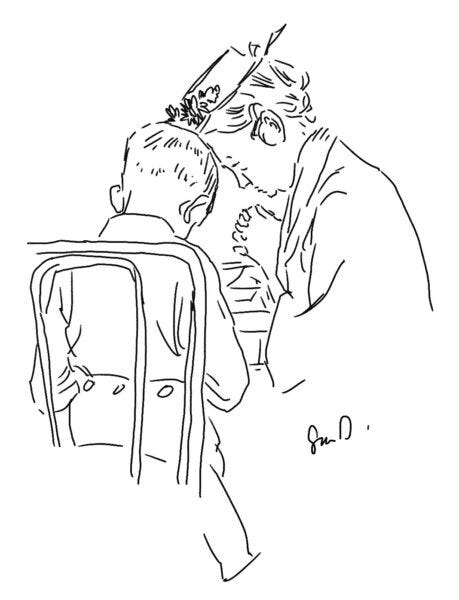
I have a thing for Norman Rockwell. When I was a kid, I collected Rockwell memorabilia in the form of calendars, picture books, and posters. I clipped illustrations from books and plastered them upon my bedroom walls.
I have a few favorites.
“Shuffleton’s Barber Shop” (1950). A group of old men playing music in a barbershop. Everyone is smiling. Someone’s sawing a fiddle. Classic.
“The Runaway” (1958). A cop sits in a diner alongside a little boy carrying a hobo’s bindle. They’re on stools. You just know the cop is urging the kid to go back home.
“Saying Grace” (1951). A crowded restaurant, a big industrial city, maybe Pittsburgh. A mother and son. They sit at a table. People in the restaurant are gawking at the mother and son because Mama’s hands are folded and the boy’s head is bowed.
Every time I start thinking about this painting I feel something. I don’t know why.
Maybe it’s because Norman saw the world differently than most. He found his masterworks in the commonplace.
Still, I always wondered whether Norman Rockwell’s depictions of a benevolent America were true. Can human beings really be as kind as they are in his universe?
Early on, I decided the answer was no. When I was a kid, I did not believe people were THAT nice. Life was not THAT charming. For crying out loud, read the news. Everyone on this planet wants to either get rich or kill each other trying.
I was a young man when the Rockwell exhibit passed through Birmingham. I had never seen a Rockwell painting up close. When I heard the exhibit would be closeby, I had to go.
I called in sick for work.
“What do you mean you’re sick?” screamed my boss. “You don’t sound sick.”
“It’s a gallstone.”
“A gallstone?”
“Yes.”
“How do you know?”
“Because my galls hurt.”
I packed a backpack. I fixed peanut butter and jelly sandwiches. I raided my shoebox-bank for gas money. And I tore out for a four-hour drive to see Norman.
I coasted into the Birmingham Museum of Art on fumes. I walked into the exhibit and time stopped.
I laid eyes on my first Rockwells. I toured the exhibit slowly, taking small bites. I stood motionless before each painting for 10, 15, sometimes 20 minutes.
His draftsmanship. His bravura brushwork. The faintest pink glaze applied to a little girl’s rosen cheeks. The veins in an old man’s arm.
Midway through the exhibit, I sat on a bench and I wept silently.
A lady sat next to me. She was old enough to be my grandmother. The woman wore a long woolen coat and red scarf, and somehow I still remember that.
The woman didn’t say anything as I sniffled. She just sat with me. She never introduced herself. Never spoke. She remained shoulder-to-shoulder to a young man with an uncommonly tragic childhood. Both of us looking at the painting.
Finally, after a few awkward moments together, the woman simply patted my thigh. It was a motherly pat. Then she walked away.
It was a small gesture. Such a tiny act. But it did something to me. Because, don’t you see? This little movement; this flick of her wrist; this matronly act of lovingkindness meant something.
The paintings were true.
Questions: SeanDietrich@gmail.com
Visit the Sean of the South Website
Find out where you can see Sean live.
Originally published on Sean’s website. Republished here with permission.
If you enjoyed this article, then please REPOST or SHARE with others; encourage them to follow AFNN. If you’d like to become a citizen contributor for AFNN, contact us at managingeditor@afnn.us Help keep us ad-free by donating here.
Substack: American Free News Network Substack
Truth Social: @AFNN_USA
Facebook: https://m.facebook.com/afnnusa
Telegram: https://t.me/joinchat/2_-GAzcXmIRjODNh
Twitter: https://twitter.com/AfnnUsa
GETTR: https://gettr.com/user/AFNN_USA
CloutHub: @AFNN_USA