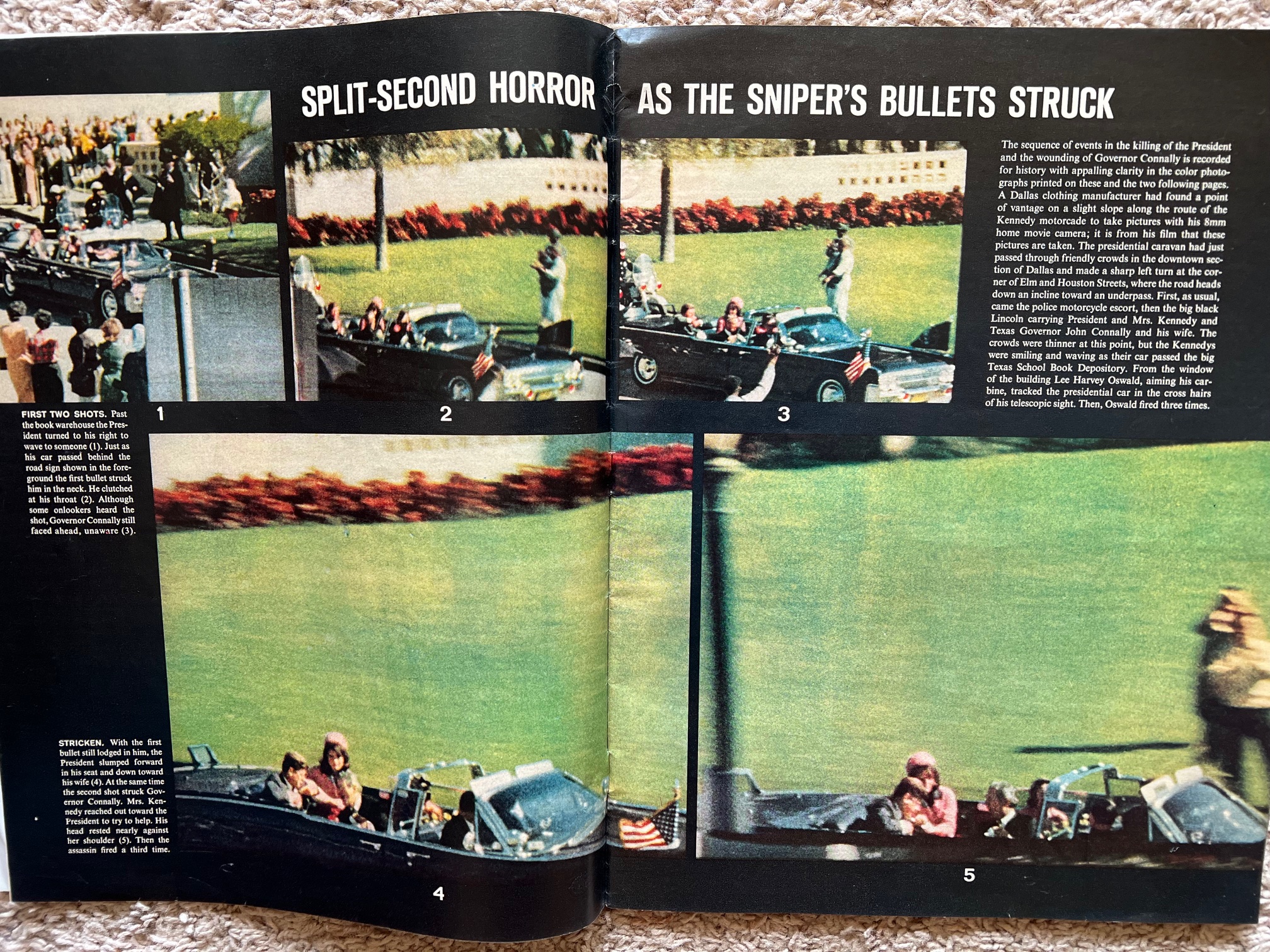
The Carefully Crafted Narrative About The Provenance Of The Zapruder Film Collides With Intelligence Community Intrigue To The Detriment Of Both
Part 1 detailed the actions of Abraham Zapruder getting his JFK Assassination Film processed up through the time that he relinquished control of the original film negative and three certified copies to Life Magazine and the Secret Service (SS) in Dallas, Texas 23 November 1963.
Part 2 introduced the Central Intelligence Agency (CIA,) National Photographic Interpretation Center (NPIC,) building 213, Washington Navy Yard in DC, which performed analysis of what was believed to be the original Zapruder Film in processed Kodak 8mm roll film format.
The esoteric but important takeaway from this event that had NPIC’s Dino Brugioni as a central figure was the provenance of the film and the products made for the SS on 24-25 November 1963 as a result of his efforts.
Which only became known some four decades later as a happenstance following the discovery that a second crew at NPIC had done basically the same work later that same day for a different SS Agent (SSA)-“Bill Smith”-with a different film, work that was finished early morning 25 November 1963: for-in theory-the same customer(s).
The Assassination Records Review Board (ARRB) discussed in Part 2-Doug Horne-became aware in early 1997 that two NPIC employees-Homer A. McMahon, the former head of the NPIC photographic color laboratory, and Morgan Bennet “Ben” Hunter, McMahon’s Assistant-had worked on what was believed to be the original Zapruder Film on 25 November 1963. The ARRB conducted a series of interviews in 1997 that included one approved video session in July 1997 led by Horne to clarify a number of discrepancies.
At the time of these interviews Horne was not aware of the Dino Brugioni NPIC work that produced the original products for the SS/CIA, which became known to him in January 2009 when he was contacted by JFK Assassination researcher Peter Janney, who was conducting a long series of interviews and discussions about the history of photo intelligence with Dino Brugioni.
Regarding the now second NPIC session and the film itself, SSA Smith revealed to McMahon and Bennet that an individual had given-gifted-the unprocessed film to the government-the SS (winky, winky)-with Smith personally taking the unprocessed film to the Kodak Hawkeye Works Lab in Rochester, NY, where it was developed into the 16MM, negative format that he brought to NPIC.
All in the NPIC photo processing side of the business were familiar with the Hawkeye Works, which was funded by the government-the CIA-to do photo processing of the U-2 and Corona missions, although the Navy Lab in Suitland, MD was often used for urgent jobs.
There is almost no chance-near zero-that an SSA would have a relationship-contractually or otherwise-with the Hawkeye Lab sufficient to show up at some rando time with some rando film to get work done: Smith is most certainly a cover CIA Directorate of Operations or Intelligence officer.
The film could (not) plausibly be one of the two that was sent to Life Magazine in Chicago on 23 November 1963, one of which had been insinuated to be destined for the New York Life Magazine HQs. But-of course-it could only have been copy two that was not processed into an 8mm finished film: but that film was already developed.
Or it could have more likely been copy 3 that was sent from Dallas to Washington for the SS on 23 November 1963: but that film was also already developed, and it would have been far quicker-easier-more intuitive to get it processed locally in DC, maybe by bringing it to NPIC in the first place (if you had the connections.)
Why reach through your legs to scratch the back of your head taking it to Rochester and then back to DC at a time where there seemed to be a sense of urgency, as evidenced by the late night-on a weekend-visit to NPIC?
There was also the possibility that film copy number 1 that was in the hands of the SS in Dallas-which has mention of it in some references as having been loaned to local FBI agents: could have, would have, should have-but-again, copy 1 was already developed.
These aren’t quite academic discussions. The macro level details matter but the bottom line is that such acts as have been detailed above-in particular the obvious CIA subterfuge to produce one true set of violent evidence to be used to control elements of our government-that inarguably gave away the game, showing multiple assassins-followed by a second effort to produce a different set of evidence to arguably cover up the truth exposed by the original set-and to deep six any and all evidence possible about the first-tells you all you need to know about the state of our government in the fall of 1963.
Consider the Warren Commission being advised by former CIA Director Allen Dulles, with then current CIA Director John McCone at the ready if needed. Two leading figures of the time, prominent government civilian servants at the helm of our government: and yet nobody knew about the Zapruder Film analysis at NPIC for decades.
Which Zapruder Film did the Warren Commission review over several days? Were the NPIC experts offered up by the CIA to do analysis-again (that’s funny right there…?) The implications are staggering-condemning-obvious.
What is next for conspiracy debunkers, that in the midst of the swirl of-everything-chaos in the government in November 1963 that maybe CIA DIR McCone forgot about the Zapruder Film briefing panels he was discreetly delivered that weekend-one briefing set received on 24 November 1963-the two-panel display, with the second set received on 25 November 1963-the four-panel display?
I mean-he was likely a very busy man that weekend. Who had a new boss. Who had a reputation for killing the messenger: President LBJ. Is it even remotely plausible that McCone did not brief LBJ on both sets of briefings: immediately?
There are entire bodies of works-studies-debunking in advance the speculation-a conspiracy theory-that the second Zapruder Film analyzed at NPIC that weekend was altered-doctored. Based on the belief that technology at the time lacked the capability to create-to alter such a thing. Which is truly in the realm of an academic discussion so many years down the road when you have to almost pick and choose the truth that you believe because the government made it so.
Arthur Lundahl, Dino Brugioni and the NPIC Team that became famous for their efforts in the Cuban Missile Crisis are given scant regard when it comes to the controversy about the Zapruder Film. Is it possible that a film video would only have one frame-313-of the kill shot?
I’m not a math wizard, but I have supervised photo processors, photo processing operations, a photo lab, planned airborne reconnaissance missions to figure out how much film to load, and worked with emulsion-based imagery from scads of military systems for a dozen years or more before the digital form-computer based exploitation of pixels-became ubiquitous.
Zapruder’s 8MM Bell and Howell Zoomatic Director Series Model 414P camera with Kodachrome based 1A film had some known characteristics that introduced some ambiguity in the frame rate that was discernable in the developed negatives, but no limiting artifacts that showed in the negative sufficient to cause problems.
If the Zapruder Film consisted of 486 frames and some 26.6 seconds, that is a measured frame rate of a little over 18 feet a second (18.27067….) For comparison’s sake the modern standard for high definition is >30 frames per second-all things being equal-although the military high-definition specification H.264 standard calls for approximately 60 frames per second to meet a 1080P standard. The critical metric is the “Q” value of the lens which determines the image quality and the depth of field.
The nominal advertised rate for the model 414P was 16 frames per second, with operator selectable options for slow motion-“Slo Mo Mode”-at 45 frames per second and “Animation Mode,” which allows single frame operation as if it is a regular camera.
Meaning that short of windy conditions sufficient to dramatically alter or disrupt a scene-which was not the case-we see no mist visible in frame 312 below which is presumed pre-impact-a lot of apparent bloody mist on frame 313 which is assumed impact-and the mist is completely gone by frame 314: which is simply impossible.
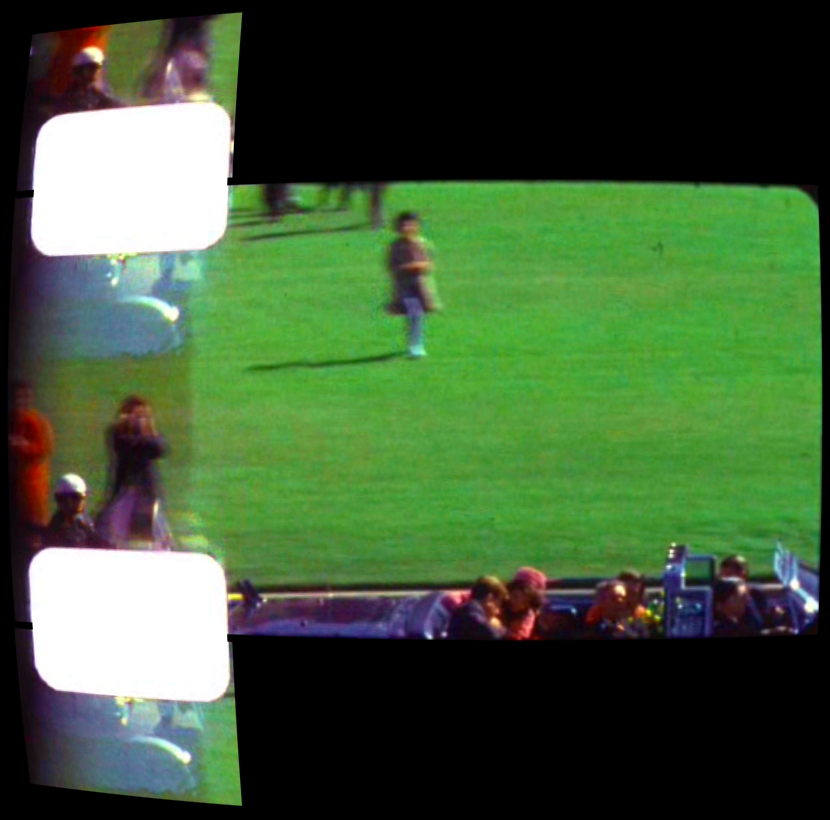
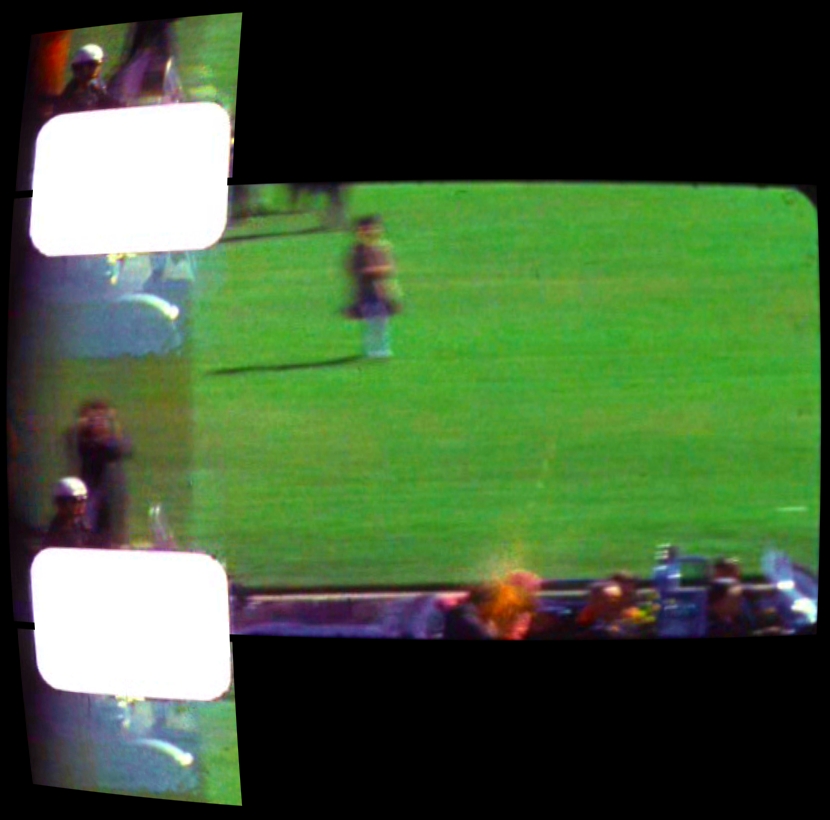
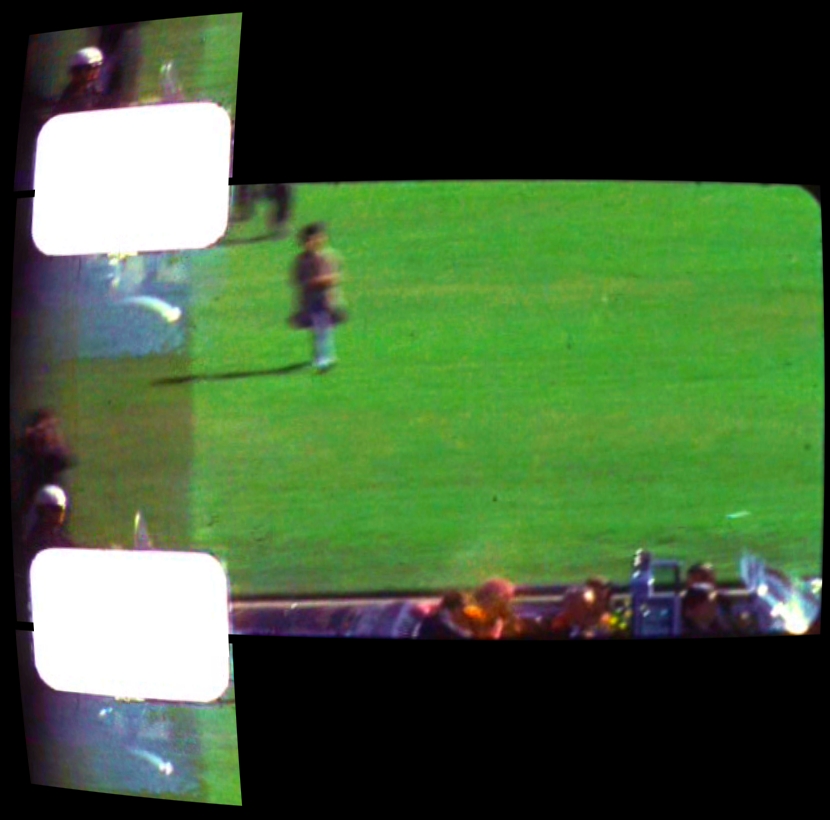
The other somewhat inconvenient truth is that Dino Brugioni remarked on seeing the second set of NPIC prepared briefing panels in 2011-the four panel product out of the archives that he did not work on-that the photos did not match what he observed on the original Zapruder Film he worked on.
Number one was there were multiple pictures of the fatal shot damage in the original, number two the somewhat cloud above JFK’s head was whiteish-not red or orange, number 3 the extent or expanse of the “cloud” was 3-4 feet above his head, and number 4 there was very visible-discernable-matter amidst the cloud which was believed to be pieces of JFK’s skull blown out by the shot from the front.
There was also the recollection of seeing the limousine in the midst of the turn onto Elm St., as well as the limousine totally stopping in the ambush or kill zone for a very brief but discernable period.
In these pictures you can see these are prints from an 8mm film because of the sprocket advance white slots on the left side of the film.
With some years of experience working in the field, I find the arguments put forth by folks like Roland Zavada-who was brought in by the ARRB to assess the veracity and provenance of the Zapruder Film-to be similar to using a howitzer to kill a flea.
I’m reminded of how we used to deal with certain Army Mohawk missions that strayed too close to Target TT in Austin, Texas where rumor had it there was a nudist colony by the lake that was somewhat like the Bermuda Triangle with a magnetic anomaly draw to pilots and technical observers alike.
I can honestly say that I never saw such a thing on any completed processing job that came out of our ES-38 photo processor: with the operative term “completed,” which is what is called in the Army an “NCO answer…”
Where does this leave us on the issue of the Zapruder Film? We will take up some of the ramifications of the Zapruder Film “truth” in Part 4.
Once thing is clear and that is when Abraham Zapruder accepted the Life Magazine offer to buy his photo rights, the subsequent actions regarding his film resulted in a loss of control of assassination evidence that released the proverbial hounds in terms of potential-if not actual-mischief.
Which was doubly true when Life Magazine revisited the agreed upon deal reportedly 25 November 1963-the day of JFK’s funeral-when Life offered Zapruder 150K for the motion picture rights to the film, while offering some percentage of any profits gleaned from the film.
Max Dribbler
25 March 2026
LSMBTGA: Lamestream media echo chamber (LMEC-L) social media (SM) big tech tyrants (BT,) government (G) and academia (A)
If you enjoyed this article, then please REPOST or SHARE with others; encourage them to follow AFNN. If you’d like to become a citizen contributor for AFNN, contact us at managingeditor@afnn.us Help keep us ad-free by donating here.
Substack: AmericanFreeNewsNetworkSubstack
TruthSocial:@AFNN_USA
Facebook: https://m.facebook.com/afnnusa
Telegram: https://t.me/joinchat/2_-GAzcXmIRjODNh
Twitter: https://twitter.com/AfnnUsa
GETTR: https://gettr.com/user/AFNN_USA
CloutHub: @AFNN_USA