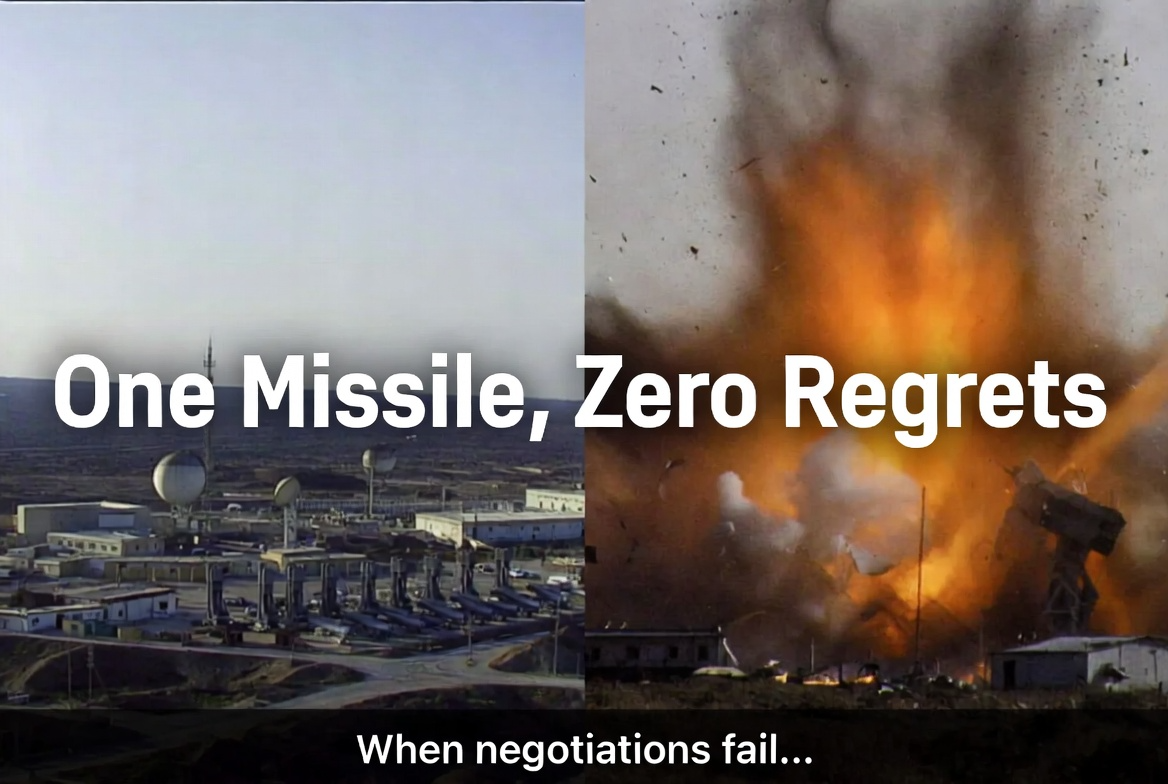
Cognitive dissonance is in the air once again. Failed former Obama and Biden national security and foreign policy apparatchiks, Democrats in Congress, assorted globalists in Europe, pro-CCP influence peddlers, the descendants of Neville Chamberlain, and the legion of legacy media talking heads afflicted with TDS have been doing their damnedest to undermine the long-delayed rescue operation of the Iranian people who have been held hostage by a theocratic autocracy since 1979.
And that is exactly what Operation Epic Thunder is: the rescue of the downtrodden and long-oppressed Iranian people. This simple fact is ignored by all of the aforementioned naysayers in their latest fevered effort to “get Trump.”
The naysayers’ arguments are specious. The rationale for initiating Epic Thunder at this moment in time is quite clear and is laid out below.
Regarding American Deaths Being “Far Away”
First of all, Iranian-linked American deaths since 1979 have been trivialized in order to remove this rationale for the campaign by suggesting geography diminishes responsibility. This misreads both law and strategy. The 1983 Beirut barracks bombing killed 241 American servicemembers — a sovereign military operation. The Khobar Towers bombing in 1996 killed 19 U.S. Air Force personnel. Iranian-supplied EFP (explosively formed penetrator) IEDs were responsible for hundreds of American deaths in Iraq after 2003, with the Pentagon explicitly attributing these weapons to Iranian Revolutionary Guard Corps (IRGC) supply chains.
The IRGC Quds Force directed these operations. These were not incidental — they were deliberate acts of war against American military personnel by a state actor. The “neighbor’s yard” analogy collapses entirely when the neighbor is actively manufacturing the weapons, directing the shooter, and publicly celebrating the outcome.
Iran’s Nuclear and Ballistic Missile Threat
The convergence of two existential timelines is ignored by the naysayers. Iran has significantly advanced uranium enrichment toward weapons-grade levels, with IAEA inspectors repeatedly denied access. Simultaneously, Iran’s Shahab and Khorramshahr missile programs — despite years of official denials — have demonstrated ranges approaching and potentially exceeding 4,000 km. This brings Western European capitals within range. Iran’s partnership with Venezuela, which has permitted Iranian military and intelligence infrastructure on South American soil, extends the threat vector toward the continental United States.
The combination of a near-nuclear state with demonstrated long-range delivery capability and established Western Hemisphere footholds is not theoretical — it is an operational threat matrix that cannot be addressed through diplomacy that Iran has repeatedly abandoned.
Iran as the World’s Leading State Sponsor of Terrorism
The U.S. State Department has designated Iran the world’s foremost state sponsor of terrorism continuously since 1984. This is not ideological labeling — it reflects documented material support for Hezbollah, Hamas, Palestinian Islamic Jihad, Houthi forces in Yemen, Kata’ib Hezbollah and other Iraqi militias, and networks operating across Africa, Latin America, and Southeast Asia. The financial figures are staggering: hundreds of millions of dollars annually to Hezbollah alone.
Suggestions from the Obama and Biden people who gave us the ridiculous pallets of cash and the smoke screen of the JCPOA that “better policies could defeat Iran financially and politically” ignore four decades under presidents from both political parties during which sanctions, diplomacy, and political pressure failed to alter the regime’s fundamental behavior or its terror financing.
“Death to America” as Operational Policy, Not Rhetoric
In their relentless efforts to attack Israel, some even characterize Iranian hostility to the US and Israel as rhetorical grievance about “Baal worship” — a fringe conspiratorial interpretation wholly unsupported by Iranian state documents, IRGC operational planning, or the regime’s own stated theology.
Since 1979, “Death to America” has been institutionalized state policy encoded in the Islamic Republic’s constitutional framework, which explicitly designates the United States as the primary enemy of the Islamic revolution. For many years, Supreme Leader Khamenei repeatedly reaffirmed this in formal fatwas and state addresses — not as metaphor but as religious-political directive. His successor(s) whoever they are show no signs of moderating. Over a thousand Americans killed at Iranian or Iranian-proxy hands across 45 years is not rhetorical. It is a body count.
Iran’s Wartime Actions Against the United States
At least four past Iranian actions constitute acts of war under conventional international law:
- The 1979 hostage seizure — seizure of a sovereign U.S. embassy and 444-day captivity of 52 American diplomats, a clear violation of the Vienna Convention and an act of state aggression.
- The 1983 Beirut barracks bombing — a state-directed mass casualty attack on U.S. military forces.
- Tanker warfare (1987–1988) — Iran mined international shipping lanes and attacked U.S.-flagged vessels, prompting Operation Praying Mantis.
- The IED/EFP campaign in Iraq (2003–2011) — state-directed lethal operations against U.S. armed forces, killing and maiming hundreds.
- The 2024 direct ballistic missile and drone attacks on Israel — while not targeting Americans directly, these constituted Iran’s first open declaration of conventional warfare against a close U.S. treaty partner, requiring direct U.S. military interception.
Any single one of these, committed by a European state, would have triggered Article 5 NATO responses. Iran has committed all five.
On the Strait of Hormuz
Some naysayers (especially fellow travelers of the Chinese communists) claim that the petrodollar as a corrupt construct not worth defending. But the Strait of Hormuz is not about dollar hegemony — it is about the physical movement of approximately 20% of the world’s total oil supply and roughly 25% of global LNG.
Iran has repeatedly threatened and rehearsed closure operations, including naval exercises simulating the mining of the strait and mock attacks on tanker traffic. A sustained closure of even 30 days would trigger energy price shocks affecting every industrialized and developing nation on earth, collapsing supply chains, destabilizing emerging market currencies, and producing humanitarian crises entirely unrelated to geopolitics.
Epic Fury is not American imperialism — it is the elementary defense of global economic infrastructure on which billions of people depend.
Nuclear Deterrence and the 12th Imam Doctrine
Various opponents of Epic Thunder assume that if Iran acquires nuclear weapons, standard MAD (mutually assured destruction) deterrence logic will contain them — the same logic that stabilized U.S.-Soviet relations. This assumption is dangerously inapplicable. The Islamic Republic’s founding theological framework explicitly incorporates apocalyptic eschatology: the belief that sufficient chaos and conflict can hasten the return of the Hidden Twelfth Imam, an event the regime regards as the supreme political and religious objective.
This is not fringe theology within the IRI — it informed Khamenei’s public statements and shaped IRGC strategic doctrine (which they still apparently cling to despite losing most of their leadership). A regime that frames martyrdom — including of its own senior leadership — as a pathway to divine fulfillment cannot be reliably deterred by the threat of national annihilation. Deterrence requires a counterpart that values regime survival above ideological objectives. The IRI’s own doctrine explicitly subordinates survival to eschatological mission.
Regime change via Epic Thunder is therefore not an aggressive option — it is the only strategically coherent long-term solution.
Iranian Operations on U.S. Soil
Epic Thunder opponents also downplay this dimension, but it is among the most compelling justifications for action. The FBI and DOJ have documented and prosecuted multiple Iranian intelligence operations on American territory, including:
- A 2011 plot to assassinate the Saudi Ambassador on U.S. soil using a Mexican cartel intermediary, directly authorized by the IRGC Quds Force.
- A 2022 plot to assassinate former National Security Advisor John Bolton and former Secretary of State Mike Pompeo.
- Ongoing cyberespionage campaigns targeting U.S. critical infrastructure, defense contractors, and federal agencies, attributed directly to IRGC-affiliated units.
- Active attempts to smuggle intelligence assets across the southern border, documented in FBI counterintelligence reporting.
FBI Director Christopher Wray testified before Congress that Iranian-linked networks inside the United States represent one of the most active foreign threat environments currently monitored. These are not hypothetical threats — they are ongoing hostile intelligence operations on sovereign American soil.
The Iranian People as a Strategic Asset and the Question of Timing
Perhaps the most significant analytical failure is the naysayers’ assumption that military action means “blowing them sky high” and foreign boots on the ground with no internal counterpart. This misreads the strategic landscape entirely. Iran is not a cohesive, unified adversary. Persians constitute less than half the population in a nation of seven major ethnic groups including Azeris, Kurds, Arabs, Baloch, Turkmen, and Lurs — many with deep grievances against the Persian theocratic center.
The 2009 Green Movement, the 2019 fuel protest crackdown that killed hundreds, the 2022 Mahsa Amini protests that spread to every major Iranian city — all demonstrate that the regime’s internal legitimacy has been severely eroded. Iran’s youth population, among the most educated and Western-oriented in the Middle East, has shown consistent willingness to challenge the regime at personal risk.
Economic mismanagement, hyperinflation, water scarcity, and energy poverty have compounded political repression into a comprehensive legitimacy crisis. Targeted air power that destroys the IRGC’s coercive infrastructure — the instruments by which the mullahs suppress internal dissent — creates the precise conditions under which the Iranian people themselves can be the decisive force.
The timing of Epic Thunder is therefore not arbitrary: it reflects the convergence of an imminent nuclear threshold, a weakened regime, and an internally mobilized population. This window will not remain open indefinitely.
The Futility of Negotiating with Iran: The Witkoff Disclosures
The 2025–2026 Trump administration negotiations with Iran produced perhaps the most damning firsthand account ever delivered by an American envoy of an adversary’s bad faith — and in doing so, validated decades of skepticism about whether Iran was ever a genuine negotiating partner.
The broader history of negotiating with the IRI confirms what the Witkoff disclosures crystallized in real time. Every major negotiating framework — the 1994 Agreed Framework’s regional analog, the 2015 JCPOA, and the 2025 talks — followed the same pattern: Iran accepts talks under economic duress, extracts sanctions relief or diplomatic breathing room, refuses structural disarmament, and resumes or accelerates its program when pressure eases. The Iranians have used negotiations as strategic cover for continuing development of nuclear weapons. Senior Trump administration officials stated that the Iranians never offered to significantly compromise, and that their proposals would have allowed Iran to continue pursuing a nuclear bomb. Foreign Policy for America
Witkoff stated plainly: “We went in there and tried to make a fair deal with them. It was very, very clear that it was going to be impossible, probably by the end of the second meeting, but we then went back for the third meeting just to give it the last college try.”
The Trump Administration Strategic Framing
Trump administration officials and associated media reporting have framed Operation Epic Fury within a coherent strategic doctrine: that the Iranian nuclear program has crossed irreversible red lines; that prior administrations’ reliance on JCPOA-style diplomacy enabled rather than restrained Iranian weapons development; that the Abraham Accords created a regional coalition architecture capable of sustaining post-action stability; and that the cost of inaction — a nuclear-armed Iran with intercontinental reach and active terror networks on five continents — vastly exceeds the costs and risks of decisive military action now.
The preferred alternative expressed by many opponents and TDS-afflicted of “financial, political, and religious” pressure has been the operative U.S. strategy, in various forms, for 45 years. It has not prevented a single Iranian proxy attack, has not halted uranium enrichment, and has not moderated the regime’s foundational hostility toward the United States. Continuing that approach while Iran crosses the nuclear threshold is not a policy — it is a deferral of catastrophe.
CONCLUDING THOUGHTS
President Trump was right to act now. In fact, it was his duty as president to do so when he recognized the imminent threat that the IRI is. Their continued intentions to obtain a nuclear weapons capability that could threaten the world (and the US directly) were made apparent during the Witcoff negotiations in Paris.
President Trump is interested in solving generational threats, not kicking cans down the road for future presidents to deal with, and the Death to America theocracy in Tehran is a festering boil that should have been excised long ago. He deserves our continued support.
The end.
StuinSD is a reader-supported publication. To receive new posts and support his work, consider becoming a free or paid subscriber.
This article originally appeared in Stu Cvrk’s Substack. Reprinted here with permission
If you enjoyed this article, then please REPOST or SHARE with others; encourage them to follow AFNN. If you’d like to become a citizen contributor for AFNN, contact us at managingeditor@afnn.us Help keep us ad-free by donating here.
Substack: American Free News Network Substack
Truth Social: @AFNN_USA
Facebook: https://m.facebook.com/afnnusa
Telegram: https://t.me/joinchat/2_-GAzcXmIRjODNh
Twitter: https://twitter.com/AfnnUsa
GETTR: https://gettr.com/user/AFNN_USA
CloutHub: @AFNN_USA