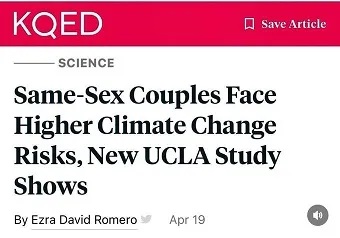
A weekend link by Instapundit revived an NPR story from two years ago, “Same-Sex Couples Face Higher Climate Change Risks, New UCLA Study Shows.”
Wow. Those poor homosexuals are in peril simply because they married one another rather than marry someone of the opposite sex.
The story said:
Same-sex couples have a significant risk of exposure to the adverse effects of climate change—wildfires, floods, smoke-filled skies, drought, etc.—compared to straight couples, according to a new report by the Williams Institute at UCLA School of Law.
“Our research cuts against the narratives that LGBT people often live in safe pockets of coastal cities where they have access to all the resources that they need,” said Ari Shaw, study co-author, senior fellow and director of International Programs at the Williams Institute.
Climate change represents a global challenge, but it also exacerbates existing disparities among individuals and communities. LGBT people face discrimination and exclusion, creating unique vulnerabilities that compound and heighten their exposure to climate-related harms. This report provides some of the first empirical documentation as to how LGBT people differentially experience the negative effects of climate change compared to non-LGBT people. Using U.S. Census data and climate risk assessment data from NASA and the Federal Emergency Management Agency (FEMA), we conducted a geographic analysis to assess the climate risk impacting same-sex couples.
LGBT people in same-sex couples are at greater risk of exposure to the negative effects of climate change compared to straight couples.
LGBT people in same-sex couples are disproportionately located in coastal areas and cities. Among the 15 counties with the highest proportions of same-sex couples, all are coastal or urban.
In the United States, same-sex couples disproportionately live in counties with greater risks due to climate change.
- A 1 percentage point increase in the proportion of same-sex couples by county is associated with a 17.17 percentile increase in the NASA composite risk score, which focuses on meteorological changes such as extreme cold, heat waves, excessive precipitation, and dry conditions.
- A 1 percentage point increase in the proportion of same-sex couples by county is associated with a 6.13 percentile increase in the FEMA risk projection score, which focuses on natural hazards and disasters such as flooding, tornadoes, wildfires, hail, and lightning.
- Same-sex couples are more likely to reside in communities with poorer infrastructure and less access to resources. They are, therefore, less prepared to respond and adapt to natural hazards and other climate disruptions.
- A 1 percentage point increase in the county-level proportion of same-sex couples relative to opposite-sex couples is associated with a 15.27 percentile increase in the NASA exposure risk projections.
- This indicates that LGBT people in same-sex couples are more likely to be located in places with large impervious surface areas, high housing density, and low-lying infrastructure.
Washington, D.C., a county equivalent, has the highest proportion of same-sex couples of any county in the United States. It scores high for a variety of climate risks, including heat waves (97th percentile), flooding (95th percentile), and dangerously strong winds (98th percentile).
Well, there is only one thing to do.
Ban gay marriages, right? If such a ban saves one life, it is worth the sacrifice, right?
Except there is no link to climate change and gay sex.
The headline is in error. Same-sex couples DO NOT face higher climate change risks. While gays and lesbians have shorter life expectancies than straights, the fact is being gay does not make you more vulnerable to climate change.
Living in Washington or San Francisco does. Those are the two cities that climate change Chicken Littles claim are the two cities most vulnerable to climate change.
Where you live matters. If you chose to live in West Virginia, you don’t have to fear the oceans rising. San Franciscans choose to live by the sea, by the sea, by the beautiful sea.
The headline also errs in using UCLA as a source. UCLA did not conduct the study. The Williams Institute did.
The institute is explicitly an LGBT advocacy research center at UCLA Law. Its mission is to produce data on sexual orientation/gender identity to influence law, policy, and public opinion in favor of LGBT issues. They don’t hide this—they frame their work as countering “stereotypes” and shaping decisions affecting the community.
The KQED story said:
The study’s authors recommend that policymakers, cities and providers ensure that disaster relief is accessible and given without discrimination based on sexual orientation, gender identity or gender expression.
Solutions could include safe shelters, access to medication and financial aid for displaced LGBTQ people.
Because the study found that LGBTQ people often live in areas with poor infrastructure and lack resources to respond to climate change, the researchers suggest cities expand green spaces and enhance structural resilience.
Or you can rent them U-Hauls and have them move inland. But actually solving a problem has a downside. If LGBT people stop being victims, the donations to the non-profits supporting victimhood drop.
You can subscribe to Don’s Daily Substack Here.
This article first appeared on Don Surber’s Substack. Reprinted here with permission.
If you enjoyed this article, then please REPOST or SHARE with others; encourage them to follow AFNN. If you’d like to become a citizen contributor for AFNN, contact us at managingeditor@afnn.us Help keep us ad-free by donating here.
Substack: American Free News Network Substack
Truth Social: @AFNN_USA
Facebook: https://m.facebook.com/afnnusa
Telegram: https://t.me/joinchat/2_-GAzcXmIRjODNh
Twitter: https://twitter.com/AfnnUsa
GETTR: https://gettr.com/user/AFNN_USA
CloutHub: @AFNN_USA
All is proceeding as I have foreseen.
“(G)ays and lesbians have shorter life expectancies than” normal people, which begs the question of why that is. They tend to be slightly wealthier, and have far fewer children, so medical care ought to be more affordable for them.