Lies: People lie for two fundamental reasons: to protect themselves from something bad or to gain something good. That simple framework covers everything from a child’s first fib to a calculated fraud, but the full picture involves brain wiring, developmental milestones, personality traits, and social pressures that make deception a deeply human behavior. The average person lies once or twice a day, though that number is misleading. Most lies are told by a small minority of people, while many others rarely lie at all. Telling the truth is your brain’s default setting. Lying requires overriding that default, which demands real cognitive effort. Neuroimaging research shows that deception activates the prefrontal cortex, the region responsible for higher-level thinking and self-control, far more than honest responses do.
Three specific mental processes work together when you lie. First, you have to hold the truth in working memory while simultaneously constructing a false version of events. Second, you need inhibitory control to suppress the truthful response that your brain wants to produce. Third, you have to switch rapidly between what’s real and what you’re fabricating, making sure your story stays consistent. Brain regions involved in working memory, impulse suppression, and task switching all light up during deception, particularly areas in the front and sides of the prefrontal cortex. This is why lying is harder when you’re tired, distracted, or under pressure. Your executive control system has limited bandwidth, and deception uses a lot of it. It also explains why skilled liars tend to score higher on measures of cognitive flexibility: they’re better at juggling competing pieces of information in real time.
Propaganda: A communication that is primarily used to influence or persuade an audience to further an agenda, which may not be objective and may be selectively presenting facts to encourage a particular synthesis or perception, or using loaded language to produce an emotional rather than a rational response to the information that is being presented.[1] Propaganda can be found in a wide variety of different contexts. Beginning in the twentieth century, the English term propaganda became associated with a manipulative approach, but historically, propaganda had been a neutral descriptive term of any material that promotes certain opinions, ideologies or concepts.[1]
A wide range of materials and media are used for conveying propaganda messages, which have changed as new technologies were invented, including paintings, cartoons, posters, pamphlets, films, radio shows, TV shows, and websites. More recently, the digital age has given rise to new ways of disseminating propaganda, for example, in computational propaganda, bots and algorithms are used to manipulate public opinion, e.g., by creating fake or biased news to spread it on social media or using chatbots to mimic real people in discussions in social networks.
It was late September, an early fall in Montana in 2013. I received a call to inquire if I would co-chair a non-governmental organization (NGO) delegation to Cairo, Egypt. The purpose was to meet with the head of the Egyptian Armed Forces and other groups involved in the protests and the removal of the Muslim Brotherhood and President Morsi (the Second Revolution). After serious thought, I accepted and was then briefed in detail on the delegation’s mission. We rendezvoused in Washington, DC, with the delegation team and departed for Cairo on October 5, 2013.
The Obama government was supporting Morsi and his Muslim Brotherhood. It rejected the military control of the Egyptian government and the removing and jailing of Morsi. Our Congress passed legislation to block foreign and military aid to the newly formed government. This upset the Egyptian government and the military Generals who were dealing with almost insurmountable challenges to restore order and recover a devasted economy. The leadership threatened to align itself (again) with the Russians for aid that was being deprived by the US government.
These events brought to Egypt a leader named Fattah Saeed Hussein Khalil El-Sisi. First Egyptian Revolution (2011), Mohamed Morsi was elected to the Egyptian presidency. El-Sisi was appointed Minister of Defense by President Morsi on August 12, 2012.
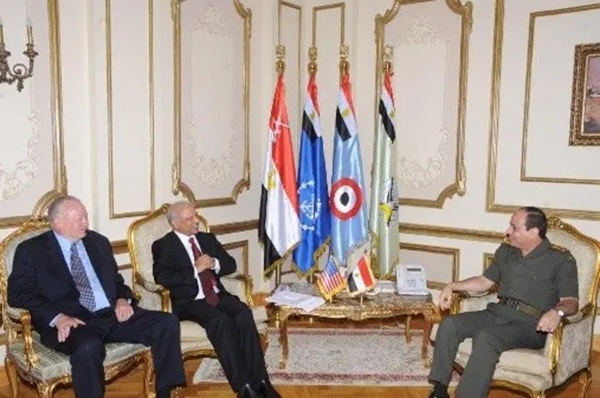
In October 2013, I co-chaired a US Delegation to meet with General El-Sisi, the Commander-in-Chief of the Armed Forces, who later became President of Egypt. The Delegation mission was to assure General El-Sisi that the American people solidly supported the removal of the Muslim Brotherhood and President Morsi after this second revolution. A vast majority (young and old) of the Egyptian people supported the removal of Morsi by El-Sisi.
Our US delegates were welcomed by El-Sisi and his Staff of 12 Generals. I had the respect of the Egyptian high staff, as many were fellow graduates of the Army War College in Carlisle, Pennsylvania. I was a bit apprehensive as I thought that I may be held in disdain and perceived as a supporter of US actions against Egypt. The thought went through my mind: Maybe they believed I was an Obama apostle and one of his Generals? Not the case! General El-Sisi and I bonded, as I did with his staff. There was mutual respect as we were fellow graduates of the Army War College. As our meeting progressed, it was apparent that the staff Generals were terribly angry. They were incensed that after 45 years of being good allies the US Congress would stop aid to Egypt. I tried my best to explain that while Obama supported the Muslim Brotherhood and Morsi, most Americans did not support Obama’s action. It was widely known that Obama was sympathetic to Islam and the Brotherhood’s reign. Obama famously said in his book that he would, “Stand with the Muslims.”
After a lengthy discussion, General El-Sisi turned to me and asked, “Why does America always seem to make its decisions looking through a Political Prism rather than through a Reality Prism?” Suddenly, I had an epiphany! I related to the history of Egypt, the pyramids as a symbol, and how they appear as a prism on our dollar bills.
America must wake up and accept the truth and reality. It seems apparent that US politicians rarely look through a Reality Prism. Lies and propaganda dominate the media (television, the internet, and talk radio). El-Sisi understood, and we must also pursue the truth!
www.standupamericaus.org; Contact: suaus1961@gmail.com;

MG Paul, this is one of the best and concise articles I ever recall reading.
may I suggest this be the basis for a book and/or movie?
talk about high stakes, real events and intrigue…
TY for this GREAT piece