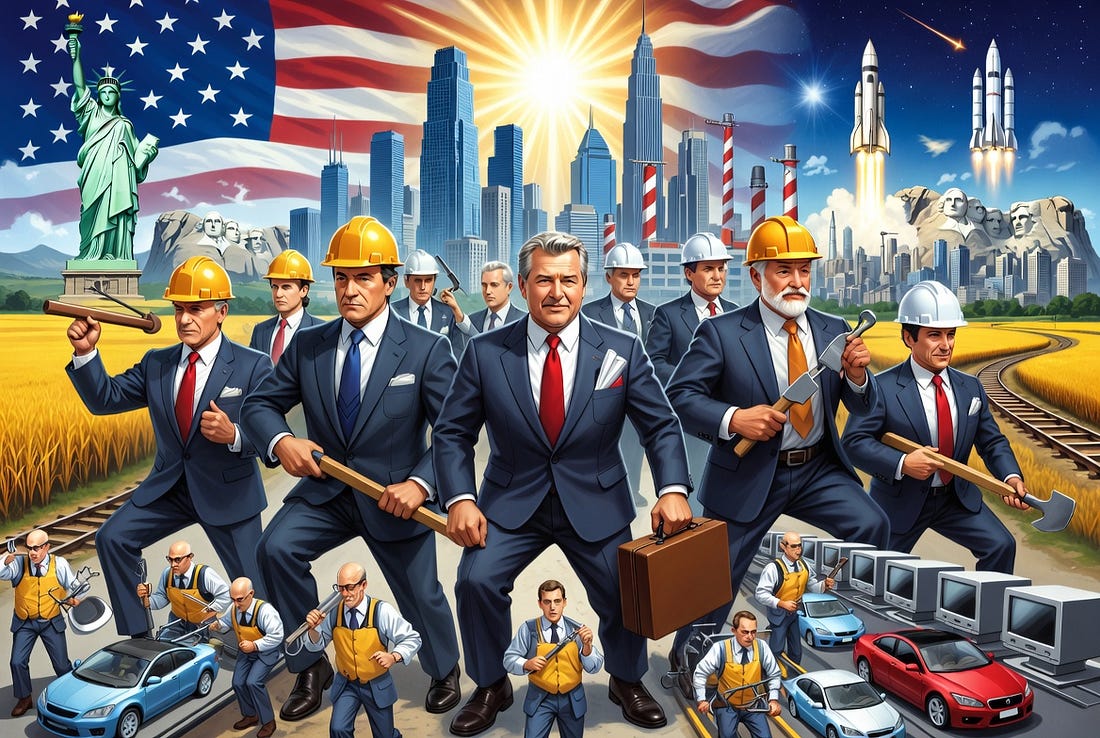
They built this country. They built this country—those billionaires.
Now that Bernie Sanders and most American socialists are millionaires, the Lazybones senator from Vermont and his acolytes are demonizing billionaires with AOC saying:
I want to talk about how this is in the heritage of our country, because America was founded. You look at Thomas Jefferson writing to Madison in revolt of British aristocracy. The American Revolution was against the billionaires of their time. And we are declaring independence from such an extreme marriage of wealth and power and the state that the voices of everyday people did not exist.
The opposite was true. The billionaires—as she calls them—battled politicians like her who wanted to run our lives from an ocean away.
The American Revolution succeeded because it was run by successful businessmen and professionals. The five richest Americans in 1776 signed the Declaration of Independence and at least 50 of the 56 signers were wealthy. They risked it all. They put their lives, their fortunes and their sacred honor on the line. Many, indeed, lost their fortunes. A few had their homes ransacked and burned to the ground. But none lost his honor.
Other revolutions—French, Russian, Cuba, et cetera—were run by criminals and rabble-rousers. They ended in tyranny. Haiti’s slave rebellion ended with the slaughter of every white person in their land in 1804.
The spirit of wealthy men leading the nation continued after we kicked the Brits out. John Jacob Astor came to America from Germany via London in 1784. After working with his brother the butcher (as their father was), Astor struck out on his own and began the American Fur Company.
He sold bearskins and pelts to the Chinese in exchange for tea and silks. He established Fort Astoria on the West Coast, which later served as proof of America’s claim to the Oregon Territory. England ceded most of the territory to the USA in 1846.
Astor used his fortune to buy farmland in Manhattan that would someday become skyscrapers. The butcher’s son became so rich that the wife of one of his grandsons began the Astor 400 as the gatekeeper to high society.
Margaret Dumont owed her movie career to such snobbery.
Commodore Cornelius Vanderbilt began a ferry service between Staten Island and Manhattan when he was a teen. He sold his service and hired out as a steamship captain, which is why people called him The Commodore. He started a steamship company with a route to Nicaragua so prospectors—49ers—could go through the jungle and catch a ship sailing to California where they joined the Gold Rush.
He saw the rise of railroads and entered that business. He supported the Union cause and even gave the Navy his personal yacht.
After the war, he donated to a Methodist college in Nashville. He was so generous that they renamed it Vanderbilt. He helped pioneer transportation in America but he is now known for a pretty good school that, like Harvard, has never won an SEC football championship.
Stephen Girard of Philadelphia was one of the wealthiest men of the early republic through international banking, shipping, and real estate. He bequeathed the bulk of his fortune to build a boarding school for orphaned boys, a school that survives to this day having educated more than 20,000 boys (and girls since 1982). He fed them and housed them.
Ezra Cornell worked as a carpenter and a mechanic before making his fortune in the telegraph industry. He built telegraph poles and eventually co-founded Western Union. He used his fortune to build a land-grant college in Ithaca, his hometown. We call it Cornell. It, too, has never won an SEC football championship.
Henry Wells was a freight forwarder and agent on the Erie Canal, operating between Albany and Buffalo. Wells partnered with William G. Fargo to move freight—mainly mail, bank notes, coins, documents and small packages—from Buffalo to the western frontier. They formed American Express.
Later, they founded Wells Fargo. Duh.
Wells decided he would not die rich. His philanthropy included the establishment of Wells College for Women.
Fargo did not. It was his money. What he accomplished—what all these men did—was in the work they left behind.
Western Union, Wells Fargo and American Express are still handling financial transactions. These men were settlers and made America great. You can eat the rich, but eventually you will starve like Haiti.
Andrew Carnegie came to America with his family from Scotland when he was 13. He worked as a bobbin boy in a textile factory in Allegheny, Pennsylvania. He put in 12-hour days for $1.20 a week. The telegraph rescued him from the factory when he became a telegram messenger boy for $2.50 a week.
On Saturdays, Colonel James Anderson opened his personal library to working boys. Carnegie took advantage of this. In his own words he said this “opened the windows in the walls of my dungeon through which the light of knowledge streamed in.”
Anderson’s father ran a sawmill and brickyard. The son served as a colonel in the War of 1812 under William Henry “Tippecanoe” Harrison. After the war, Anderson built a bridge company and an ironworks.
After the Civil War ended, Andrew Carnegie did the samee. He and his brother began the Keystone Bridge Company. Their biggest project was in Missouri.
James Eads designed and built the Eads Bridge in Saint Louis, crossing the Mississippi. It is more than a mile long. Carnegie supplied the steel, which was a new material for bridges. People did not trust the bridge. Carnegie brought in 14 elephants to cross thhe bridge over the Mississippi. That shut critics up.
His entry into the steel business helped build American skyscrapers and the railroads that united the country. In 1904, Carnegie erected the Colonel James Anderson Monument, sculpted by Daniel Chester French, depicting a young workman reading, in front of the Carnegie Library in Allegheny—the first of 1,200 Carnegie libraries.
The inscription reads, “To Colonel James Anderson, Founder of Free Libraries in Western Pennsylvania. He opened his Library to working boys and upon Saturday afternoons acted as librarian, thus dedicating not only his books but himself to the noble work. This monument is erected in grateful remembrance by Andrew Carnegie, one of the working boys.”
On January 10, 1870, John D. Rockefeller and his partners founded Standard Oil in Cleveland selling kerosene for 26 cents a gallon. He was so ruthless and such a monopolist that the price of kerosene was a whopping 6 cents a gallon 30 years later.
Some say he saved the whales by replacing whale oil with kerosene. This helped put the American whaling industry—which reached 735 ships in 1846—out of business. They had also run out of whales.
Well, computers put Linotype operators out of business in the 1960s and 50 years later, the Internet put newspapers out of business. That’s how things work.
Coal fueled Rockefeller’s refineries, but only 60% of the oil became kerosene. This meant wasting much of the oil and dumping it in the Cuyahoga. Well, you can see how he hated that and he tasked his chemist to develop another use for naphtha (a waste byproduct) and the answer was to have it replace coal in fueling theh combustible engines that ran the refineries.
That innovation later saved the company when that pesky Thomas Edison developed the practical electric lamp (lightbulb) which replaced kerosene lamps except at Boy Scout camps. Naphtha became gasoline and fueled the revolution in transportation led Henry Ford, R.E. Olds (Oldsmobile and REO), William Durant (GM) and the Dodge Brothers.
By the way, Ford was Henry’s third automobile company. His first one (Detroit Automobile Company) produced 20 vehicles in 1901. With his second company, his shareholders rebelled and later renamed the company Cadillac.
But Ford marched on. Failure is only final when you give up.
That these entrepreneurs left behind colleges, libraries, parks and concert halls is commendable, but what they did while they were men and not household words was their true gift.
Consider Stanford University. It became the heart of the high-tech revolution. When Leiland Stanford’s only child died of typhoid at 15 in 1885, his parents founded the college, which opened in 1891. Stanford has never won an SEC football championship but among its first graduates was Herbert Hoover—the man who reshaped the Mississippi Valley with levees and floodways following the horrific floods of the 1920s.
He also was a president blamed for a depression that his successor dragged out for a decade.
The Stanfords’ gift made Silicon Valley possible.
But the real gift was in how he made his money. Stanford and his partners (Collis Huntington, Mark Hopkins, and Charles Crocker) built the western portion of the first transcontinental railroads. The track from Sacramento went over and through the Sierra Nevada mountains peaking at Donner Pass about 7,000 feet above sea level.
They built 15 tunnels through solid granite. They endured blizzard after blizzard. They faced labor shortages. They almost went broke. Hardship didn’t stop them.
On May 10, 1869, Leland Stanford drove the Golden Spike at Promontory Summit in Utah Territory, connecting his Central Pacific Railroad to the Union Pacific.
Later, Leiland and Jane Stanford turned the grief of their son’s death into a legacy that would educate 94 future billionaires, according to Fortune magazine. Their average net worth was $11.76 billion in 2025.
How dare AOC say, “You can’t earn a billion dollars. You just can’t earn that. You can get market power. You can break rules. You can do all sorts of things. You can abuse labor laws. You can pay people less than what they’re worth. But you can’t earn that, right? And so you have to create a myth—you have to create a myth of earning it.”
Speak for yourself, sister. We would be Zimbabwe without these gentlemen.
You can subscribe to Don’s Daily Substack Here.
This article first appeared on Don Surber’s Substack. Reprinted here with permission.
If you enjoyed this article, then please REPOST or SHARE with others; encourage them to follow AFNN. If you’d like to become a citizen contributor for AFNN, contact us at managingeditor@afnn.us Help keep us ad-free by donating here.
Substack: American Free News Network Substack
Truth Social: @AFNN_USA
Facebook: https://m.facebook.com/afnnusa
Telegram: https://t.me/joinchat/2_-GAzcXmIRjODNh
Twitter: https://twitter.com/AfnnUsa
GETTR: https://gettr.com/user/AFNN_USA
CloutHub: @AFNN_USA
It is capitalism which has enabled people to become winners in our society, but, alas!, any society which enables people to become winners concomitantly allows people to become losers. What we are seeing today are a bunch of whining losers, and the politicians who prey on them for votes, blaming other people for them being losers. The Gender Studies major who cannot secure any job higher than a barista sees himself not as someone who lost due to his choice of majoring in something stupid, but as victimized by the evil corporations which hired the engineering grad to do engineering without creating yet another HR job for the Gender Studies major to come down hard on the engineer who happens to appreciate the Gender Studies major’s butt too obviously.