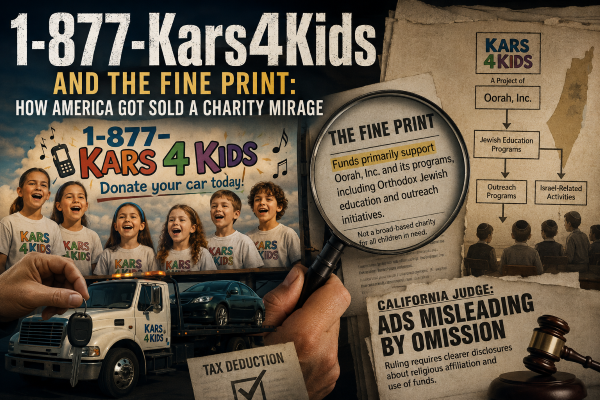
For thirty years, America has been held hostage by perhaps the most psychologically durable weapon ever created by Madison Avenue: “1-877-KARS4KIDS.” Not nuclear missiles. Not propaganda leaflets. Not TikTok brain rot. A jingle. A tiny musical parasite that crawled into the national consciousness and built a fundraising empire one donated Ford Taurus at a time.
And now, finally, a California judge looked at the operation and basically said: “Hold on… where exactly is this money going?”
That’s the real story.
Not “the Jews stole your Buick.” Not some internet-comment-section fever dream involving Mossad tow trucks lurking outside Applebee’s. The truth is both simpler and more uncomfortable: millions of Americans were likely given a misleading impression about what the charity actually funded.
Kars4Kids is real. It is a legitimate registered nonprofit. It still operates today, still advertises nationally, still accepts vehicle donations, and still routes major funding toward programs tied to its sister organization, Oorah.
The controversy is not whether the organization exists.
The controversy is whether average donors understood what they were supporting.
And according to a California court ruling in 2026, the answer was essentially no.
The ads created the broad emotional impression that donations were helping needy children in general, including local American kids. Instead, the court found that much of the money funded Orthodox Jewish educational and outreach programs largely centered in New York, New Jersey, and Israel-related activities.
That distinction matters.
Because advertising law is not just about what you say. It is also about what you intentionally leave out.
The court ruled the ads were “misleading by omission.”
That phrase is the entire battlefield.
Nobody forced people to donate. Nobody stole the cars. But donors heard “kids,” saw smiling children, and assumed something very different from the organization’s actual mission structure. The religious affiliation, geographic concentration, and program focus were largely absent from the famous ads.
And honestly, you can understand why people got angry.
Imagine donating to what you believe is a broad national children’s charity, only to later discover the money largely funds a highly specific religious network you were never clearly told about. That doesn’t automatically make the mission evil. Religious charities exist everywhere. Christian charities fund missionaries. Islamic charities fund mosques and schools. Jewish charities fund Jewish education and outreach.
That part is normal.
The issue is transparency.
And Kars4Kids has faced this criticism for years. Oregon and Pennsylvania previously fined or settled with the organization over disclosure concerns. Minnesota’s attorney general also criticized how little locally raised money actually benefited local children.
Then California finally stepped in with the legal equivalent of grabbing the radio and screaming: “You people need disclaimers.”
The ruling now requires clearer disclosures if the ads continue running in California.
And here’s the funniest part of the whole saga: the organization probably could have avoided enormous backlash by simply being upfront from the beginning.
“Donate your car to support Jewish youth education programs.”
That would have been honest.
Some people still would have donated. Some would not have. But at least everyone would know the deal.
Instead, America got one of the most aggressively vague charity campaigns in modern history. A smiling chorus of children singing a tune so catchy it could probably qualify as enhanced interrogation under several NATO conventions. Even Saturday Night Live and late-night comedians mocked it as psychological warfare.
And once people realized the details were fuzzier than the commercials suggested, the backlash became inevitable.
Because Americans hate one thing more than taxes: feeling emotionally manipulated.
That’s the core truth here.
Not a grand ethnic conspiracy.
Not a secret foreign operation.
Not “all Jewish charities are scams.”
Just a massively successful nonprofit campaign that blurred reality hard enough that courts eventually stepped in and said the public deserved clearer information.
And honestly? That’s probably the correct conclusion.
If you ask people for money, especially through emotional advertising, you owe them radical clarity about where it goes. Otherwise trust collapses, cynicism spreads, and eventually every charity starts looking like a used-car dealership with a tax deduction attached.
Which, in this case, may have been a little too close to reality for comfort.
If you enjoyed this article, then please REPOST or SHARE with others; encourage them to follow AFNN. If you’d like to become a citizen contributor for AFNN, contact us at managingeditor@afnn.us Help keep us ad-free by donating here.
Substack: American Free News Network Substack
Truth Social: @AFNN_USA
Facebook: https://m.facebook.com/afnnusa
Telegram: https://t.me/joinchat/2_-GAzcXmIRjODNh
Twitter: https://twitter.com/AfnnUsa
GETTR: https://gettr.com/user/AFNN_USA
CloutHub: @AFNN_USA
Good reporting.