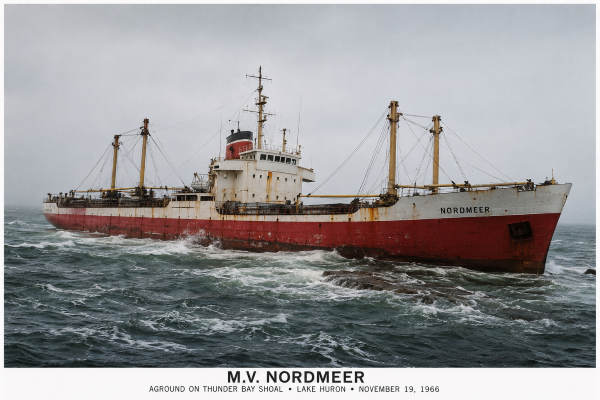
I’ve been diving the Nordmeer since 1986.
Back then, parts of the wreck still stood above the surface. We would climb up to the pilot house and jump off about 12-15 feet into into 30-40 feet of cold turquoise water.
Lake Huron had not yet finished eating her.
Today, most divers know the Nordmeer as one of the most popular wrecks in Thunder Bay National Marine Sanctuary. It sits in relatively shallow water, making it accessible to new divers while still offering enough steel, machinery, and history to keep experienced wreck divers coming back.
But the Nordmeer is more than a dive site.
It’s a story that stretches from Germany to Michigan, from industrial shipyards to the bottom of Lake Huron, and from the optimism of modern engineering to the harsh reality of Shipwreck Alley.
The funny thing is that I knew the Nordmeer long before I knew where she came from.
Years after I began diving her, I found myself stationed in Germany. While there, I attended a Schützenfest in the city of Flensburg, near the Danish border. Anyone who has spent time in Germany knows these festivals are part celebration, part tradition, and part excuse to gather with friends over food, music, and marksmanship.
At the time, it was simply another memorable stop during my military career.
Only later did I discover the connection.
Flensburg was the birthplace of the Nordmeer.
The same city where I had celebrated German tradition was the city where the Nordmeer had been built in 1954. I had walked the streets of the town that launched the very ship whose remains I had explored for years beneath the waters of Lake Huron.
History has a funny way of connecting places that seem worlds apart.
The Nordmeer was a 471-foot German freighter built by Flensburger Schiffbau-Gesellschaft. She was a product of postwar German industry, built during a period when Germany was rebuilding itself and once again becoming an industrial powerhouse.
She was steel from bow to stern.
In November 1966, she entered the Great Lakes carrying 990 coils of rolled steel destined for American factories in Chicago and Milwaukee.
Think about the irony.
A steel ship.
Built to carry steel.
Crossing an ocean to deliver steel.
Only to be destroyed by a rock.
On November 19, 1966, the Nordmeer was approaching Thunder Bay Shoal north of Thunder Bay Island. The night was clear. The shoal was marked by a flashing buoy. Yet somewhere in the chain of human decisions that guide every vessel, something went wrong.
The ship passed on the wrong side of the buoy.
Moments later, the hull struck rock.
The Great Lakes can be brutally efficient.
Within minutes, cargo holds flooded. The engine room flooded. The giant freighter settled hard onto the shoal.
Most of the crew evacuated safely. The vessel appeared salvageable. The cargo was valuable. The ship was modern. Surely there would be a way to save her.
Then Lake Huron had its say.
A week later, November weather arrived in force. Winds approached fifty miles per hour. Waves climbed to more than twenty feet. The storm battered the stranded freighter relentlessly. Coast Guard helicopters evacuated the remaining crew as the Nordmeer began to break apart.
No lives were lost.
That fact is often overlooked, but it matters.
In a place known as Shipwreck Alley, survival is never guaranteed.
The wreck, however, was far from finished making history.
The cargo alone became a massive salvage operation. Nearly a thousand steel coils sat aboard the damaged vessel. Salvage crews spent months recovering them. Each coil weighed roughly ten tons. The operation required divers, heavy equipment, barges, and a great deal of determination.
One of those salvage barges still rests beside the Nordmeer today.
It has become part of the wreck itself.
Divers often joke that the Nordmeer is a two-for-one shipwreck.
Then came the environmental concerns.
Thousands of gallons of fuel remained trapped within the vessel. Over several years, extensive efforts were undertaken to remove the fuel and prevent pollution of Thunder Bay. Divers worked to access tanks, remove oil, and ensure the wreck would not become an environmental disaster.
The story of the Nordmeer was no longer simply about a wreck.
It was about engineering, salvage, environmental protection, and the constant battle between man and nature.
And while the Nordmeer was breaking apart on Thunder Bay Shoal, another chapter of Great Lakes history was about to unfold.
Just ten days later, Lake Huron claimed the Daniel J. Morrell.
Unlike the Nordmeer, which grounded in shallow water and lost no lives, the Morrell was caught in a violent storm. The ship broke apart and sank. Twenty-eight men died.
Only one survived.
Dennis Hale’s story remains one of the most remarkable survival stories in Great Lakes history.
The connection between the two vessels serves as a reminder that November on the Great Lakes is not a season.
It is a warning.
For decades after the wreck, the Nordmeer remained visible above the water.
Boaters visited her.
Photographers documented her.
Locals pointed her out to visitors.
Winter after winter, Lake Huron continued dismantling what German shipbuilders had created. Ice crushed sections of the hull. Storms twisted steel. Wave after wave carried away another piece.
The process took decades.
By the late 2000s, the remaining portions finally slipped beneath the surface.
The lake had finished its work.
Today, when I dive the Nordmeer, I don’t just see a shipwreck.
I see the craftsmanship of the men who built her in Flensburg.
I see the welders, fitters, machinists, and ironworkers who shaped thousands of tons of steel into a vessel capable of crossing the Atlantic.
I see the immense diesel engine that once pushed her through oceans.
I see cargo hatches large enough to swallow trucks.
I see steel plates that have endured sixty years of punishment from Lake Huron and still remain.
Most divers see a wreck.
An ironworker sees workmanship.
A machinist sees precision.
A sailor sees a cautionary tale.
A historian sees a chapter of Great Lakes history.
And a diver who has visited the site for forty years sees something else entirely.
A connection.
Flensburg and Alpena are separated by thousands of miles.
One gave the Nordmeer life.
The other became her final resting place.
One forged her from steel.
The other slowly reclaimed her through wind, wave, ice, and time.
The Nordmeer lost its battle with Lake Huron long ago.
Yet somehow it still endures.
Not as a ship.
But as a story.
And for those willing to descend beneath the waters of Thunder Bay, it remains one of the finest stories the Great Lakes have to tell.
If you enjoyed this article, then please REPOST or SHARE with others; encourage them to follow AFNN. If you’d like to become a citizen contributor for AFNN, contact us at managingeditor@afnn.us Help keep us ad-free by donating here.
Substack: American Free News Network Substack
Truth Social: @AFNN_USA
Facebook: https://m.facebook.com/afnnusa
Telegram: https://t.me/joinchat/2_-GAzcXmIRjODNh
Twitter: https://twitter.com/AfnnUsa
GETTR: https://gettr.com/user/AFNN_USA
CloutHub: @AFNN_USA