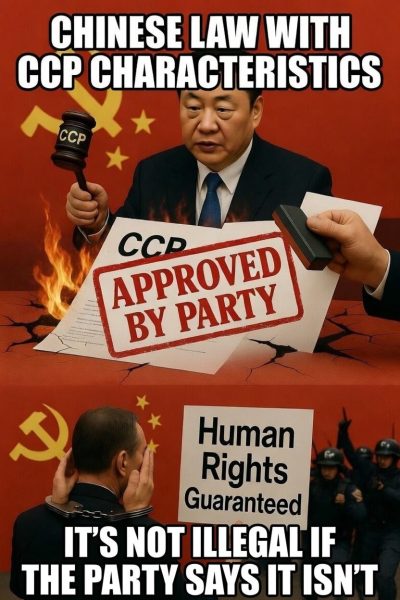
Every once in a while, Chinese leader Xi Jinping makes a grand announcement that makes a person laugh out loud. His statement on 18 November of last year was one such event, as parroted by state-run China Daily: “President Xi Jinping has called for upholding the unity between Party leadership, the running of the country by the people and law-based governance, and making concerted efforts to break new ground in advancing the rule of law in China.”
Incredible! The highfalutin gobbledygook of that sentence is quite meaningless, as the Chinese Communist Party determines what the law is, who it applies to, and how it is applied every single minute of every day in communist China. Arbitrarily so, insofar as it advances the security, longevity, and (false) credibility of the Party.
CHINESE LAW
There are Four Cardinal Principles (四项基本原则) that frame the Chinese legal system: “keep to the socialist road,” “uphold the people’s democratic dictatorship,” CPC leadership, and “uphold Marxism-Leninism” (and Mao Zedong Thought and Xi Jinping Thought). [Reference: https://8964museum.com/time/en/t-b03-002/ ] From these principles, the founding document of communist China (the Constitution of the PRC) was derived and modified over the years. The first divergence from the rule of law as practiced in the West occurs at this level, as the concept of “unconstitutionality” is not practiced or enforced in China. The National People’s Congress (NPC) and its Standing Committee have sole power to interpret and amend it. And there are no checks and balances on the arbitrariness of the NPC’s actions, and the ~1.3 billion Chinese who AREN’T communist have no say so.
Below the constitution, there is a blizzard of Chinese laws that governs virtually every aspect of Chinese society. These include fifteen separate “framework laws” that cover criminal code, civil code, criminal procedure, civil procedure, administrative procedure, national security, Hong Kong national security, data security, personal information protection, cybersecurity, counter-espionage, foreign relations, state secrets, counter-sanctions, and anti-foreign sanctions.
THE CHINESE LEGAL SYSTEM
Even more complex is the byzantine bureaucratic and administrative structure that administers and enforces these framework laws, as the list below elucidates:
National People’s Congress (全国人大) and its Standing Committee. This body writes and modifies Chinese law. The Congress is composed entirely of CCP members plus a handful of minor party members who are completely controlled by the CCP. In essence, only the ~100 million members of the CCP are involved in making Chinese laws (and administrative regulations). The other 93% of Chinese citizens have no say in determining and administering Chinese law.
State Council (国务院). This executive-level body issues the vast majority of day-to-day rules in the form of “administrative regulations” (行政法规) that actually govern economic, social, and administrative life in communist China. The Council issues a maximum of about 30 regulations per year, all of which have binding legal force in the communist system.
Supreme People’s Court (SPC). The Court essentially runs the entire Chinese judicial system. The real working law in China is the law as interpreted and administered by the SPC, not the bare text passed by the NPC. The SPC performs the following major functions: issues “Judicial Interpretations” that have binding legal force on all lower courts; creates narrow case law precedents by issuing guiding cases that lower courts are required to cite and follow in their deliberations; controls judicial budgets, personnel appointments, key performance indicators (KPIs) for evaluating judicial performance, and disciplinary punishments for all judges in China; delivers a Work Report to the NPC outlining policy priorities set by the Politburo (circular reporting!); directly establishes and runs three international commercial courts, six circuit courts, three internet courts, and an intellectual property court; runs the “National Court Execution Command Center” that can freeze bank accounts and property nationwide to enforce judgments; issues all detailed rules of civil, criminal, and administrative procedures, including evidence and online litigation rules.
Supreme People’s Procuratorate (最高人民检察院). The SPP is the highest prosecutorial organ in China. The SPP and its local branches have the exclusive right under Chinese law to bring criminal charges in court. Specifically, Article 134 of the Constitution gives procuratorates the authority to “exercise legal supervision over trial activities.” Police cannot file charges directly; all serious cases must go through a procuratorate decision to either be prosecuted or dropped. The SPP can also launch “public-interest litigation” (公益诉讼) by suing government agencies, state-owned enterprises, private companies, and individuals for “public crimes” such as harming the ecology, damaging food and drug safety, protecting the reputations of “heroes and martyrs,” and abusing state-owned land and property rights. The SPP is one of the main instruments empowered by Xi Jinping’s ongoing anti-corruption campaigns since public interest litigation is initiated by individual procurators without oversight (on direct orders). The SPP is also the primary enforcer of many Politburo-directed political campaigns of the moment, e.g., the crackdown on telecom and online fraud, the anti-gangster “Sweeping black and eliminating evil” (扫黑除恶) campaign, and the crackdown on personal information collection.
National Supervision Commission (国家监察委员会). The NSC is the highest supervisory organ in China per Article 123–127 of the Chinese Constitution and is the most powerful investigative and disciplinary body in China for anything involving public power, such as replacing the police/procuratorate as the investigator for almost all serious corruption cases for political reasons, punishing public officials by bypassing the courts, and issuing nationwide policy through “supervision suggestions” and joint interpretations. Supervision suggestions (监察建议) are official written orders from a supervision commission telling a government department, state-owned enterprise, public hospital, university, or other public institution to immediately fix a systemic legal violation or loophole that allowed duty-related crimes or serious misconduct to happen. This is equivalent to making Chinese law/regulations and pushing new national policies on the fly without involvement of the other legal bureaucracies! The essence of arbitrariness.
Central Political and Legal Affairs Commission of the CPC (中共中央政法委员会). Frequently referred to as the Zhengfawei, this body is Party organ, not a state bureaucratic entity, that sits above the State Council, the SPC, the SPP, the National Supervision Commission, the Ministry of Public Security, and the Ministry of State Security in real decision-making involving the day-to-day administration and enforcement of virtually all Chinese law in practice. As the Zhengfawei sits outside and above the government bureaucracy, Chen Wenqing 陈文清), the Secretary of the Commission, reports directly to the Politburo and Xi Jinping personally. To summarize how the Zhengfawei controls Chinese law at the behest of the Politburo and Xi Jinping: the NPC passes laws; the State Council, SPC, SPP, and NSC enforce them day-to-day; but it is the Zhengfawei that decides what those laws actually mean in a given year, which cases get prosecuted, and who wins or loses in the legal system. In short, the Zhengfawei, acting as directed by the Politboro, is the real headquarters of Chinese law enforcement and legal administration. And whatever the Party says IS the law.
Below these six top-level institutions, the nuts and bolts of Chinese law is administered and enforced on a day-to-day basis by a much larger web of central ministries, commissions, and their local branches, plus specialized police and quasi-police forces. Some of the more important of such entities include:
Eight ministerial level bodies, including the powerful Ministry of State Security (国家安全部) (enforcement of the national security law, counter-espionage law, and state secrets law) and the Ministry of Public Security (公安部) (enforcement of criminal law, criminal procedure law, cybersecurity law, and counter-espionage)
Four specialized armed law enforcement bodies under the State Council and/or dual State Council and Party command, including:
People’s Armed Police (中国人民武装警察部队): A paramilitary force that guards embassies, suppresses riots, runs some detention facilities
China Coast Guard (中国海警): A maritime force that enforces maritime claims (esp. South China Sea and Senkakus), rams foreign vessels (East Philippine Sea), and boards fishing boats [https://www.globaltimes.cn/page/202406/1314408.shtml ]
Customs Anti-Smuggling Bureau (海关缉私局): Armed customs police with jurisdiction over foreign trade crimes
State Taxation Administration (国家税务局) (plus local tax bureaus): Armed tax enforcement police where tax evasion is treated as quasi-criminal (with an ability to freeze assets nationwide)
Lastly, in the administration and enforcement of Chinese law at the local/street level, every Chinese province, city, prefecture, county, and township has bureaus parallel to the above bodies that take direct orders from the central ministry (条) in Beijing while also answering to the local Party secretary and government (块).
That’s a lot of cooks involved in making the legal soup, as well as a lot of opportunities for corruption, misprision, and bribery, as well as conflicts across multiple levels and bureaus in the “administration of justice.” No wonder Xi Jinping has had an anti-corruption campaign going since 2012!
CONCLUDING THOUGHTS
There are many Chinese laws and a mind-boggling number of institutions, commissions, and legal bodies who administer and execute those laws. However, Central Political and Legal Affairs Commission (Zhengfawei) acts on behalf of the Politburo and Xi Jinping to determine what those laws actually mean in a given year, which cases get prosecuted, and who wins or loses in the legal system.
There is also significant overlap among the layered legal bureaucracies which provides opportunities for corruption and bribery, as well as for the state to arbitrarily implement political prosecutions directed by the Politburo via the Zhengfawei to send messages to the Chinese people as required. There are many examples of this.
One fairly well-known example is the Jimmy Lai case, which began in 2020. Hong Kong media tycoon Lai was arrested by Hong Kong police and charged under the then newly passed Hong Kong national security law with collusion with foreign forces and unauthorized assembly. The Zhengfawei was almost certainly the “hidden hand” guiding the case on behalf of the Politburo given the high-profile nature of the prosecution (the first big case under the new law). However, Beijing’s secret Office for Safeguarding National Security (OSSNS) as directed by the Zhengfawei can designate any case to be under central government jurisdiction and move defendants to the mainland for secret trial under mainland laws. Lai is still in limbo in Hong Kong, as his prosecution serves the interests of the state by warning citizens “not to collude with foreign forces” or face prosecution.
In a lesser-known case in 2018, former Interpol president and former Vice Minister of Public Security Meng Hongwei was detained by the Central Commission for Discipline Inspection
(中央纪律检查委员会) under the NSC upon landing in China for allegations of bribery and abuse of power. His case exemplifies the intersection of China’s anti-corruption campaign under Xi Jinping, Party disciplinary processes, and the inconsistencies of the broader criminal justice system. Again, the Zhengfawei was almost certainly guiding the prosecution of this case behind the scenes. He disappeared for months, was expelled from the CCP, only then subjected to the criminal process, and finally sentenced to 13.5 years for bribery in a 30-minute closed hearing. The NSC’s liuzhi detention (up to 6 months, incommunicado) completely bypassed normal criminal procedure law protections. Critics, including Meng’s wife Grace Meng, alleged the charges were fabricated or exaggerated as a pretext for removing him due to potential political rivalries within the CCP. Were the charges themselves supervision suggestions from the SPP or the Party?
Xi Jinping speaks of “law-based governance” (unspecified) and “efforts to break new ground in advancing the rule of law.” It would appear that he really means to expand close coordination of the Central Political and Legal Affairs Commission of the CPC and the Supreme People’s Procuratorate in arbitrarily promulgating new national policies and regulations through supervision suggestions such that politically targeted violators can then be quickly prosecuted by circumventing the established legal system.
So much for the rule of law with CCP characteristics.
The end.
StuinSD is a reader-supported publication. To receive new posts and support his work, consider becoming a free or paid subscriber.
This article originally appeared in Stu Cvrk’s Substack. Reprinted here with permission
If you enjoyed this article, then please REPOST or SHARE with others; encourage them to follow AFNN. If you’d like to become a citizen contributor for AFNN, contact us at managingeditor@afnn.us Help keep us ad-free by donating here.
Substack: American Free News Network Substack
Truth Social: @AFNN_USA
Facebook: https://m.facebook.com/afnnusa
Telegram: https://t.me/joinchat/2_-GAzcXmIRjODNh
Twitter: https://twitter.com/AfnnUsa
GETTR: https://gettr.com/user/AFNN_USA
CloutHub: @AFNN_USA