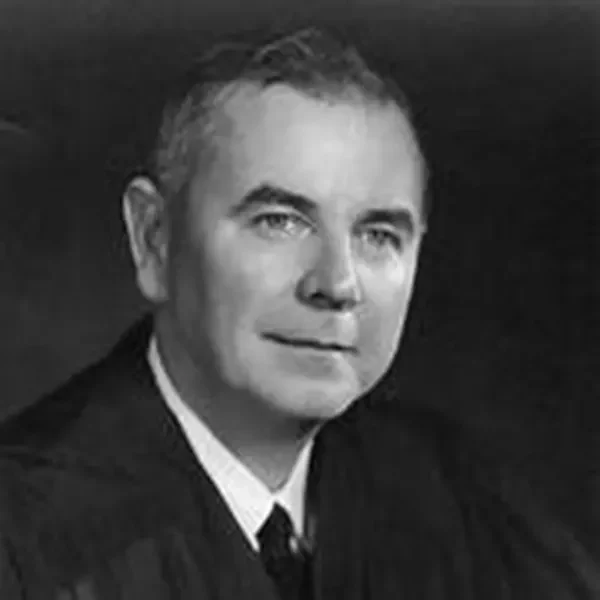
US Supreme Court Justice William J. Brennan, Jr. 1956-1990
Politicians, but not scholars, believe that birthright citizenship was created by a mere footnote, Footnote 10, in the 1982 Supreme Court case Plyler v. Doe. The issue in that case was about whether or not a state could constitutionally deny illegal alien children the same public school education as American children. Justice William Brennan^ created a central focus of legal and political debate regarding birthright citizenship in his footnote: He wrote that “no plausible distinction . . . can be made between resident aliens whose entry into the United States was lawful and resident aliens whose entry was unlawful” in the context of the Fourteenth Amendment’s jurisdiction.
Because Footnote #10 in Justice William Brennan’s majority opinion for Plyler v. Doe (1982) is considered dicta (non-binding, explanatory remark rather than a central legal holding), it is never quoted or cited directly as binding law by subsequent US Supreme Court or federal appellate rulings.
FOOTNOTE 10 IS NOT CONSTITUTIONAL, SO SCOTUS NEVER RELIED ON IT
The Plyler ruling was 5 to 4. One reason Footnote 10 never gained traction as a reliable legal authority is rooted in the immediate, fierce pushback it received within the Plyler ruling itself. Justice William Rehnquist, who would become chief justice four years later (on September 26, 1986), writing for the four dissenting justices, strongly criticized Brennan’s footnote for attempting to subtly expand the definition of the 14th Amendment’s “jurisdiction” without proper constitutional grounding. Rehnquist and subsequent scholars argued that the majority opinion mistakenly conflated the Equal Protection Clause (which applies to all “persons” physically within a state) with the Citizenship Clause (which historically required being subject to the full political jurisdiction of the United States) and was written & passed to give former slaves full citizenship.
This single footnote could not and did not create a “constitutional right” to birthright citizenship for the children of illegal immigrants, a concept that was never intended by the 14th Amendment’s framers. The footnote has been rejected by constitutional scholars because of how it interpreted the Citizenship Clause of the Fourteenth Amendment:
Broadening Jurisdiction: It suggested that the phrase “subject to the jurisdiction thereof” in the 14th Amendment applies to anyone physically present in the U.S., regardless of their legal status, which it does not.
The Rehnquist Connection: Justice William Rehnquist and three other justices dissented in Plyler v. Doe. They and many other critics argued that this footnote was dicta (a non-binding remark said in passing) that mistakenly conflated the Equal Protection Clause with the Citizenship Clause.
The Policy Debate: Over the decades since, Democrats and some RINOs in the US House & US Senate have cited this dicta as an excuse to bring ever more foreign nationals into America to give birth as a means to replace the “white” Christians and others who built America with Third World immigrants from cultures who are hostile to American culture and our Bill of Rights.
THE MOST QUOTED DICTA IN CONGRESS
The legal and historical context surrounding how this Footnote 10 is treated by the courts includes several key factors:
1. Treated as Judicial Dicta
In federal jurisprudence, footnotes that offer broad philosophical expansions on constitutional text but are not necessary to resolve the immediate question of the case (which, in Plyler, was strictly about access to public K-12 education) are classified as dicta. Because of this, subsequent judges looking to interpret the Citizenship Clause or broader birthright citizenship rules do not rely on or quote Footnote #10 as an authoritative legal standard.
2. Impact is Scholarly and Political, Not Judicial
While you won’t find federal judges quoting Footnote #10 to decide immigration or citizenship cases, it is heavily cited in:
Law Review Articles & Constitutional Treatises: Leftist “legal scholars” who debate the original intent of the 14th Amendment and other proponents of automated birthright citizenship for the children of illegal aliens, frequently quote Footnote #10. They cite it as the exact historical turning point where the modern, broad interpretation of birthright citizenship was popularized, calling it a major policy shift achieved through a single, non-binding footnote. Ad dictum, Footnote #10 has no legal or constitutional authority.
Congressional Hearings: During various legislative pushes in the late 1980s, 1990s, and 2000s to clarify or restrict birthright citizenship via statute, the footnote was repeatedly read into the Congressional Record by lawmakers arguing that the Supreme Court had overstepped its bounds through judicial activism.
A scholarly discussion of “birthright citizenship” begins at the 9-minute mark.
Check me out on X @dianelgruber.
Trump’s “Birthright Citizenship” Case
^Justice William J. Brennan Jr., serving as an Associate Justice from 1956 to 1990, was nominated by President Dwight D. Eisenhower, yet became the ideological anchor of the Court’s Liberal wing during both the Warren and Burger eras. He is remembered for his expansive interpretation of constitutional rights and his belief that the Constitution must be read as a dynamic document reflecting contemporary notions of human dignity. This ideology, of course, is what has caused so many of the problems Americans in 2026 are dealing with.
The author, Diane L. Gruber, is a First Amendment advocate who writes for Substack. She calls her Substack newsletter America First Re-Ignited. Follow me on X @DianeLGruber.
If you enjoyed this article, then please REPOST or SHARE with others; encourage them to follow AFNN. If you’d like to become a citizen contributor for AFNN, contact us at managingeditor@afnn.us. Help keep us ad-free by donating here.
Substack: American Free News Network Substack
Truth Social: @AFNN_USA
Facebook: https://m.facebook.com/afnnusa
Telegram: https://t.me/joinchat/2_-GAzcXmIRjODNh
Twitter: https://twitter.com/AfnnUsa
GETTR: https://gettr.com/user/AFNN_USA
CloutHub: @AFNN_USA
Patriot.Online: @AFNN