
I have often heard the phrase: “Democrats hate our country.” Somehow, it always seemed a bit too imprecise and all-encompassing to condemn an entire political party for having such an unpatriotic conviction.
After all, my parents and most of my family were Democrats, and I know they loved their country. I personally know other Democrats who also love America. So, I simply wrote off such statements as political hyperbole.
Then I saw this recent Gallup poll, which found that 90 percent of Republicans reported feeling “extremely” or “very” proud of their country, while only 29 percent (a new low) of Democrats feel that way.
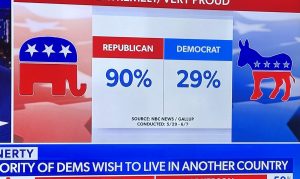
And I thought, “Well, what do you know, Democrats really do hate America—or at least 71 percent of them do.”
That’s quite a thought, given that we are only a couple of weeks away from celebrating our nation’s 250th birthday.
This brings me to a couple of other recent polls on the differences between Republicans and Democrats in how they celebrate the Fourth of July.
CBS News has tracked this specific question: “Will you fly the American flag from your home on the Fourth of July?” Their tracking shows that 80% of Republicans plan to fly the flag, compared to 58% of Democrats.
In a comprehensive YouGov survey on the American flag, 83% of Republicans reported having a “very positive” view of the U.S. flag, compared to 49% of Democrats.
So why the gap between Americans within our two major political parties when it comes to their feelings about America, the American flag, and expressions of patriotism?
While political scientists and pollsters like to point out that these trends are heavily influenced by which party occupies the White House, they also differ in cultural definitions of patriotism.
For many conservative Americans, patriotism is often expressed through traditional national symbols, military support, and a belief in the country’s foundational exceptionalism. For many left-leaning Americans, expressions of national pride are often tied to their approval of current social or political progress, so their reported pride fluctuates more sharply with the current administration and active political events.
Speaking of events by the Trump administration, Democrats were highly critical of the UFC fights held last week on the White House’s South Lawn. They were appalled by the spectacle of men clobbering one another in the shadow of the White House.
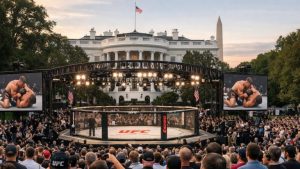
The symbolism and purpose of the White House were denigrated and belittled by the exhibition, some Democrats whined. It was as if Washington had turned into ancient Rome and the Emperor Trump had provided bloody gladiatorial games for the masses.
Wow. Really?
Okay, I get it. At its core, this Democrat vs. Republican tension pits the idea of the Executive Mansion as a dignified, formal symbol of statehood against the populist ideal of “The People’s House”—a place that should directly reflect the contemporary culture and passions of regular citizens.
The fact is, there has been a History of Populism vs. Protocol when it comes to the White House and how presidents chose to use it. The debate over how “open” or “accessible” the White House should be is as old as the Republic itself:
- Thomas Jefferson famously did away with the formal, quasi-monarchical bulwarks favored by George Washington and John Adams, choosing instead to greet visitors in casual attire and slippers to emphasize republican simplicity.
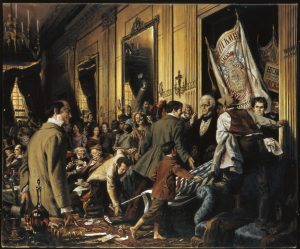
- Then there was Andrew Jackson’s infamous 1829 inauguration. Jackson opened the White House to the public, resulting in a crowd of thousands muddying the carpets, breaking China, and forcing the president to escape out a window while staff lured the crowd outside with tubs of spiked punch. What a shindig that must have been. However, I bet nobody was arrested.
- Theodore Roosevelt routinely brought the popular culture of his day into the White House, hosting prizefighters, cowboys, and jujitsu masters, and frequently sparring in the mansion’s rooms.
In the modern era, every administration uses the White House as a cultural stage, though the choice of who and what gets highlighted changes dramatically depending on the party in power.
For example, in June 2023, Joe Biden hosted more than 1,000 guests for what the administration described as the largest-ever Pride event at the White House, featuring food, lawn games, and a concert by pop singer Betty Who.
The gathering drew significant media attention and political controversy, particularly after a transgender social media influencer, Rose Montoya, posted a video of himself topless on the White House lawn during the picnic. The White House subsequently condemned the behavior as “unacceptable” and inappropriate for a formal event, stating that the individuals involved would not be invited back to future events.
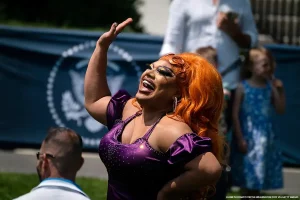
While one side of the political aisle views events like a UFC gathering or a populist rally as a triumph of working-class culture reclaiming an elite space, the other side views them as a degradation of the historical dignity and decorum traditionally demanded of the office.
In effect, Democrat elitists are leveraging a highly effective rhetorical strategy: framing political opposition not just as a disagreement over policy, but as an inherent disdain for the tastes and traditions of everyday Americans.
Ah, yes. Coastal Democrat elitists tend to despise the Great Unwashed, and there were plenty of those at the UFC event.
As the nation approaches its semi-quincentennial, I suspect the battle over how America’s history and civic spaces are celebrated will likely only intensify. The tension surrounding the nation’s 250th anniversary reflects the deep political and cultural polarization of modern America.
While the White House has framed its “Freedom 250” initiative as a populist celebration of American history, a significant portion of the political left, including congressional Democrats, cultural figures, and civil rights organizations, has pushed back against the administration’s events or outright boycotted them.
The resistance to the current festivities, its widespread nature, and why it differs so drastically from the Bicentennial of 1976 can be understood in terms of several factors.
Critics (mostly Democrats) charge that the Trump administration has “hijacked” what should be a nonpartisan civic milestone. In congressional hearings, Democrats like Rep. Jared Huffman (D-CA) accused the administration of utilizing the 250th anniversary to “promote an alternate reality,” using private, dark-money donations through the National Park Foundation to fund pet projects rather than a unified national commemoration.
Sounds sinister, doesn’t it?
The fact is, there is a fundamental disagreement over how to tell America’s exceptional story. Progressive groups and civil rights organizations, such as the NAACP, argue that the administration’s curated history sanitizes or erases the darker chapters of America’s past, such as slavery, Jim Crow, and the ongoing struggles for civil rights. Conversely, the administration’s “Freedom 250” curriculum focuses heavily on traditional, patriotic milestones, even featuring an interactive AI quiz titled “Are you a loyalist or a patriot?”
A high-profile boycott erupted surrounding the “Freedom 250” concert lineup on the National Mall. Headliners, including Martina McBride, Bret Michaels, The Commodores, and Young MC, abruptly pulled out of the events. The artists issued statements indicating they had been booked under the impression that the event was entirely nonpartisan, and that they withdrew once they felt the administration’s political branding was evident.
While the boycott by specific musicians and the criticism from coastal Democratic governors have dominated the headlines, the opposition largely reflects the nation’s existing 50/50 political divide. In conservative and independent circles, the populist tone of the White House events is widely popular, viewed as a refreshing reclamation of cultural spaces from traditional Democratic elites. The division is less a nationwide boycott and more a total divergence in how the two halves of the country choose to observe the milestone.
Does anybody recall the 1976 Bicentennial? I do. The near-universal unity of the 1976 Bicentennial stands in stark contrast to today.
I recall it vividly.
In 1976, America was still reeling from the trauma of the Vietnam War, the Watergate scandal, and the resignation of Richard Nixon. President Gerald Ford explicitly recognized that the country was fragile and cynical. He deliberately chose to keep the Bicentennial low-key, non-ideological, and focused on healing. Ford did not center the celebration on his own administration; instead, he encouraged decentralized, localized community events.
The planning for the 1976 Bicentennial was managed by the American Revolution Bicentennial Administration (ARBA), which operated with strict bipartisan congressional oversight. It was intentionally kept independent of executive meddling to ensure that no single political party could claim ownership over the country’s 200th birthday.
The “Tall Ships” event of 1976—officially known as Operation Sail 1976 (OpSail ’76)—was the undisputed crown jewel of the American Bicentennial celebrations. Held on July 4, 1976, it served as a powerful, unifying visual spectacle for a nation looking to heal after the tumultuous years of the Vietnam War and the Watergate scandal.
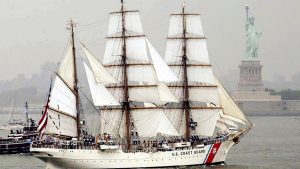
It remains one of the largest peacetime assemblies of international sailing vessels in modern history. The event featured more than 200 sailing vessels representing over 30 nations.
The stars of the show were the 16 majestic “Class A” square-rigged tall ships, which included famous training vessels like America’s own USCGC Eagle, Chile’s Esmeralda, Japan’s Nippon Maru, and the Soviet Union’s massive Tovarich and Kruzenshtern. It was a remarkable feat of diplomatic cooperation during the height of the Cold War.
The 200 ships engaged in a grand parade of sail, moving majestically up the Hudson River past millions of spectators lining the shores of New York and New Jersey. An estimated 6 million people watched from the shorelines of Manhattan, Brooklyn, Staten Island, and New Jersey. They were joined by a chaotic, celebratory armada of roughly 10,000 small private pleasure boats, yachts, and ferries that packed the harbor.
The parade was broadcast live to a global audience, pulling in tens of millions of viewers who watched the historic vessels glide past the newly completed World Trade Center towers and the Statue of Liberty.
I believe the 1976 Bicentennial succeeded because it was designed to be deliberately low-key, decentralized, and strictly non-political. The Tall Ships event embodied this perfectly. Instead of focusing on military might or partisan political triumphs, the Tall Ships event focused on shared global heritage, maritime tradition, and international goodwill.
For a brief moment on July 4, 1976, the image of these historic ships under full sail gave Americans a deep sense of historical continuity, dignity, and a much-needed breath of national optimism.
Perhaps the biggest difference between 1976 and 2026 is the vastly different cultural and media landscapes of both eras.
In 1976, Americans consumed news through three major television networks, which adhered to strict standards of institutional neutrality. There was no internet, social media, or highly segmented cable news networks to instantly weaponize civic events for political fundraising or cultural grievances.
Ultimately, the 1976 Bicentennial was used as a vehicle to bind a wounded nation together. In 2026, the 250th anniversary has instead become another theater in the ongoing American culture war, where even the definition of patriotism itself is up for debate. The White House remains the ultimate prize and symbol in that cultural tug-of-war.
When a nation is so precisely and deeply fractured, it raises a fundamental question: Is this a temporary, cyclical fever, or are we witnessing structural fatigue that leads to terminal decline?
Let’s face it. America has never been a cohesive, naturally harmonious entity. The nation was born out of a bitter, violent division (roughly a third of the population supported the Revolution, a third opposed it, and a third didn’t care).
But today, we are a nation of two primary political parties, in which 90 percent of one party love the country, and 71 percent of the other party loathe it.
The tragedy of America’s current polarization, as it prepares to celebrate its 250th birthday, is that neither side can see the value in the other’s perspective anymore.
–30–
NEXT: Thoughts about America and the American Flag as we approach our 250th Birthday (Part Two)
(Ronald E. Yates is a U.S. Army veteran, an author, a former Chicago Tribune foreign correspondent, and Professor and Dean Emeritus of Journalism at the University of Illinois.)
His website: http://www.ronaldyatesbooks.com/
If you enjoyed this article, then please REPOST or SHARE with others; encourage them to follow AFNN. If you’d like to become a citizen contributor for AFNN, contact us at managingeditor@afnn.us Help keep us ad-free by donating here.
Substack: American Free News Network Substack
Truth Social: @AFNN_USA
Facebook: https://m.facebook.com/afnnusa
Telegram: https://t.me/joinchat/2_-GAzcXmIRjODNh
Twitter: https://twitter.com/AfnnUsa
GETTR: https://gettr.com/user/AFNN_USA
CloutHub: @AFNN_USA