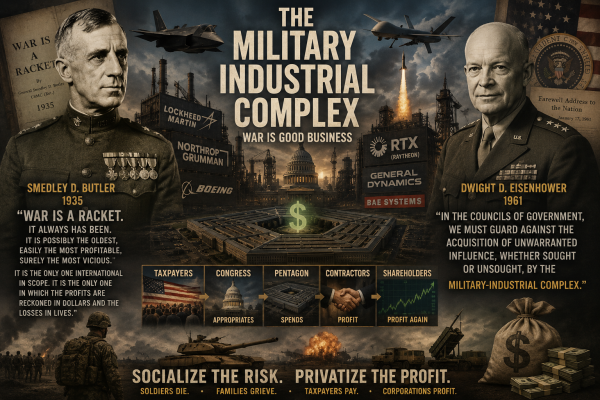
In 1935, retired Marine Major General **Smedley Butler**, twice awarded the Medal of Honor, published a little book that Washington has spent nearly a century pretending not to hear.
His opening sentence was brutally simple: “War is a racket.”
Most people stop reading there.
They shouldn’t.
Butler wasn’t arguing that America should never fight. He had spent three decades doing exactly that. His point was that once war begins, there are often powerful financial interests that prosper regardless of whether the mission succeeds, fails, or drags on indefinitely.
Twenty-six years later, another career soldier reached much the same conclusion.
In his 1961 farewell address, President Dwight D. Eisenhower warned:
“In the councils of government, we must guard against the acquisition of unwarranted influence… by the military-industrial complex.”
Remember who said that.
Not a college activist.
Not a politician who had never worn a uniform.
The Supreme Allied Commander who defeated Nazi Germany.
When men like Butler and Eisenhower wave the warning flag, perhaps it’s worth asking why.
Fast-forward to today.
For more than four years, the United States has poured tens of billions of dollars’ worth of weapons, ammunition, intelligence, logistics, and financial assistance into Ukraine. The objective may have been to help Ukraine defend itself and weaken Russia’s military capabilities without committing American troops directly—a strategy many analysts describe as a proxy conflict. But while Ukrainians fight and Russians die, one thing has become impossible to ignore.
American factories never stop humming.
Javelins.
HIMARS rockets.
155 mm artillery shells.
Patriot interceptors.
Air-defense systems.
Every shipment empties American stockpiles.
Every empty stockpile requires replenishment.
Every replenishment becomes another multibillion-dollar contract.
Then came Iran.
Cruise missiles.
THAAD interceptors.
Patriot missiles.
Precision-guided bombs.
Again, every launch became another purchase order waiting to happen.
The missile isn’t simply fired.
It’s an invoice.
Wall Street understands this better than Washington admits publicly.
Defense contractors don’t merely celebrate quarterly earnings.
They celebrate backlogs—guaranteed work stretching years into the future. Hundreds of billions of dollars in committed orders mean tomorrow’s taxpayer money has already been spoken for.
The war may end.
The contracts usually don’t.
Then came perhaps the most revealing story of all.
The Pentagon reportedly approached Ford, General Motors, GE Aerospace, Oshkosh, and other manufacturers to explore whether America’s civilian industrial base could help manufacture munitions and military equipment.
Read that again.
The richest military in world history is asking Detroit whether it can help build more weapons because the existing defense industry cannot produce enough.
That should stop every American in his tracks.
For thirty years after the Cold War, America optimized for efficiency.
Just-in-time manufacturing.
Lean inventories.
Factory consolidation.
Maximum shareholder value.
Wonderful ideas—until a real war arrives.
Now Washington is discovering that missiles cannot be downloaded like software updates.
Factories matter.
Machine tools matter.
Steel matters.
Skilled labor matters.
Industrial capacity matters.
In other words, the Arsenal of Democracy never stopped being important. We simply forgot.
But there is another lesson hiding beneath the surface.
Every new factory creates jobs.
Every new production line creates political constituencies.
Every contract creates lobbyists.
Every congressional district receiving defense dollars develops a reason to keep those dollars flowing.
Nobody has to gather in a smoke-filled room plotting endless wars.
The incentives build themselves.
That is what Butler understood.
That is what Eisenhower feared.
The military needs weapons.
Congress wants jobs.
Communities want factories.
Contractors want profits.
Investors want growth.
Politicians want to appear strong.
Meanwhile, the average American receives a larger national debt, higher deficits, and another generation of veterans carrying scars that never appear on quarterly earnings reports.
National defense is absolutely necessary. Russia, China, Iran, and North Korea present real strategic challenges that cannot simply be wished away. America needs a capable military and a healthy defense industrial base.
But those realities do not invalidate Butler’s warning.
They make it more relevant.
A free republic should never stop asking uncomfortable questions.
Is the mission clearly defined?
What does victory actually look like?
How long will this continue?
Who benefits financially?
Who bears the cost?
Because history has delivered a remarkable irony.
In 1935, Smedley Butler warned that war could become a business.
In 1961, Dwight Eisenhower warned that industry could gain unwarranted influence over national policy.
In 2026, after years of Ukraine, conflict with Iran, and an overstretched defense industrial base, the Pentagon is asking America’s largest civilian manufacturers to help produce enough weapons to sustain modern warfare.
Maybe Butler wasn’t cynical.
Maybe Eisenhower wasn’t paranoid.
Maybe they were simply looking farther down the road than everyone else.
If you enjoyed this article, then please REPOST or SHARE with others; encourage them to follow AFNN. If you’d like to become a citizen contributor for AFNN, contact us at managingeditor@afnn.us Help keep us ad-free by donating here.
Substack: American Free News Network Substack
Truth Social: @AFNN_USA
Facebook: https://m.facebook.com/afnnusa
Telegram: https://t.me/joinchat/2_-GAzcXmIRjODNh
Twitter: https://twitter.com/AfnnUsa
GETTR: https://gettr.com/user/AFNN_USA
CloutHub: @AFNN_USA