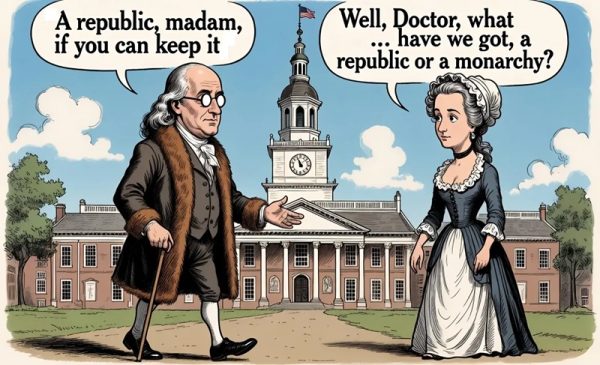
On September 17, 1787, the final day of the Constitutional Convention in Philadelphia, Benjamin Franklin, 81, shared with his fellow delegates his assessment of the new Constitution:
I confess that there are several parts of this Constitution which I do not at present approve, but I am not sure I shall never approve them: For having lived long, I have experienced many instances of being obliged by better information, or fuller consideration, to change opinions even on important subjects, which I once thought right, but found to be otherwise.
In these sentiments, Sir, I agree to this Constitution with all its faults, if they are such; because I think a general Government necessary for us, and there is no form of Government but what may be a blessing to the people if well administered.
Thus I consent, Sir, to this Constitution because I expect no better, and because I am not sure, that it is not the best.
As Franklin left Independence Hall, Elizabeth Willing Powel, a prominent Philadelphian asked him, “Well, Doctor, what have we got, a republic or a monarchy?”
He replied, “A republic, if you can keep it.”
Their exchange comes courtesy of the journal of James McHenry, a Maryland delegate to the Convention. McHenry was a surgeon in the Continental Army earlier and later would serve as George Washington’s last war secretary and Adams’s first.
McHenry did such a fine job building up the navy that they named a post in Baltimore after him. The British bombarded Fort McHenry for 25 hours straight during the War of 1812. But the rocket’s red glare, the bomb bursting in air, gave proof through the night that our flag was still there. Someone should write a song about it.
238 years after Franklin’s observation we realize we may have failed to keep that republic that our Founding Fathers bequeathed to us.
In those 238 intervening years, the country grew from 13 colonies clinging to the Eastern Seaboard with title to the land east of the Mississippi from the Great Lakes to the Gulf of America. Thomas Jefferson later made the Louisiana Purchase. After the Marines toured the Halls of Montezuma, Mexico gave up its claim to the land north of the Rio Grande from the Pacific east to the Mississippi.
Americans built canals, then when the locomotive came along, we built transcontinental railroads—plural. We invented the telegraph and linked the nation’s communications in a manner our forefathers could never imagine. We turned the Great American Desert into a bread basket and we built cities atop mountains a mile above sea level.
We survived numerous panics and depressions. We suffered a civil war. We grew and thrived. Within a century’s time, the United States had the world’s strongest (largest) economy—clearly and sustainably surpassing the United Kingdom (and all others) in total economic output. For the past 130 years, the USA’s share of the global GDP has stood at 25% or above—peaking at 28% in the 1950s.
We created entire industries such as oil and aluminum. Americans did not create the automobile. We perfected it. The same with radio and moving pictures.
This success is due in no small part to the classless society (“all men are created”) that the wealthy high society set, which included Mrs. Powel and her friends Martha and George Washington as well as Franklin, created. That allowed a lowly boy from Scotland to grow up and become Andrew Carnegie.
The media has always lied to us.
On October 9, 1903, the New York Times predicted it would take thousands or even millions of years for man to fly:
Hence, if it requires, say, a thousand years to fit for easy flight a bird which started with rudimentary wings, or ten thousand for one which started with no wings at all. It might be assumed that the flying machine which will really fly might be evolved by the combined and continuous efforts of mathematicians and mechanicians in from one million to ten million years—provided, of course, we can meanwhile eliminate such little drawbacks and embarrassments as the existing relation between weight and strength in inorganic materials.
Two brothers who ran a bicycle shop in Dayton, Ohio, took no offense. They took it as a challenge and two months and 8 days after the editorial ran, Orville and Wilbur Wright proved the New York Times was wrong.
I really enjoyed writing that last sentence.
But all was not as it seemed. This is the part where I am supposed to mention the mistreatment of black people. I will go one step beyond and point out that the entire South held second-class citizenship. The Civil War did not heal the nation.
11 years after the war, the James-Younger Gang rode into Northfield, Minnesota, to rob a bank that was associated with Union General Archibald Ames. It was a stupid act of spite that cost the gang dearly—all for $26 and some change.
The North and the West moved on and built a great economy, but the South remained prideful and poor, romanticizing a lost cause that they saw as states rights. The North saw the cause as slavery, giving them a nice virtue signaling high.
The bitter feelings continued until the Japanese bombed Pearl Harbor, which united the nation and brought boys from Arkansas, Iowa and West Virginia together on an aircraft carrier in the middle of the Pacific.
After the war, there was more respect. Civil rights extended to black people, lifting the white people in the South as well. Right-to-work laws gave access to cheap labor in America and the South indeed rose.
But the Depression and the war created a huge bureaucracy, and overturning Plessy v. Ferguson and ending separate-but-equal public accommodations made the Supreme Court unassailable in the eyes of too many Americans.
Never mind that the Supreme Court actually made separate-but-equal the law of the land. The justices who reversed that bad decision were cast as heroes in the media—the sheriff standing outside the jail to protect the defendant from the angry mob. The decision empowered the justices and lifetime tenure insulated them from consequences.
Many a bad decision followed. Roe v. Wade was the worst.
The deep state is real. Presidents are advised to pay their respects or face the consequence of being Trumped.
J. Edgar Hoover turned the FBI into a private eye (for investigator) for presidents, in part to keep his funding coming. The IRS also proved useful for FDR and others. The Church Commission in 1975 was supposed to ferret out these abuses (conveniently after Hoover died) but Obama figured out a way to use the FBI under Comey to stave off the prosecution of Hillary while concocting and promoting the Russiagate Hoax on Trump.
By the way, which is harder to get rid of: Obama or herpes?
But the real problem is that federal spending now top $7.4 trillion a year—that is 5.86% of the world’s economy. Only America and Red China top that. It is larger than the economies of Germany, Japan and UK combined.
And $2 trillion of it is borrowed. Congress has figured out a way to spend as it chooses regardless of its income. In an age of constant borrowing, taxation is not for the public good but to punish innovation and success. This is on top of making life miserable through regulation.
In fact, artificial intelligence has revealed a split in Congress between those who want to tax it (Pocahontas) and those who want to regulate it without knowing what it is (Cheeseburger Chuck).
Bernie Sanders says let’s compromise and do both.
Did we keep a republic? I don’t know. When I started writing this, I thought we failed. Certainly the criminal justice system seems like a farce in which all the cops are sinners and all the criminals saints. Grand juries in DC refusing to indict Democrats is a recipe for continuous abuse of power.
But this week’s Supreme Court decisions and the tone of the majority opinions are encouraging in that the supermajority of justices want to get back to the roots of the republic. Then again, if today they reject Trump on birthright citizenship, the dark cloud of hopelessness rises.
I am also encouraged by the positive feedback from FIFA visitors who enjoy America’s quirks, friendliness and prosperity.
Franklin would be pleased by our technological advances but regret the cost in terms of our privacy.
He also would declare war on debt spending. He once wrote “Industry pays debts, while despair increases them” and “Rather go to bed without dinner than to rise in debt.”
One of his core fears was that of corruption—“Only a virtuous people are capable of freedom. As nations become corrupt and vicious, they have more need of masters.”
For 238 years we kept (at times barely) a republic. Part of me wonders if we can keep it another 238 days.
But pessimism is easy. If it weren’t, there would not be as many pessimists, would there? We shall keep a republic because we are a stubborn people.
You can subscribe to Don’s Daily Substack Here.
This article first appeared on Don Surber’s Substack. Reprinted here with permission.
If you enjoyed this article, then please REPOST or SHARE with others; encourage them to follow AFNN. If you’d like to become a citizen contributor for AFNN, contact us at managingeditor@afnn.us Help keep us ad-free by donating here.
Substack: American Free News Network Substack
Truth Social: @AFNN_USA
Facebook: https://m.facebook.com/afnnusa
Telegram: https://t.me/joinchat/2_-GAzcXmIRjODNh
Twitter: https://twitter.com/AfnnUsa
GETTR: https://gettr.com/user/AFNN_USA
CloutHub: @AFNN_USA