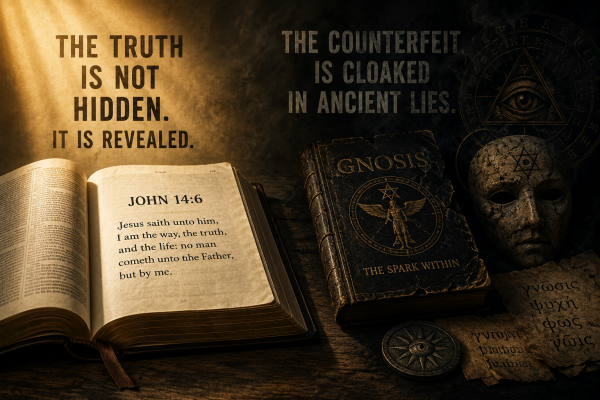
Every generation seems convinced it has finally discovered the “real” Jesus. Strip away the Church. Ignore two thousand years of Christian teaching. Find a dusty manuscript, reinterpret a Greek word, mix in a little philosophy, and suddenly you’ve uncovered the secret that everyone else somehow missed.
Funny how that keeps happening.
The counterfeit is almost as old as Christianity itself.
Before the ink on the New Testament was dry, the apostles were already warning that false teachers would arise. Paul warned the churches about “another gospel.” Peter warned of destructive heresies. John warned about deceivers who denied the truth about Christ. Jude urged believers to contend for “the faith once delivered to the saints.” They weren’t predicting a future problem. They were describing one already unfolding.
One of the earliest counterfeits was what we now call Gnosticism. It wasn’t one organized religion but a family of ideas that borrowed Christian language while changing Christian meaning. Jesus became less the crucified and risen Savior and more the enlightened teacher. Sin became ignorance. Salvation became secret knowledge. Redemption became awakening the hidden spark within yourself.
Sound familiar?
The language changes, but the melody is the same.
Today it shows up in bestselling books, YouTube lectures, social media clips, and podcasts. The modern version says Jesus didn’t really come to save us from sin. He came to teach us to discover our true selves. The Kingdom of God becomes a state of consciousness. Repentance becomes self-awareness. Grace becomes self-actualization. The cross becomes little more than an inspirational symbol.
It’s an attractive message because it leaves us in charge.
Historic Christianity says humanity has a sin problem that cannot be solved from within. The counterfeit says the answer has been inside you all along—you just need to awaken it. One requires a Savior. The other requires a coach.
That difference changes everything.
Even brilliant literature can be misunderstood. Fyodor Dostoevsky’s famous “Grand Inquisitor” is often used as proof that organized Christianity deliberately corrupted Jesus’ message. But Dostoevsky wasn’t writing history; he was writing a profound novel about freedom, authority, and the temptation to replace love with coercion. Reading the Grand Inquisitor as if it were a historical account of Christianity is like reading George Orwell as a newspaper.
The irony is hard to miss. The people who accuse Christians of twisting Jesus often twist Him themselves.
The biblical Jesus doesn’t tell people to discover their inner divinity. He tells them to repent. He doesn’t claim ignorance is humanity’s greatest problem. He says sin separates us from God. He doesn’t point people inward for salvation. He points them to Himself.
That doesn’t mean Christianity rejects reason, growth, or personal responsibility. Quite the opposite. Following Christ transforms the heart, renews the mind, and changes how we live. But transformation is the result of God’s grace, not the discovery of an inner divine essence.
This matters because counterfeits rarely look ridiculous. If they did, nobody would believe them. They look close enough to the truth that they fool people who haven’t handled the genuine article.
A counterfeit twenty-dollar bill isn’t printed on purple construction paper. It resembles the real thing.
So do counterfeit gospels.
They quote Jesus. They talk about love. They mention forgiveness. They use biblical vocabulary while quietly redefining nearly every important word.
The best defense has never changed.
Know the Scriptures.
Read them in context.
Compare every new teaching against the whole counsel of God rather than against a compelling speaker or viral video.
The apostles expected counterfeits. Jesus Himself warned that false christs and false prophets would arise. Their existence shouldn’t surprise Christians. What should surprise us is how quickly attractive ideas can replace biblical truth when we stop opening our Bibles.
The real Jesus isn’t hidden behind a secret code waiting for modern intellectuals to uncover Him. He isn’t trapped inside forgotten manuscripts or unlocked through mystical insight. He has been proclaimed openly for two thousand years through the Scriptures, faithfully preserved despite persecution, empires, and every fashionable philosophy that promised something “new.”
The oldest lie in history has never really changed.
“Did God really say?”
The answer still determines everything.
If you enjoyed this article, then please REPOST or SHARE with others; encourage them to follow AFNN. If you’d like to become a citizen contributor for AFNN, contact us at managingeditor@afnn.us Help keep us ad-free by donating here.
Substack: American Free News Network Substack
Truth Social: @AFNN_USA
Facebook: https://m.facebook.com/afnnusa
Telegram: https://t.me/joinchat/2_-GAzcXmIRjODNh
Twitter: https://twitter.com/AfnnUsa
GETTR: https://gettr.com/user/AFNN_USA
CloutHub: @AFNN_USA