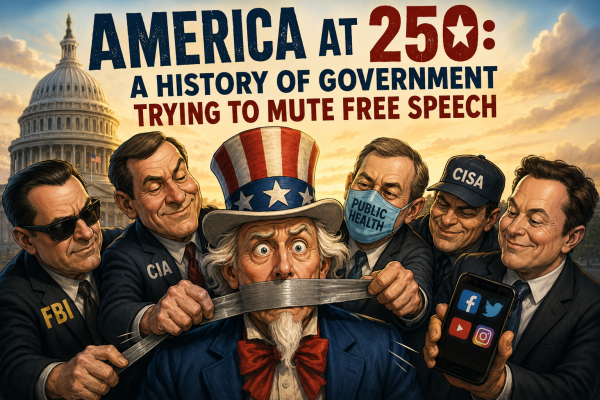
“Our liberty depends on the freedom of the press, and that cannot be limited without being lost.” — Thomas Jefferson, 1786
Jefferson understood something that every generation of Americans eventually rediscovers: governments rarely wake up one morning and announce they’re abolishing free speech. Instead, they find a reason. A war. A rebellion. A foreign threat. Terrorism. Public health. Misinformation. The justification changes with the times, but the temptation remains remarkably consistent.
The First Amendment might be America’s most quoted promise—and its most frequently tested one.
It reads like a command: “Congress shall make no law… abridging the freedom of speech.” Pretty simple. No footnotes. No exceptions for “national emergencies.” No clause that says, “unless politicians are nervous.”
Yet the ink wasn’t even dry before Washington started looking for the exits.
The Bill of Rights was ratified in 1791. Seven years later, Congress passed the Alien and Sedition Acts of 1798. Seven years.
Apparently the Founders’ greatest accomplishment immediately became a speed run challenge for the next generation of politicians.
The Sedition Act made it a federal crime to publish statements considered “false, scandalous, and malicious” against President John Adams or Congress. Newspaper editors were arrested. Political opponents were prosecuted. Americans discovered that criticizing the government was acceptable—until the government decided it wasn’t.
Thomas Jefferson called the law unconstitutional. After defeating Adams in 1800, he allowed it to expire and pardoned those convicted.
One crisis down.
Plenty more to go.
Fast-forward to the Civil War. President Abraham Lincoln faced the greatest constitutional crisis in American history. To preserve the Union, his administration suspended habeas corpus in many areas and shut down or interfered with newspapers viewed as aiding the Confederacy. Whether those extraordinary measures were justified remains debated, but they demonstrated a recurring lesson: in wartime, governments often claim extraordinary powers.
Then came World War I.
Congress passed the Espionage Act of 1917 and the Sedition Act of 1918. Thousands were investigated. More than two thousand people were prosecuted. Socialist leader Eugene V. Debs received a ten-year prison sentence simply for delivering an anti-war speech urging resistance to the military draft.
Think about that.
A presidential candidate was sitting in a federal prison because of a speech. If social media had existed in 1918, Debs probably would have been labeled “harmful misinformation.”
The Cold War simply found a different target.
Fear of communist infiltration fueled loyalty oaths, congressional investigations, and blacklists. Teachers, actors, military officers, scientists, and ordinary citizens lost careers because they were suspected of holding the wrong political views or associating with the wrong people. You didn’t necessarily have to commit a crime. Sometimes knowing the wrong person was enough.
Then came the 1960s.
The FBI launched COINTELPRO, secretly infiltrating and disrupting organizations ranging from civil rights groups to anti-war activists and political organizations across the ideological spectrum. The goal wasn’t merely to observe. Internal FBI documents described efforts to “disrupt,” “misdirect,” and “neutralize” organizations viewed as subversive.
The methods changed.
The instinct stayed remarkably familiar.
After September 11, 2001, terrorism became the new justification.
The USA PATRIOT Act dramatically expanded surveillance authorities. Most Americans accepted the trade-off because the fear was real. But once governments gain new powers during emergencies, history suggests they rarely volunteer to hand them back.
Then came COVID.
This wasn’t your grandfather’s censorship.
Nobody kicked down your door because of a Facebook post.
That would have been too obvious.
Instead, the government discovered something far more efficient.
It didn’t always need to censor speech itself. It could encourage someone else to do it.
Emails and communications released through litigation showed federal officials regularly contacting major technology companies regarding posts involving COVID-19, vaccines, lockdowns, masks, natural immunity, election integrity, and other controversial subjects. The administration maintained it was helping combat dangerous misinformation. Critics argued federal officials crossed the constitutional line by using government influence to pressure private companies into suppressing protected speech.
The result looked remarkably effective.
Posts disappeared.
Accounts were suspended.
Videos vanished.
Scientists who questioned prevailing guidance sometimes found themselves buried by algorithms or removed altogether. Doctors who disagreed with official policy could be labeled misinformation spreaders one month, only to see aspects of their concerns debated openly months or years later.
Remember when discussing a possible laboratory origin of COVID was treated as internet heresy?
Today it is a mainstream subject of investigation.
Remember when natural immunity was dismissed?
Today it is widely recognized as an important part of the scientific discussion.
Funny how yesterday’s “dangerous misinformation” sometimes becomes tomorrow’s accepted possibility.
The Supreme Court eventually heard Murthy v. Missouri, a case challenging whether federal officials improperly pressured social media companies. The Court ultimately dismissed the case because the plaintiffs lacked standing to pursue it, meaning it did not decide whether the government’s conduct violated the First Amendment.
That’s a procedural ruling—not a declaration that everything was constitutional.
Here’s the uncomfortable pattern stretching from 1798 to today.
1798: “The French are a threat.”
1861: “The Union is at risk.”
1917: “The war requires unity.”
1952: “Communists are everywhere.”
2001: “Terrorists are coming.”
2020: “Misinformation is killing people.”
Different centuries.
Different slogans.
Different villains.
Curiously similar solutions.
Every generation is told that this emergency is unique. This crisis is too important for unrestricted debate. This time the Constitution should take a short vacation.
And every generation eventually looks back and wonders whether fear became an excuse for expanding government power.
The First Amendment was never written to protect popular opinions. Popular opinions don’t need protection.
It was written to protect the speech that makes people in power roll their eyes, grind their teeth, and wish you’d just be quiet.
Because if history teaches anything, it’s this:
The ink wasn’t even dry before Washington tested the limits of free speech.
More than two centuries later, it’s still taking the test.
“I have sworn upon the altar of God eternal hostility against every form of tyranny over the mind of man.”
— Thomas Jefferson
The condition upon which God hath given liberty to man is eternal vigilance…
— John Philpot Curran
If you enjoyed this article, then please REPOST or SHARE with others; encourage them to follow AFNN. If you’d like to become a citizen contributor for AFNN, contact us at managingeditor@afnn.us Help keep us ad-free by donating here.
Substack: American Free News Network Substack
Truth Social: @AFNN_USA
Facebook: https://m.facebook.com/afnnusa
Telegram: https://t.me/joinchat/2_-GAzcXmIRjODNh
Twitter: https://twitter.com/AfnnUsa
GETTR: https://gettr.com/user/AFNN_USA
CloutHub: @AFNN_USA