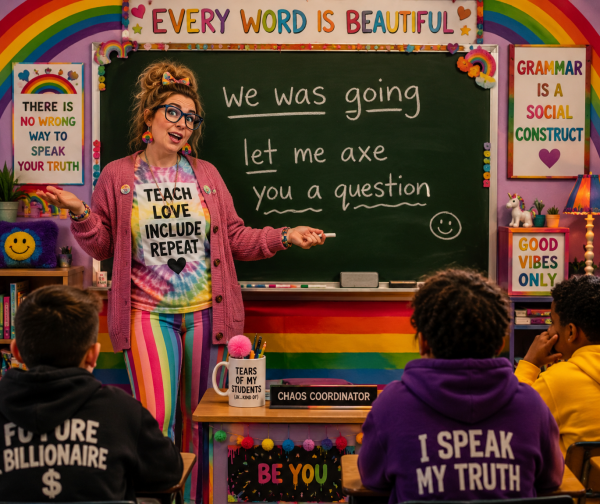
California has never met an educational experiment it didn’t want to hug, fund, expand, and eventually require. If there were Olympic medals for confusing cultural studies with core academics, Sacramento would have a trophy room the size of Yosemite.
The latest debate? Ethnic studies courses and proposals to spend classroom time teaching students about African American English—its history, grammar, and how society has viewed it. Supporters argue it’s about understanding language and culture. Fair enough. Understanding different dialects has legitimate academic value.
The question isn’t whether dialects exist.
The question is whether this is what schools should prioritize while reading scores, math proficiency, and basic literacy continue to struggle.
Somewhere along the way, education stopped asking, “How do we prepare kids to succeed?” and started asking, “How do we redefine success so nobody feels left behind?”
That’s a very different mission.
A common language isn’t oppression. It’s infrastructure.
America has welcomed immigrants speaking thousands of languages over nearly 250 years. Italians, Germans, Poles, Koreans, Vietnamese, Mexicans, Nigerians—you name it. The expectation wasn’t that they abandon their heritage. It was that everyone gained proficiency in Standard English so a welder from Detroit, a banker from New York, a rancher from Texas, and a Marine from California could all communicate without needing subtitles.
That’s not cultural erasure.
That’s civilization.
Instead, we’re drifting toward a philosophy that treats every standard as suspect.
Grammar? Oppressive.
Standardized testing? Biased.
Correcting writing? Harmful.
Pretty soon, spelling bees will be replaced with “orthographic self-expression festivals.”
The movie “Idiocracy” was supposed to be satire, not a policy brainstorming session.
The irony is almost painful. Wealthy parents aren’t telling elite prep schools to lower grammar standards. They’re still paying thousands of dollars for rigorous writing instruction, debate teams, Advanced Placement courses, and college essay coaching. The people with the most influence still understand something remarkably old-fashioned:
The language of opportunity still matters.
If your goal is to expand opportunity, you teach every student the language used in universities, courtrooms, boardrooms, scientific journals, military operations, and engineering firms. Then, by all means, teach them about regional dialects, history, and cultural identity.
That’s addition.
Replacing one with the other is subtraction.
Education should be a ladder, not a mirror. It shouldn’t merely reflect students back to themselves; it should equip them to climb somewhere they couldn’t reach before.
California often mistakes lowering the hurdle for raising the athlete.
And that’s the real concern.
Not that students might learn about language.
But that schools increasingly seem more interested in validating every starting point than ensuring every graduate reaches the same finish line.
When society starts confusing standards with discrimination, excellence slowly becomes optional.
History suggests that’s rarely how great civilizations are built.
But hey, at least everyone gets participation credit and a diploma.
If you enjoyed this article, then please REPOST or SHARE with others; encourage them to follow AFNN. If you’d like to become a citizen contributor for AFNN, contact us at managingeditor@afnn.us Help keep us ad-free by donating here.
Substack: American Free News Network Substack
Truth Social: @AFNN_USA
Facebook: https://m.facebook.com/afnnusa
Telegram: https://t.me/joinchat/2_-GAzcXmIRjODNh
Twitter: https://twitter.com/AfnnUsa
GETTR: https://gettr.com/user/AFNN_USA
CloutHub: @AFNN_USA