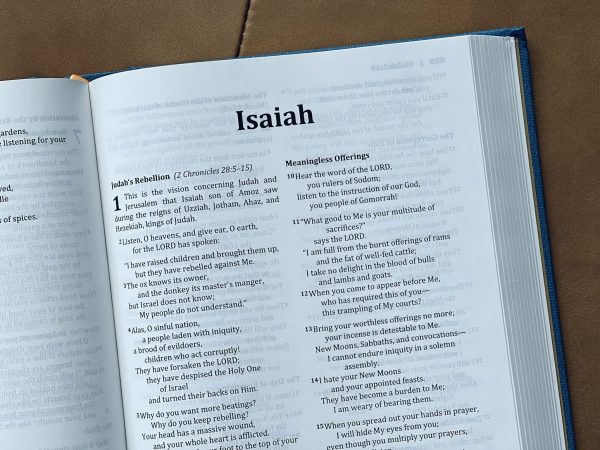
The headlines can feel relentless.
Conflict in the Middle East seems unending. We live in a post-9/11 world where threats feel constant, truth is debated, and morality often seems negotiable. Wars rage, leaders posture, and it doesn’t take much scrolling through the news to wonder if everything is coming apart.
Perhaps that is why this may be the perfect time to revisit the book of Isaiah.
If you’re looking for a light, comforting read, Isaiah probably isn’t your first choice. This Old Testament prophet does not offer a simple “love your neighbor and everything will work out” message. Isaiah does what prophets were called to do: he warns God’s people. He speaks hard truths about judgment, consequences, and the cost of turning away from God.
And Isaiah is long—sixty-six chapters of poetry, imagery, symbolism, and sometimes bewildering passages that leave modern readers scratching their heads. At first glance, it can feel like an endless parade of gloom and doom.
But if you stay with it long enough, something remarkable begins to emerge.
Isaiah points directly to Jesus Christ.
For that reason, many scholars call Isaiah “the Fifth Gospel.” Long before Bethlehem, Calvary, or the empty tomb, Isaiah described the coming Messiah with astonishing clarity:
“For to us a Child is born, to us a Son is given; and the government shall be upon His shoulder, and His name shall be called Wonderful Counselor, Mighty God, Everlasting Father, Prince of Peace” (Isaiah 9:6).
“Behold, the virgin shall conceive and bear a Son, and shall call His name Immanuel” (Isaiah 7:14).
“But He was pierced for our transgressions, He was crushed for our iniquities… and by His wounds we are healed” (Isaiah 53:5).
Many of the Bible’s most beloved verses come from Isaiah:
“Though your sins are like scarlet, they shall be as white as snow” (Isaiah 1:18).
“Arise, shine, for your light has come” (Isaiah 60:1).
“And I heard the voice of the Lord saying, ‘Whom shall I send, and who will go for us?’ Then I said, ‘Here am I. Send me!’” (Isaiah 6:8).
Isaiah himself lived a difficult life and likely died a brutal death. Christian tradition holds that he was the prophet referred to in Hebrews 11:37 as one who was “sawn in two.” His message was not popular, but it was faithful.
His central message was surprisingly simple:
“Cease to do evil, learn to do good” (Isaiah 1:16-17).
The people of Judah had turned away from God. Their worship continued, but their hearts were far from Him. They were spiritually blind, repeatedly unrepentant, and unwilling to listen.
Sound familiar?
Isaiah condemned corrupt leaders, dishonest judges, greedy landowners, and people who ignored suffering while pursuing their own comfort. One scholar summarized the headlines of Isaiah’s day as discriminatory laws, venal judges, irresponsible leaders, and self-indulgent people with power and wealth.
Have you read today’s headlines?
Isaiah captured this moral confusion with words that sound remarkably current:
“Woe to those who call evil good and good evil, who put darkness for light and light for darkness” (Isaiah 5:20).
What was once widely understood as right is questioned, and what was once clearly wrong is often defended or applauded.
Yet Isaiah does not end with judgment.
The structure of Isaiah itself tells the story. The first thirty-nine chapters contain warnings, judgment, and consequences. Then comes a dramatic shift beginning in chapter forty:
“Comfort, comfort my people, says your God” (Isaiah 40:1).
Suddenly the focus turns toward restoration, redemption, and hope.
Interestingly, Isaiah contains 66 chapters: 39 chapters of warning followed by 27 chapters of comfort and redemption. The Bible itself contains 66 books: 39 in the Old Testament and 27 in the New Testament. Whether intentional or providential, the parallel beautifully reflects God’s story—from law and judgment to grace and salvation through Christ.
Isaiah reminds us that God does not warn His people simply to condemn them. He warns in order to call them back.
Again and again Isaiah repeats God’s invitation: Listen.
Listen—not to the endless noise of culture, not to the outrage cycle of social media, not to the shifting opinions of the day—but to God.
The world may feel as though it is unraveling, but Isaiah reminds us that God is neither absent nor surprised. He is patient, but He is also just. He warns, but He also saves.
The question is not whether God is speaking.
The question is whether we are listening.
“Give ear and come to me; listen, that you may live.”
Isaiah 55:3
If you enjoyed this article, then please REPOST or SHARE with others; encourage them to follow AFNN. If you’d like to become a citizen contributor for AFNN, contact us at managingeditor@afnn.us Help keep us ad-free by donating here.
Substack: American Free News Network Substack
Truth Social: @AFNN_USA
Facebook: https://m.facebook.com/afnnusa
Telegram: https://t.me/joinchat/2_-GAzcXmIRjODNh
Twitter: https://twitter.com/AfnnUsa
GETTR: https://gettr.com/user/AFNN_USA
CloutHub: @AFNN_USA