Washington has a solution for everything: create another agency, another headquarters, another assistant deputy undersecretary for the Office of Coordinating the Office of Coordination. If bureaucracy actually stopped invasions, America would be the safest nation on Earth.
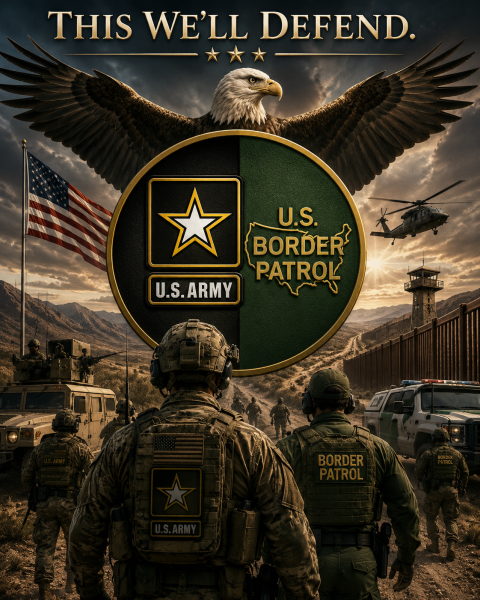
Retired Colonel Douglas MacGregor has proposed something that sends Beltway bureaucrats reaching for their smelling salts: put the U.S. Border Patrol under the Department of the Army.
The immediate response is predictable. “You can’t militarize the border!”
Funny. Nobody says we’ve “militarized Europe,” “militarized Korea,” or “militarized the Middle East” by stationing tens of thousands of soldiers there. But suggest the Army should play a permanent role in defending the one piece of real estate called the United States, and suddenly everyone forgets what the Army was created to do.
The Army exists to defend the nation.
Not to referee endless proxy wars.
Not to conduct PowerPoint diplomacy.
Not to spend decades rebuilding countries whose governments collapse faster than IKEA furniture.
The homeland should never become an afterthought.
Today, Border Patrol sits inside the Department of Homeland Security, a department born in the frantic months after 9/11. More than two decades later, it has grown into a sprawling bureaucracy with layers of headquarters, policy offices, contracting divisions, human resources staffs, IT departments, communications offices, strategic planners, and enough organizational charts to wallpaper the Pentagon.
Meanwhile, the Army already owns almost everything Border Patrol depends on.
Helicopters.
Drones.
Engineers.
Military intelligence.
Communications.
Cyber capabilities.
Logistics that can move an armored brigade across an ocean.
The only thing Washington somehow concluded it needed was… another bureaucracy.
Colonel MacGregor’s proposal isn’t about replacing Border Patrol agents with infantry squads conducting traffic stops. Border Patrol agents would remain trained law enforcement professionals enforcing immigration laws. The difference is that they would operate inside America’s largest and most capable homeland defense organization instead of beneath another cabinet department built on overlapping support structures.
The savings aren’t magic. No one is pretending every dollar currently spent on Border Patrol disappears. But every duplicate headquarters, contracting office, procurement system, legal staff, IT network, aviation support office, training bureaucracy, and administrative layer that can be consolidated is money no longer extracted from taxpayers to fund government managing government.
Washington has perfected perpetual expansion.
Consolidation has become a forgotten language.
The benefits become even stronger when you think about people instead of paperwork.
Imagine a young Army intelligence analyst spending several years tracking cartel networks along the southern border before returning to an operational Army unit with firsthand knowledge of transnational criminal organizations.
A drone operator transitions into border surveillance instead of leaving federal service altogether.
A combat engineer builds border infrastructure rather than searching LinkedIn for civilian employment.
A logistics officer rotates between Army sustainment commands and border operations, carrying hard-earned experience in both directions.
Instead of constantly recruiting, hiring, retraining, and rebuilding expertise from scratch, America develops one national security workforce capable of moving where the mission requires.
That’s called efficiency.
Government used to like that word.
The cartels certainly understand efficiency.
They coordinate across international borders. They employ drones, encrypted communications, tunnel systems, financial networks, cyber tools, and military-style tactics. They don’t care which federal agency’s logo appears on the letterhead.
Why should America’s defenders operate like disconnected franchises while criminal organizations operate like Fortune 500 companies?
Critics correctly point out that Congress would need to change existing law, including addressing the Posse Comitatus Act and clearly defining law-enforcement authorities. They’re right. Major reform requires legislation.
But legal complexity is not the same thing as strategic stupidity.
Congress rewrote the federal government after World War II.
It created the Department of Homeland Security after September 11.
It can reorganize again if the nation’s security demands it.
Perhaps that’s the biggest reason Colonel MacGregor’s proposal deserves serious discussion.
It forces Washington to answer an uncomfortable question.
If the Department of the Army exists to defend the United States, why has America convinced itself that defending America’s border is someone else’s job?
Sometimes the boldest reform isn’t creating another federal agency with another shiny logo and another headquarters full of deputy assistant undersecretaries.
Sometimes it’s taking one of the oldest institutions in the Republic, pointing toward the homeland, and saying, “Do the job you were created to do.”
If you enjoyed this article, then please REPOST or SHARE with others; encourage them to follow AFNN. If you’d like to become a citizen contributor for AFNN, contact us at managingeditor@afnn.us Help keep us ad-free by donating here.
Substack: American Free News Network Substack
Truth Social: @AFNN_USA
Facebook: https://m.facebook.com/afnnusa
Telegram: https://t.me/joinchat/2_-GAzcXmIRjODNh
Twitter: https://twitter.com/AfnnUsa
GETTR: https://gettr.com/user/AFNN_USA
CloutHub: @AFNN_USA