Reflections on principle and pragmatism, on the anniversary of the death of Secretary Hamilton
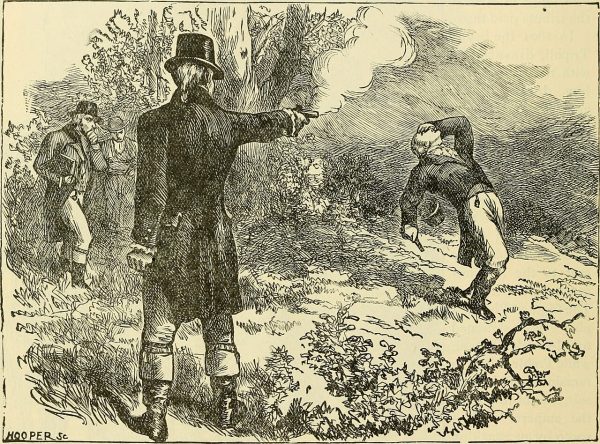
As dawn was breaking over the heights of Weehawken, New Jersey on July 11, two boats rowed across from Manhattan Island (such interviews as they planned were illegal in New York). The first to arrive was the Vice President and his second; twenty minutes later, the other boat brought the former Secretary of the Treasury and his second.
Once they had dispensed with the formalities, two of the most prominent men in America faced each other and fired. Struck in the abdomen, General Alexander Hamilton lay on the ground, to die in agony the following day. This indispensable, Founding Father left a rich legacy – the Federalist Papers, the victory at Yorktown, the Bank of New York, his guides for the New York bar exam, military procedure, and the Customs ports… and the American economic system he built almost from whole cloth, the masterpiece of his years as Treasury secretary.
The man who killed him left no such legacy. Aaron Burr served in the Revolutionary War, was a respected attorney, bon vivant, and politician, prominent in New York and federal politics, essentially tying in the contest for the presidency in 1800. But the events of July 11, 1804, near the end of his term as Vice President of the United States, brought his political career to an end. Having touched the pinnacle of American governance at 45, he spent his remaining thirty years as an outcast; his fall from grace dates from the day he killed his greatest rival.
For over 200 years, Americans have scratched their heads in wonder. After many chances to call off the duel with the sort of non-apology apology so commonplace today (“I’m sorry if what I said offended you; no hard feelings”), these two little giants went ahead with it. Hamilton aimed to miss, while Burr aimed to kill; both succeeded.
Americans should study Alexander Hamilton, for what he accomplished, for what he represented, for the fascinating story of his unbelievable rise from Caribbean orphan to founder of a nation (start with Brookhiser, then, your appetite whetted, move up to Chernow). But we should also study him for why and how he died, for it may be as great a lesson for us today as anything else we can learn from him.
By 1804, the great Hamilton had already made three of his four great mistakes (the fourth being his fatal duel), but he had already accomplished so much for his country by then that he appears to have come to the conclusion that even if he perished in the effort, ridding the nation of Aaron Burr would be worth it. But why did he hate Burr so much?
That’s the odd thing… he didn’t, at least, not at first. Hamilton had gotten along with Burr, privately, for decades. Not great buddies, but they had nevertheless worked together over the years. Serving together off and on during the War of Independence (Burr hadn’t fit in with General Washington’s staff, as Hamilton had, but he served honorably enough under other generals), they sometimes cooperated as joint counsels when practicing law in New York. Polite in person, Hamilton attacked Burr‘s character when apart, whenever politics arose as the subject. For 15 years, Hamilton had been singling out Aaron Burr as the most dangerous sort of politician: the one who didn’t have philosophical underpinnings for his positions.
It is difficult for us today to conceive of such horror as Hamilton felt in the rise of Aaron Burr. We are accustomed to politicians of all kinds – liberals, conservatives, and moderates, being vocal on a myriad of issues. We have people on either side of legalized abortion, the Fair tax, the middle eastern wars, the attempted destruction of Israel. We have people vocal on handguns, but silent on taxes, or vocal on the First amendment, but silent on the Tenth. And we have people silent on most.
Not then. In the Founding era, politicians may have been silent on some things, but they all had opinions on most – certainly on all of the major issues of the day. That was why they were involved in politics in the first place, after all: because they cared about issues. Maybe not every issue, but the big ones. All except for Aaron Burr.
Hamilton had other enemies. He disagreed with his principal rivals, Jefferson and Madison, on the size and scope of the federal government, on whether the government could or should operate a bank, on whether plantation agriculture or a mixed economy, featuring merchants and manufacturers, was best for the country.
But while he had such enemies, he respected their principles. To Hamilton’s mind, Thomas Jefferson and James Madison were the products of a corrupt and dated culture, who wrongly mistrusted merchants, bankers, and manufacturers. They were wrong on principle, not from malice, but from a simple lack of understanding how commerce works, a lack of appreciation for the city life so foreign to the largely barter-based hill country of the Old Dominion.
Not so with Burr.
Hamilton had no disagreement on Policy matters with Burr, because nobody knew where Burr stood on anything. Burr was just a politician, a survivor, the leopard that can indeed change his spots. He was open to either party in any election, devoid of any devotion to either the Federalists or the Jeffersonians. In an era of huge divisions, how on earth could a successful politician manage to get along without making known his positions on assumption, on the Bank, on the building of a navy, on the quasi-war, on so many other issues? Burr somehow managed, and even thrived.
Jefferson and Madison had opposed the Bank, for example, because they didn’t believe the government should be involved in banking; by all accounts, Burr voted against it in the Senate out of spite, without even the most rudimentary philosophical reasoning to justify his view.
Rather than failing politically as he should have, for refusing to take a stand on the issues of the day, Burr rose all the way to the vice presidency on charm and organizational ability. To the presidency itself, in fact; were it not for Hamilton‘s surprise endorsement of Jefferson over Burr when the battle wound up in the House of Representatives, Burr would most definitely have become president in 1800.
In Hamilton’s eyes, that made this chameleon terribly dangerous.
Hamilton believed that our nation could succeed with both people like himself and people like Jefferson trading office every cycle, because while they disagreed, they did so from principle. Burr would be dangerous because his stands were fluid and unpredictable. The voters would never know what they were getting if they elected him.
And what if he started a trend? What if Burr‘s success would encourage others like him, until America would someday be run by a majority of slick politicians who get elected on personality, then spin with the wind on every issue? No, Burr had to be stopped, in the hope that his line would stop. And Hamilton was the man to do it. Hamilton hoped to survive the day, but he was confident that even if he didn’t, his death would doom Burr’s career sufficiently to save the nation from him and his ilk, at least for a while.
And so it did. Burr was ruined by the (somewhat unfair) charge of “Murderer!” – he never again held public office, or even enjoyed much private respect either, in the 32 years left to him. In Hamilton‘s own eyes, therefore, Hamilton would not have died in vain.
For a long time, therefore, America enjoyed a politics of vigorous debate… and we enjoyed great prosperity in that era.
But then one day, we started accepting a new idea at election time: the idea that the intelligence, looks, and speaking ability of a candidate were enough, that the candidates’ positions on issues weren’t important, and might even be considered “extreme” – that a nice, caring, compassionate person was really what we needed, not some partisan advocate who harped on the Constitutionality of this or that, getting in the way of what the people really wanted or thought they needed at the time.
In the great ratification fight between the Federalists (who believed that the Constitution protected us well enough from overgrown government) and the Anti-federalists (who believed that it did not), it could be argued that the 19th century was proof that Hamilton was right, and the 20th century was proof that he was wrong. For it was only in the 20th century that we saw widespread elections of people who no longer felt in any way limited by the Constitution – the kind of politicians whom Hamilton feared most of all – the Aaron Burrs.
Consider the Supreme Court, which, since the advent of judicial review, is considered the final arbiter of constitutionality, the last defense of the people against unconstitutional, unlimited government. What do so many of today’s Senators ask our Supreme Court nominees? And what kind of answers do they accept?
Well, Senator Leahy (D, VT) asked Sonia Sotomayor “What are the qualities that a judge should possess?” and she responded. “keeping an open mind” and “making a decision that is limited to what the law says.” Not one person honestly thought that this bravely partisan leftist would ever keep an open mind; she would view every case through the prism of an activist leftist, and so she has in her time on the court, despite her false acknowledgments of the supremacy of the Constitution in her confirmation hearings.
And then the same occurred, memorably, shortly thereafter, in the Elena Kegan hearings, and in their aftermath. Senators asked whether she thought the televising court proceedings would have an impact, whether she was enjoying the hearings now that she was a participant, whether she sided with the Twilight series’ vampires or werewolves. And she responded just as lightly, as if the question of whether any issue is really the business of a limited government at all, or not, never had entered, nor would enter, her mind.
The villains of this tale aren’t the incompetent, unqualified, statist nominees themselves: if you get an appointment to a great job, you go for it; why not? The villains are the President who appoints them, the Senators who play along, the media who fail to respect the process and the real issues at the heart of the debate.
This is what Hamilton feared: that one day, if we ever allowed the slick, affable Burrs of the world a chance to populate our government, then we might lose the quality of debate entirely.
Given 50 Hamiltons and 50 Jeffersons, you have an honorable debate in a free country. Given 24 Hamiltons, 24 Jeffersons, and 52 Burrs, you have an unprincipled government and certain tyranny.
Hamilton and Jefferson both knew that you cannot allow a legislature to base their decisions on whether “it sounds like a good idea” or “it would help people” or “it’s for the children.” Practically every bill, viewed in a vacuum, may have good enough intentions to pass that test.
No, we needed a limited government – strictly and solidly limited, with enumerated powers – to act as a brake upon well-intentioned politicians who would plunge their nation deep into debt again, if given unlimited opportunity. The Constitution was to be that crucial limit, and all those in government – the President, the Congress, and the Court – were expected to act as the Constitution’s enforcers.
The Founders never dreamed that it would fall to the Supreme Court alone to enforce the limits of government; they believe that since all these branches take the oath, all would see this as among their principal duties.
They never would have imagined that we would see occasions like the one, early in the Bush II administration, when Congress passed, and the President signed, a campaign finance bill in blatant violation of the First Amendment, on the grounds that “we know it’s partially unconstitutional, but that’s okay, the Supreme Court will surely negate the unconstitutional parts.” The fact that the Supreme Court failed to do the job expected of them is bad enough, but if our politicians have indeed reach the point when they calmly, happily pass laws in violation of the Constitution, and therefore, of their oaths of office – leaving to others the enforcement of constitutional limits, or uncaring as to whether such enforcement ever occurs – then we are indeed in the grip of a government of Burrs, and worse.
This is what Hamilton envisioned, and feared, beyond all other threats: that our political class would diminish after the revolutionary generation was gone; that people would forget the reasons for the revolution and be swayed by charm and slick speeches. It took a long time to get here, but sure enough, here we are, ruled by the government Hamilton and his colleagues had worked so hard to forestall.
But there is yet a way out. This system allows us a new chance to remake our government every other November. It takes decades to remake the Court, six years to fully remake the Senate, just four for the Executive and a mere two for the House. If we learn our lessons well – not just the lessons of today the lessons that the tyrannical troikas of Obama, Pelosi, and Reid, and of Biden, Pelosi and Schumer, have taught us every day of their reigns, but also the lesson that Hamilton taught us over two centuries ago – then we can return to a limited government of statesman who respect those limits, and the nation will again be on the way to recovery.
Copyright 2010-2026 John F. Di Leo
This column originally appeared in Illinois Review, on July 11, 2010.
John F. Di Leo is a Chicagoland-based international transportation and trade compliance trainer, speaker, and consultant. His book on vote fraud (The Tales of Little Pavel), his political satires on the Biden-Harris administration (Evening Soup with Basement Joe, Volumes I, II, and III), his first nonfiction book, “Current Events and the Issues of Our Age,” and his brand new collection of stories about the heroes of the American Founding, “The Founding Generation: The Patriots Who Built America,” are all available in either eBook or paperback, only on Amazon. His trade compliance training practice is available either in person or by webinar.
If you enjoyed this article, then please REPOST or SHARE with others; encourage them to follow AFNN. If you’d like to become a citizen contributor for AFNN, contact us at managingeditor@afnn.us Help keep us ad-free by donating here.
Substack: American Free News Network Substack
Truth Social: @AFNN_USA
Facebook: https://m.facebook.com/afnnusa
Telegram: https://t.me/joinchat/2_-GAzcXmIRjODNh
Twitter: https://twitter.com/AfnnUsa
GETTR: https://gettr.com/user/AFNN_USA
CloutHub: @AFNN_USA