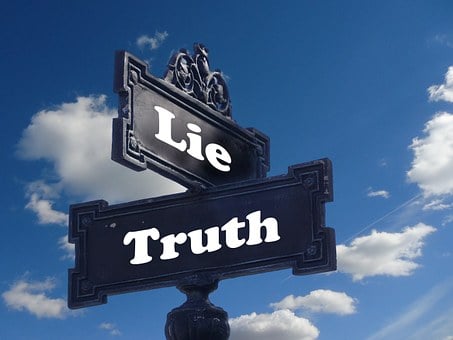

Do any of these sound familiar?
“Yes, Aunt Jean, your hair looks great!”
“No, honey, that dress does not make your butt look fat.”
“The boss just stepped out of the office.”
“I didn’t eat all the cookies, Mama.”
“And that fish? Oh, it was at least two feet long.”
Most of us smile because we’ve heard these before. Some of us smile because we’ve said them before.
As a former high school principal, one of the more common meetings in my office involved a student, a disappointed parent, and a story that somehow didn’t quite match the facts. After hearing the evidence, a parent would often say something like, “I asked Sally if she did that, and she swore she didn’t. My daughter doesn’t lie to me.”
I tried very hard not to roll my eyes. Instead, I usually responded with something along the lines of, “Well, Mom, that was your first mistake.”
The truth is that lying is one of the few sins that nearly everyone commits while simultaneously insisting that they don’t. We rename it. We soften it. We call it exaggeration, diplomacy, tact, sparing someone’s feelings, or simply being polite.
Steven J. Cole, in his lesson To Tell the Truth, cites a survey in which 91% of respondents admitted they lied regularly. The most common reason? Saving face. Nearly as many said they lied to avoid offending someone else.
That sounds familiar, doesn’t it?
We convince ourselves that a “white lie” isn’t really a lie because our intentions are good. Surely God doesn’t expect us to hurt people’s feelings. Surely omitting part of the truth isn’t the same as telling an outright falsehood.
Besides, even some of the heroes of Scripture had less-than-stellar moments in the honesty department.
Abraham wasn’t completely truthful about Sarah being his wife (Genesis 12:11-13). Sarah laughed and then denied laughing when confronted by God Himself (Genesis 18:11-15). Peter, in one of the most heartbreaking scenes in the Gospels, denied even knowing Jesus—not once, but three times (Luke 22:54-62).
Perhaps we read those stories and conclude that a little dishonesty isn’t such a big deal.
But brothers and sisters, if we’re not careful, we end up creating our own version of fake news.
Deep down, most of us know lying is wrong. Many of us learned that in Sunday School before we could spell the word “commandment.” The Eighth Commandment says plainly, “You shall not bear false witness against your neighbor” (Exodus 20:16).
Scripture doesn’t leave much wiggle room.
“Do not lie to each other, since you have taken off your old self with its practices” (Colossians 3:9).
“Keep your tongue from evil and your lips from telling lies” (Psalm 34:13).
“A false witness will not go unpunished” (Proverbs 19:9).
Fortunately, the Bible doesn’t simply tell us what not to do. It also tells us what we should do instead.
“The Lord detests lying lips, but He delights in people who are trustworthy” (Proverbs 12:22).
“Speak the truth to each other” (Zechariah 8:16).
And perhaps most importantly: “Speak the truth in love” (Ephesians 4:15).
There it is—the difficult part isn’t simply telling the truth. It’s telling the truth lovingly.
The danger of half-truths goes all the way back to the Garden of Eden. Satan didn’t begin with an outrageous lie that Eve would immediately reject. He started with something much more effective: a distortion.
Yes, her eyes would be opened.
Yes, she would know good and evil.
But the serpent conveniently left out the part about sin, separation, and death.
As writer Eddie Foster observes, Eve’s new knowledge did not make her like God. Instead, it opened the door for humanity to embrace Satan’s way of thinking rather than God’s.
Maybe that’s the real question behind every lie, every exaggeration, and every carefully edited version of the truth:
Whose character are we reflecting?
God is truth. Satan is called the father of lies.
Those are our choices.
Of course, speaking truthfully doesn’t mean saying every thought that pops into our heads. Ephesians doesn’t tell us to speak the truth harshly, bluntly, or with the enthusiasm of a wrecking ball. It tells us to speak the truth in love.
Sometimes that means asking, “How would I want someone to say this to me?”
Sometimes it means choosing gentleness.
And sometimes it means saying, “I’m not free to discuss that matter,” rather than betraying a confidence or sharing information that isn’t ours to share.
Wisdom and honesty are not enemies.
Neither are truth and kindness.
As for me, I need to include a rather large disclaimer. Hi, my name is Teresa, and I have been guilty of lying, exaggerating, omitting details, and occasionally describing fish that were larger than they actually were.
Thankfully, I also know something else to be true.
God forgives liars. And thank God, literally, for that.
If you enjoyed this article, then please REPOST or SHARE with others; encourage them to follow AFNN. If you’d like to become a citizen contributor for AFNN, contact us at managingeditor@afnn.us Help keep us ad-free by donating here.
Substack: American Free News Network Substack
Truth Social: @AFNN_USA
Facebook: https://m.facebook.com/afnnusa
Telegram: https://t.me/joinchat/2_-GAzcXmIRjODNh
Twitter: https://twitter.com/AfnnUsa
GETTR: https://gettr.com/user/AFNN_USA
CloutHub: @AFNN_USA