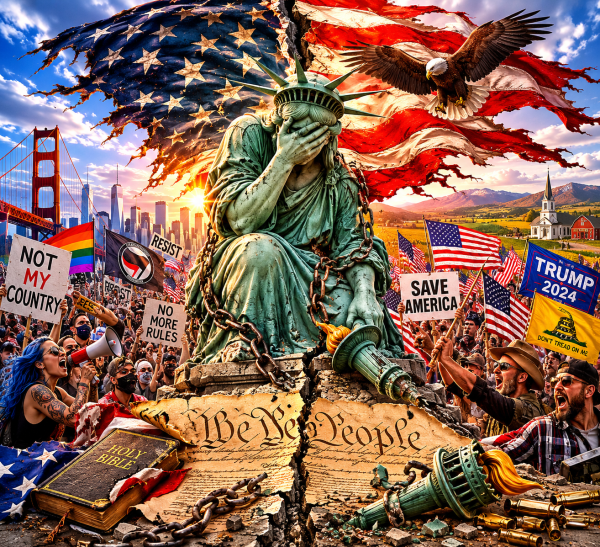
Civilizations don’t usually collapse with a Hollywood soundtrack. They don’t announce their intentions with trumpets and banners. More often, they rot quietly from the inside until one day everyone looks around and wonders how the impossible became the evening news.
Americans like to think we’re different. We have a Constitution, elections, courts, a professional military, and over two centuries of relatively peaceful transfers of power. Those are extraordinary strengths. But history has an uncomfortable habit of reminding every generation that no nation is exempt from human nature.
Yugoslavia wasn’t supposed to implode.
Rwanda wasn’t supposed to implode.
Lebanon wasn’t supposed to implode.
Ask someone who lived there ten years before the shooting started whether they believed neighbors would eventually kill neighbors. Students would kill their teachers. Most would have laughed at the suggestion. Civilization feels permanent—right up until it isn’t.
The frightening lesson from the Balkans wasn’t simply that war occurred. It was how normal life unraveled once enough people stopped believing the system was legitimate.
History suggests that legitimacy is the true center of gravity. Governments survive criticism. They survive protests. They even survive corruption. What they struggle to survive is a critical mass of citizens concluding that elections no longer matter, courts no longer referee fairly, and the opposing political faction isn’t merely wrong but fundamentally illegitimate.
That’s where democracies enter dangerous territory.
Today, Americans increasingly inhabit separate realities. Two people can watch the same event and emerge convinced they witnessed entirely different histories. Social media rewards outrage. Cable news rewards fear. AI can manufacture convincing images and videos. Every controversy instantly spawns competing narratives, each amplified by an army of influencers eager to monetize division.
It’s hard to compromise when both sides believe they’re defending democracy from the people trying to destroy it.
Political scientists have warned for years that affective polarization—the tendency to dislike and distrust the opposing party as people, not just disagree with their policies—has risen dramatically. That doesn’t mean violence is inevitable. It does mean the emotional barriers against it become weaker.
History teaches another sobering lesson: civil conflict rarely begins with two neatly organized armies wearing matching uniforms.
Instead, legitimacy fractures first.
Local governments begin resisting national directives. Citizens organize around identity instead of institutions. Trust migrates from constitutions to personalities. Every legal ruling is dismissed as partisan by someone. Every election result is questioned by someone else. Every institution becomes suspect.
Eventually, people stop asking, “What does the law say?”
They begin asking, “Whose law?”
That question has haunted collapsing societies for centuries.
The wars that shattered Yugoslavia weren’t simply military failures. They were failures of shared identity. Once neighbors stopped seeing each other as fellow citizens and began seeing each other primarily as members of competing tribes, atrocities that once seemed unimaginable became possible.
Rwanda demonstrated a different but equally chilling truth: propaganda and dehumanization can accelerate societal collapse with horrifying speed when institutions fail.
America is not Yugoslavia. America is not Rwanda.
The differences matter. Our federal system disperses power. Our economy is larger and more resilient. Our military has a deeply ingrained tradition of remaining subordinate to constitutional civilian authority rather than partisan politics. Those are powerful stabilizing features.
But history also cautions against complacency. Stable societies often appear strongest just before they discover how much of their stability depended on mutual confidence rather than written laws alone.
Perhaps the greatest danger isn’t that Americans disagree.
We’ve always disagreed.
The danger is when disagreement evolves into the belief that defeat at the ballot box is indistinguishable from national extinction.
That’s a mindset that leaves little room for compromise.
The old saying is that civilization is only a thin veneer over human nature. Whether that’s entirely true is debatable. But history repeatedly demonstrates that institutions require continual public trust and reinforcement. When enough people abandon the belief that constitutional processes are a fair way to settle disputes, the path back becomes far steeper.
None of this means America is destined for internal conflict. Democracies have weathered periods of extraordinary tension before. The United States itself survived the turmoil of the 1960s and 1970s without descending into nationwide civil war.
History is not prophecy.
It is, however, a warning label.
The most dangerous assumption any civilization can make is believing collapse is something that happens only to other people.
The Balkans thought that.
Lebanon thought that.
Rwanda thought that.
History’s most unsettling lesson is not that civilization is fragile.
It’s that nearly every civilization believed it was stronger than it really was—until the day it found out otherwise.
If you enjoyed this article, then please REPOST or SHARE with others; encourage them to follow AFNN. If you’d like to become a citizen contributor for AFNN, contact us at managingeditor@afnn.us Help keep us ad-free by donating here.
Substack: American Free News Network Substack
Truth Social: @AFNN_USA
Facebook: https://m.facebook.com/afnnusa
Telegram: https://t.me/joinchat/2_-GAzcXmIRjODNh
Twitter: https://twitter.com/AfnnUsa
GETTR: https://gettr.com/user/AFNN_USA
CloutHub: @AFNN_USA