Why do we use investment advisors?
Why do people who are perfectly competent in their own specialties – as doctors or dentists, architects or Customs brokers, chefs or entrepreneurs – still hire someone else to manage their retirement funds and other investments?
Because no matter how talented and intelligent we may be in our own professions, most of us are amateurs at the complicated world of stocks, bonds, commodities, and other investment vehicles. And our retirement funds and other investments are too important to us to entrust to someone who is an amateur in that world. Even if we pay a couple percent of our profit in fees to a respected professional, it’s worth it because of how superior we expect our money’s growth to be in his hands.
This is all the more important when we consider the level of risk in the investment world today. We’ve all read about the corrupt investment schemes that have enveloped, and even bankrupted, famous people who should have known better, from the original Charles Ponzi himself to more recent con men like Bernie Madoff and Sam Bankman-Fried.
We don’t want to join that club of con artists’ marks, so we hire advisors with the resources and experience to build safe strategies and steer clear of the con men.
And it’s the same with government.
The more land, people, resources, and funds for which a government is responsible, the more the risk.
We entrust our governments to look out for many aspects of our security, our financial well-being, and our standard of living. We count on local, state, and national governments, in different ways, to build our roads, bridges, and schools, to defend our borders and neighborhoods with armies and police, and to do a thousand other things for us. We pay them taxes to cover the cost, and we leave the management of these constitutional duties (and sometimes unconstitutional ones too) to our elected officials and the bureaucrats they select.
But no matter how big a government you have, it can never have so many of the right people, with the right professions at the right time, to do all this themselves, as well as they need to. So we expect them to hire outsiders too – construction companies to build the roads, I.T. consultants to build security into the systems infrastructure, university researchers to develop the munitions, and a thousand other types of expertise as well.
All this outsourcing increases the odds that shady characters will get into the bidding process, and the smaller the government, the greater the risk that con men and crooks will permeate the firewall, endangering everyone.
And this brings us to Greenland.
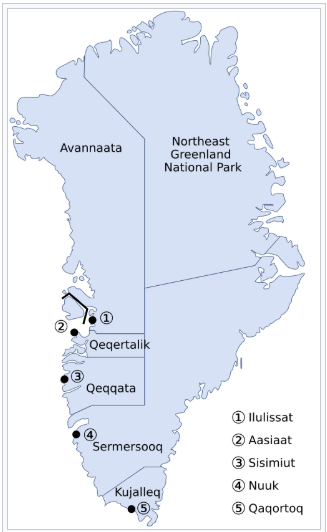
Greenland is a small country in population and GDP, a large country in natural resources and geography (the world’s 11th largest by acreage), and an incredibly significant country in terms of location.
Greenland is blessed with rare earths (certain minerals and ores, some of which are actually plentiful, but very labor-intensive and cost-intensive to mine and process). Just as petroleum was around forever, but only became valuable in the late 19th century because of technology, rare earths too have been around forever, but only started to become valuable in the 20th century.
Now, all of a sudden, practically every modern motor, power source, or appliance is dependent on rare earths like lithium, neodymium, and uranium, and Greenland has them in spades. Greenland is, in fact, the second largest potential source of many rare earths after China.
Then there’s transportation. If the world were flat, the most direct route between the USA and Europe would be directly across the Atlantic, and the most direct route between the USA and Asia would be directly across the Pacific.
But the world isn’t flat. Due to the curvature of the earth, many of the most direct routes across the northern hemisphere go through, or even across, the Arctic circle. Far too dangerous a route to be considered even a century ago, again, technology has changed the environment so that trans-Arctic shipping is now somewhat practical, and will likely become even more so, as ships and planes are ever better able to handle Arctic conditions. Greenland’s position as a potential transportation hub and refueling location grows every year.
Consider military positioning. A major enemy of the west for most of the past century has been Russia, and Russia sits in much of the Arctic circle. The nations with territorial presence within the Arctic circle are the United States (because of Alaska), Canada, Greenland, Norway, and Russia. Iceland too, if you count the tippie-toes of its northern glacier. Of these countries – no insult intended – which of them can stand up to a Russian attack? Which could defend not only itself, but also everyone in the path, if Russia were to use the Arctic as one of its attack routes, in case of a war? (not to say that Russia is expected to start a major war, but it’s always possible with Russia, and dissuading them from attacking is always a better choice than having to defend against an attack you’ve allowed/encouraged them to start, as Europe is learning from the Ukraine conflict).
Finally, we have the biggest enemy nation on the planet, the one that has focused all of its energy over the past few decades on accumulating both willing and unknowing client states all over the world, through a combination of its money, its manufacturing dominance, and its Belt and Road Initiative. China has convinced dozens and dozens of countries all over the world to hire China to build or rebuild their ports, their railroads, their bridges, their power stations, usually on terms that make it impossible to pay back so China is able to use the old mob approach of just taking over the operation when the client defaults. As a result, China has a foothold – economic, population, and military – in dozens of countries, on every continent except Antarctica.
It may not be particularly dangerous to the security of the world that China runs ports in Angola, Djibouti, or Thailand. Maybe it is, maybe not. But it’s certainly dangerous that China runs ports in Kuwait, Israel, and Greece; these and many more are key points in global commerce. And it’s certainly dangerous that China controls ports in Australia, Thailand, South Korea and the Philippines. In case of a war between China and Taiwan, these are the countries we would expect to support Taiwan; how will they do that if China can shut down their major seaports?
Since the turn of the millenium, the Chinese have engaged in a quiet and diverse program of interest in Greenland, bidding on multiple projects, only occasionally being stymied by Danish or American pressure. Some of China’s mining activities in Greenland, having been welcomed in by the Greenland government, failed because China didn’t do them successfully. They weren’t stopped by anyone at all, it is only due to China’s bad luck (and therefore good luck for the rest of the world) that China’s footprint in Greenland isn’t already much larger than it is.
The kinds of people who like to minimize President Trump’s concerns tend to stress the fact that Chinese efforts were stopped, perhaps hoping readers won’t notice that in order for an effort to be stopped, it first had to be attempted.
The evidence is therefore that China has indeed been interested in Greenland, for military reasons, for rare earth reasons, and for its general global footprint reasons, for a long time, and that Greenland has often welcomed China’s interest, requiring Denmark and the United States to be the adult in the room and say No. And with China’s ongoing efforts to add to the importance of its own rare earths, we know – without a doubt – that they will continue to try to control the competing rare earths of other countries as well.
Now, back to where we began: When the most important things to you, and to those who depend on you, are areas outside your specialty, you need to hire professionals. You need to outsource.
Just as the worker looks for a professional investment advisor to handle his retirement fund, and just as the local police station hires expert software engineers to manage its I.T. security, a government as small as Greenland’s needs to hire the services of a competent outsider to protect its own internal agencies from making dangerous deals and allowing the enemy’s nose under the tent.
The population of Greenland is about 57,000 people.
Yes, you read that right.
That’s not just smaller than most countries, it’s less than a tenth the size of the USA’s smallest state (Wyoming, at 580,000). In my area of northwest suburban Chicagoland, it’s smaller than most of our towns and villages.
Would we entrust the village boards or city councils of our local towns with the security of the entire country – both economic and military – with our aldermen and mayors?
Well, leaving Greenland’s security up to Greenland’s government is the equivalent of leaving the security of the Northern Hemisphere up to a local township chairman or city councilman.
This is not an insult. No offense intended. But no matter how smart, dedicated, and wise such people may be, Greenland as a country plays too monumental a role in the world today, for Greenland alone to be granting building licenses, development deals, and public-private partnerships with foreign countries more than 10,000 times bigger than they are. They need help.
The new security supervisory deal between the United States, Denmark, and Greenland will do more to secure the economic and military safety of Western Civilization than most treaties, initiatives, or wars in the past few generations.
By the United States now having, essentially, an absolute veto over foreign meddling in Greenland, we can protect not only Greenland, but the free societies of the West, from the con men of the world who could otherwise take advantage of gullible, well-intentioned, but ultimately insufficiently cautious local stewards.
And the mainstream media, naturally, are denouncing this deal as either bullying or unnecessary, which only goes to show that the press is every bit as much of a gullible mark as many governments are.
Copyright 2026 John F. Di Leo
John F. Di Leo is a Chicagoland-based international transportation and trade compliance trainer, speaker, and consultant. His book on vote fraud (The Tales of Little Pavel), his political satires on the Biden-Harris administration (Evening Soup with Basement Joe, Volumes I, II, and III), his first nonfiction book, “Current Events and the Issues of Our Age,” and his brand new collection of stories about the heroes of the American Founding, “The Founding Generation: The Patriots Who Built America,” are all available in either eBook or paperback, only on Amazon. His trade compliance training practice is available either in person or by webinar. And as a member of the Chicagoland theatre community, his next performance will be as Archie in Brigadoon from October 3 through 18, 2026.
If you enjoyed this article, then please REPOST or SHARE with others; encourage them to follow AFNN. If you’d like to become a citizen contributor for AFNN, contact us at managingeditor@afnn.us Help keep us ad-free by donating here.
Substack: American Free News Network Substack
Truth Social: @AFNN_USA
Facebook: https://m.facebook.com/afnnusa
Telegram: https://t.me/joinchat/2_-GAzcXmIRjODNh
Twitter: https://twitter.com/AfnnUsa
GETTR: https://gettr.com/user/AFNN_USA
CloutHub: @AFNN_USA