
I spent almost 10 years of my journalistic career covering Japan—a place long considered inscrutable by Westerners, even though today’s decidedly Westernized Japan is about as inscrutable as Iowa.
During those years, I watched Japanese leaders wrestle with a foreign policy hamstrung by a constitution that essentially prohibits war as an option for failed diplomacy.
It was no accident, therefore, that Japan’s American conquerors effectively co-wrote the Japanese constitution along with handpicked Japanese representatives not long after World War II ended. In their minds, Japan failed to fully democratize itself after the Meiji Restoration of 1868, which shifted the nation from a feudal society into a modern industrial state. Instead, militarists effectively transformed Japan into a military junta.
That must never happen again, they insisted.
To understand how deeply ingrained that constitutional straitjacket was, one must look back at the historical momentum the Americans were trying to reverse. Here is a quick flyover of recent Japanese history:
During the late 19th and early 20th centuries, Japan’s expansionist militarist leaders feared Western powers would try to colonize the country. Under their leadership, Japan turned rapidly into a military power. Japan’s victories in the First Sino-Japanese War (1894-95) and the Russo-Japanese War (1904-05) bolstered national confidence and sparked imperial ambitions. These military successes demonstrated that an Asian nation could defeat a Western power, fueling Japanese nationalism and further expansion.
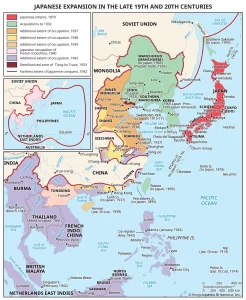
Under its policy of establishing a pan-Asian “Greater East Asia Co-Prosperity Sphere” (Dai Tōa Kyōeiken) in the 1930s, Japan launched annexations and military strikes against neighboring nations such as Korea, China, Hong Kong, British Malaya, French Indochina, Singapore, the Philippines, and Indonesia, aiming to drive Western colonial powers out of Asia while asserting that the Japanese people (the superior Yamato race) had a special destiny to lead Asia.
That ambition ended when the United States dropped atomic bombs on Hiroshima and Nagasaki in August 1945, ending World War II in the Pacific. In 1947, American and Japanese authorities penned a new constitution that renounced war. The Americans wanted to ensure Japan never returned to the aggressive military power it once was while disabusing the Japanese of their supposed racial superiority.
As Supreme Commander of the Allied Powers, General Douglas MacArthur wielded immense authority over the document, shaping a constitution that emphasized democratic values, human rights, and the separation of powers. He wanted Japan to morph into a fully democratic nation that could live with its Asian neighbors without attempting to subjugate them.
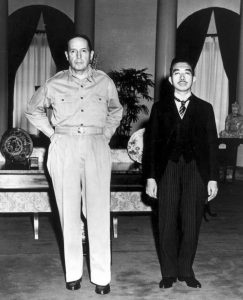
It worked. Since the end of World War II more than 80 years ago, Japan has become an economic powerhouse while remaining at peace with itself and its neighbors. A primary reason for that position has been Article 9 of the Japanese constitution, which renounces war as a sovereign right and prohibits maintaining military forces.
Article 9 has had a profound and enduring impact on Japanese society. Its inclusion in the constitution created a unique pacifist identity for Japan, emphasizing peaceful coexistence and prioritizing diplomacy over military aggression. Often called the “Peace Clause,” the provision has guided Japan’s foreign policy and approach to international conflicts.
The official English translation of Article 9 says: “Aspiring sincerely to an international peace based on justice and order, the Japanese people forever renounce war as a sovereign right of the nation and the threat or use of force as means of settling international disputes.
To accomplish the aim of the preceding paragraph, land, sea, and air forces, as well as other war potential, will never be maintained. The right of belligerency of the state will not be recognized.”
Until recently, there was no reason to think Japan wouldn’t remain that same peace-loving, anti-war nation that has abided by Article 9 since 1947.
But in global politics and diplomacy, nothing is static—not even in a nation whose standard foreign policy is often characterized as “checkbook diplomacy.” For decades, Japan’s foreign policy strategy has relied primarily on financial aid, economic assistance, and funding—rather than military forces or direct boots-on-the-ground presence—to fulfill its international obligations and influence geopolitics.
For decades, that monetary buffer allowed Tokyo to keep its head down. But in today’s East Asia—where Chinese warships regularly circle Japan’s Senkaku Islands and Beijing’s rhetoric around Taiwan grows increasingly belligerent—the checkbook has run out of currency.
Throughout the late 20th century, Japan consistently ranked as the world’s top provider of Official Development Assistance (ODA). In the 1970s and 1980s, Japan poured billions in low-interest yen loans and grants into nations like Indonesia, Vietnam, Thailand, and the Philippines to build ports, bridges, and power grids. The country consistently provided non-military financial aid to the Palestinian Authority, Jordan, and Egypt to foster regional stability without joining regional security alliances.
However, a critical defining moment in this strategy was the 1990-1991 Persian Gulf War during which the United States led a multinational coalition to liberate Kuwait. Because of Article 9 and intense domestic political resistance, Tokyo could not send any Self-Defense Forces (SDF) to join the military campaign.
Instead of sending personnel, Japan provided about $13 billion to fund the coalition’s military efforts and support frontline states affected by the war (such as Egypt, Jordan, and Turkey). Despite contributing a massive financial share—funded partly by a temporary tax hike on its own citizens—Japan faced widespread international criticism for practicing “checkbook diplomacy.” When the government of Kuwait ran a full-page thank-you ad in The New York Times acknowledging the nations that aided its liberation, Japan was famously omitted because it had sent no personnel.
This trauma deeply reshaped Japanese foreign policy, eventually leading to the passage of the 1992 Peacekeeping Operations (PKO) Law, allowing non-combat overseas dispatches for UN missions.
Today, checkbook diplomacy is giving way to deliberate strategic engagement. The Japanese people have mixed views on Article 9. Some appreciate the presence of American forces in Japan, seeing them as a safeguard against threats from neighboring countries. They believe that Article 9 and the security alliance with the United States provide protection and stability.
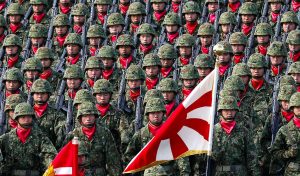
However, a growing majority advocate for revising or even abolishing Article 9, arguing that it restricts Japan’s ability to defend itself and contributes to an overreliance on the United States for security.
I am not at all surprised by that attitude. During my time in Japan, I watched the nation adopt a more assertive posture on the world stage, primarily in response to increasing Chinese aggression. At the same time, Tokyo has had to walk a careful balancing act in its relations with Beijing and Washington, depending heavily on the former for trade and the latter for defense. Japan is also grappling with internal challenges, from an aging population to a decline in innovative technological breakthroughs.
So here we are today, some eight decades after Pearl Harbor and Hiroshima, and Japan has, somewhat reluctantly, at long last begun to reassert itself on the world stage.
Confronted by China’s rapid military expansion, North Korea’s relentless missile testing, and deepening Sino-Russian security coordination, Tokyo has undertaken its most radical military transformation since World War II.
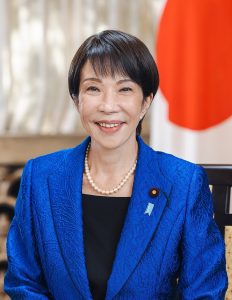
When Sanae Takaichi assumed office a year ago as the country’s first female prime minister, she already had earned a reputation for taking a harder line than her predecessors. The BBC labeled her “a staunch conservative and admirer of the late former British PM Margaret Thatcher” and noted that “she is seen as hawkish when it comes to an increasingly powerful China.”
Some examples of this new diplomatic stance include Japan’s active Support for Ukraine. Deviating sharply from its traditional stance on international conflicts, Tokyo has imposed strict sanctions on Russia and provided billions in financial and non-lethal military aid to Kyiv. This signals a fundamental shift: Japan now views security in Europe and security in the Indo-Pacific as inextricably linked.
Japan has also anchored itself within expanded regional security arrangements, including the Quad (US, Japan, India, Australia) and the Trilateral Camp David partnership with the US and South Korea.
Through the GCAP (Global Combat Air Program) alongside the UK and Italy, Japan is co-developing its next-generation fighter jet, rolling back decades-old self-imposed bans on military hardware exports and joint defense R&D.
Since taking office in October 2025, Takaichi—a long-time protege of Shinzo Abe—has lived up to her hawkish reputation. She has been vocal about Taiwan’s security being directly tied to Japan’s survival, openly discussing contingency scenarios and pushing for closer bilateral coordination with Taipei.
Unlike some of her moderate predecessors who favored incremental defense tweaks, Takaichi has continually advocated formally amending Article 9 to explicitly acknowledge the Japanese Self-Defense Forces (JSDF) in the Constitution. Leveraging her prior stint as Minister for Economic Security, she has tightened regulations on semiconductor exports and critical tech transfers to China, prioritizing supply chain resilience over short-term trade convenience.
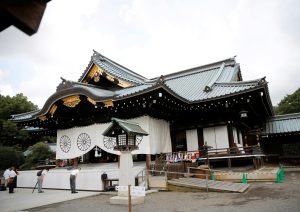
Takaichi’s past visits to the controversial Yasukuni Shinto Shrine, where Japan’s 2.5 million war dead and Class-A war criminals are enshrined, and her controversial positions on Japan’s checkered past tend to reinforce her standing as an unabashed ideological nationalist, rather than just a pragmatic defense strategist.
Reactions across Asia to Takaichi and Japan’s aggressive foreign policy have been mixed. Nations that once loathed Japan for its bellicose behavior during World War II now want Japan to take a more active role in Asian affairs as a buffer against China.
South Korea, historically the most vocal critic of Japanese rearmament alongside China, has significantly softened its posture over the past decade. Shared threat perceptions regarding North Korea and China have led Seoul to prioritize bilateral intelligence sharing and trilateral defense pacts over historical grievances.
Rather than fearing a remilitarized Japan, many Southeast Asian nations (such as the Philippines, Vietnam, and Malaysia) actively welcome Japan’s military presence. They view Japan as a reliable, non-coercive counterweight to Chinese territorial incursions in the South China Sea and have eagerly accepted Japanese patrol vessels and military radar systems.
China, on the other hand, routinely accuses Tokyo of reviving “militarism” and violating the post-WWII international order. China uses Japan’s defense buildup to justify its own aggressive naval presence around the Senkaku Islands and inside Japan’s Exclusive Economic Zone (EEZ).
Beijing insists that the JSDF today bears little resemblance to the strict territorial force of past decades.
For example, under its 2022 National Security Strategy, Japan made a major doctrinal shift by acquiring stand-off weapons, including Tomahawk cruise missiles, that could be used to strike enemy launch sites preemptively when an attack is imminent—a capability long considered taboo under Article 9.
The JSDF converted its Izumo-class helicopter destroyers into light aircraft carriers capable of operating F-35B stealth fighters with short takeoff and vertical landing.
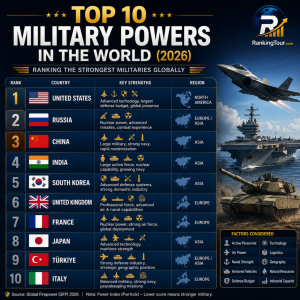
Tokyo has also pledged to double its defense spending to 2% of GDP, bringing Japan in line with NATO standards and making its defense budget the world’s eighth-largest.
Most concerning to Beijing has been Japan’s response to its pressure over Taiwan and the Senkaku Islands (Diaoyu). Japan has fortified its Ryukyu arc with anti-ship and air-defense missile units—a move China views as excessively belligerent.
Predictably, Beijing has reacted with fierce opposition to Japan’s intensified remilitarization. Chinese Defense Ministry spokespersons and official commentaries in the People’s Liberation Army Daily have accused Tokyo of stripping away its pacifist pretense and leaping toward “first-strike capabilities” under the guise of counterstrike defense.
For its part, Japan views its new proactive foreign policy as a critical counterweight to China’s rapid expansion via the Belt and Road Initiative. In effect, Japan’s approach has shifted from passive checkbook diplomacy to strategic economic statecraft.
Japan—often in partnership with the Asian Development Bank—offers high-quality, long-term infrastructure funding (“quality infrastructure”) to countries like Vietnam, India, and Sri Lanka. The goal is not strictly to buy a client state, but to offer a transparent alternative to Chinese debt and maintain a “Free and Open Indo-Pacific.”
Today, Japan has largely moved past pure checkbook diplomacy. Tokyo actively provides maritime security assistance (such as donating patrol vessels to the Philippines and Vietnam), conducts joint military exercises, and engages in bilateral security agreements. Financial infrastructure aid remains a core pillar, but it is now closely integrated with regional security partnerships rather than substituting for them.
As someone who has watched Japan for decades—from the heady heights of its economic boom to the long, frustrating years of constitutional paralysis—it is striking to see a nation so famously risk-averse finally turn the page. The pacifism hardwired into Japan’s postwar DNA was never just a constitutional mandate; it was deeply ingrained in its national identity.
Yet, as Beijing’s shadow lengthens across the Indo-Pacific and Washington demands more from its regional allies, Tokyo has come to a stark realization: in the unforgiving realm of 21st-century geopolitics, a checkbook is no longer a shield.
Whether led by unapologetic hawks like Prime Minister Takaichi or more traditional consensus-builders, Japan can no longer afford passive diplomacy. The path ahead will be tense. Managing a delicate economic tightrope with China while relying on an increasingly unpredictable United States for defense—all against the backdrop of a shrinking domestic workforce and fading tech dominance—will test Japanese leadership as never before.
But eight decades after the ashes of 1945, the era of the quiet reluctant giant is over. Japan has stepped back onto the world stage, not out of imperial ambition, but out of sheer survival.
–30–
(Ronald E. Yates is a U.S. Army veteran, an author, a former Chicago Tribune foreign correspondent, and Professor and Dean Emeritus of Journalism at the University of Illinois.)
His website: http://www.ronaldyatesbooks.com/
If you enjoyed this article, then please REPOST or SHARE with others; encourage them to follow AFNN. If you’d like to become a citizen contributor for AFNN, contact us at managingeditor@afnn.us Help keep us ad-free by donating here.
Substack: American Free News Network Substack
Truth Social: @AFNN_USA
Facebook: https://m.facebook.com/afnnusa
Telegram: https://t.me/joinchat/2_-GAzcXmIRjODNh
Twitter: https://twitter.com/AfnnUsa
GETTR: https://gettr.com/user/AFNN_USA
CloutHub: @AFNN_USA