Co-Pilot & guest writer Mike Ford
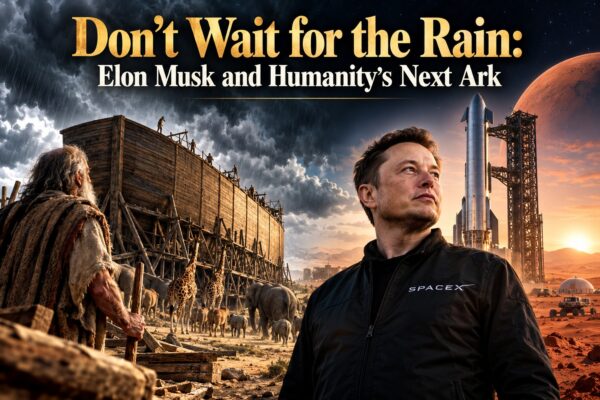
Imagine watching an old man build a gigantic ship because he believed someday everyone was going to need one.
You’d probably think he was nutz!
Genesis calls that man Noah.
Now we’re watching another eccentric guy build gigantic spacecraft because he believes humanity eventually needs to get off this rock.
His name is Elon Musk. May have heard of him.
No, Elon isn’t Noah. This isn’t Sunday school, and I’m certainly not nominating Musk for sainthood. It’s a thought experiment. But the parallel is interesting.
The best time to build an ark is before you need one.
And if anyone on Earth can afford to build one, it’s Musk.
He’s become the richest man on the planet. At some point, another billion dollars probably doesn’t materially improve breakfast. So what do you do when you already have more money than any reasonable human being could spend?
Apparently, you build rockets.
There are worse hobbies.
Whatever you think about Musk personally, he has poured enormous resources into rockets, satellites, spacecraft, human cyborgs and engineering, all toward his stated goal of making humanity multiplanetary. I can’t know the man’s motives, but he certainly doesn’t appear to need another zero on his bank statement.
He already won capitalism.
Now he seems interested in something considerably bigger.
The problem is pretty simple. Humanity has eight billion people, thousands of years of accumulated knowledge and essentially our entire civilization sitting on one rock hurtling through space.
In engineering that’s a single point of failure.
Asteroids have hit Earth before. Polar Shift, Supervolcanoes exist. Pandemics happen. Solar events happen. Then there is humanity’s remarkable ability to invent increasingly efficient ways of killing itself.
And while all of this is happening, we’re still fighting over oil, minerals, water, territory and shipping lanes.
We’re like two children standing waist-deep in a swimming pool filled with gasoline, fighting over who owns the box of matches.
Maybe we’re solving the wrong problem.
For decades we’ve heard variations of the same argument: Earth has finite resources, so humanity must consume less, grow less and divide the existing pie more carefully.
Musk represents almost the opposite proposition.
Make a bigger pie.
There are asteroids containing metals. There is more energy pouring from the Sun than humanity currently knows what to do with. There are planets, moons and resources we haven’t even figured out how to use yet.
Instead of endlessly managing scarcity, expand the frontier.
And here is where the Noah comparison gets a little stranger.
Jesus actually referenced Noah when talking about His return. In Matthew 24, He said, “as the days of Noah were, so shall also the coming of the Son of man be.”
The interesting part isn’t trying to calculate dates or drawing an end-times flowchart on the kitchen table.
It’s what Jesus says people were doing.
Eating. Drinking. Getting married. Going about normal life.
Right up until Noah entered the Ark.
Then suddenly normal wasn’t normal anymore.
That is an observation about human nature that works whether you’re talking theology, military planning, investing or hurricane preparedness: we assume tomorrow will look more or less like yesterday.
Until it doesn’t.
Noah didn’t wait for the rain.
He built the Ark while everyone else was still going about Tuesday.
Maybe humanity needs that kind of thinking again.
We spend enormous amounts of money and brainpower figuring out how Americans, Russians, Chinese and everybody else can kill each other more efficiently. Maybe we already have a common enemy worth worrying about.
Human Extinction.
It doesn’t have a flag. It doesn’t care whether you’re American, Chinese, Russian, Christian, Muslim, atheist, capitalist or communist.
Imagine if even a fraction of the intelligence and engineering talent devoted to figuring out better ways of killing each other were instead aimed at expanding humanity beyond Earth.
There would still be competition. Of course there would. We’re fallen humans.
But there’s a considerable difference between competing to build the first permanent settlement on another world and competing to build the best missile for vaporizing somebody else’s city.
One creates engineers.
The other creates craters.
Maybe Mars won’t work. Maybe Musk’s timelines are wildly optimistic. Maybe our descendants discover the real destination is somewhere we haven’t considered yet.
That’s almost beside the point.
Noah’s lesson doesn’t require a sermon. It requires understanding risk.
Humanity has spent thousands of years fighting over who gets which corner of the sandbox.
Musk is spending his fortune asking a much more interesting question:
Why are we still fighting over the sandbox when there’s an entire universe outside it?
Maybe he’s wrong.
But the Noah story leaves us with one heck of a strategic lesson.
Everybody keeps living like tomorrow will be normal.
Right up until it isn’t.
Don’t wait for the rain to start before you build the Ark.
If you enjoyed this article, then please REPOST or SHARE with others; encourage them to follow AFNN. If you’d like to become a citizen contributor for AFNN, contact us at managingeditor@afnn.us Help keep us ad-free by donating here.
Substack: American Free News Network Substack
Truth Social: @AFNN_USA
Facebook: https://m.facebook.
Telegram: https://t.me/
Twitter: https://twitter.com/AfnnUsa
GETTR: https://gettr.com/user/AFNN_
CloutHub: @AFNN_USA