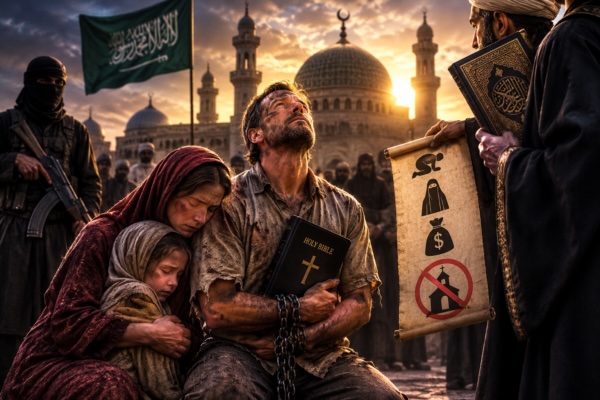
Imagine waking up tomorrow and discovering that the First Amendment has gone missing.
Not temporarily misplaced behind the couch cushions in Washington. Gone.
You are still a Christian. Your Bible hasn’t changed. Jesus hasn’t changed. But the government under which you live now operates according to an Islamic legal system in which your Christianity is tolerated only within boundaries established by the state.
For purposes of this thought experiment, let’s make those boundaries increasingly uncomfortable.
First comes the tax.
You’re informed that because you’re a non-Muslim, you owe jizya, the historically recognized tax imposed on certain non-Muslim subjects under classical Islamic governance.
Well, that’s irritating.
Actually, depending upon the particular historical system, “irritating” might be putting it rather politely.
So what does our brave Christian revolutionary do?
Probably pay it.
Sorry.
Jesus ruined the tax rebellion fantasy when somebody asked Him about Caesar.
“Give to Caesar the things that are Caesar’s.”
Paul made matters worse in Romans 13 when he specifically told Christians to pay taxes and revenues.
The Roman government wasn’t exactly donating the proceeds to Gideons International.
Christians paid taxes to an empire whose religious assumptions they rejected.
So you pay the jizya.
You can complain about it. You can consider it discriminatory. You can pray for its abolition.
But writing the check doesn’t make you Muslim.
Test number one: unpleasant, but biblically survivable.
Then the government announces that your wife and daughters must follow a legally mandated dress code.
Now Americans start hyperventilating.
But biblically?
Still complicated.
Christianity doesn’t command women to wear yoga pants to Target.
There is no Eleventh Commandment saying, “Thou shalt expose thy elbows.”
If the government requires more clothing than Christianity requires, wearing it isn’t necessarily denying Christ. It may be coercive. It may be discriminatory. It may deserve criticism.
But fabric isn’t apostasy.
So your family complies.
And suddenly our thought experiment gets interesting because we’re discovering something modern Americans don’t particularly enjoy hearing:
Not every injustice gives Christians permission to disobey government.
Sometimes Christians endure injustice.
That isn’t cowardice.
It’s practically the plot of half the New Testament.
But then the rules tighten.
Your children can attend school, but you aren’t permitted to teach them that Jesus Christ is the Son of God.
Now we’ve got a problem.
Scripture repeatedly places responsibility upon parents to teach their children about God.
Government has moved from regulating your behavior to regulating your discipleship.
Then another decree arrives.
Your church may no longer meet.
Now Hebrews 10:25 starts getting uncomfortable.
Then evangelism is prohibited.
Jesus said make disciples of all nations.
The government says don’t.
Houston, we have a jurisdictional dispute.
Then comes the final test.
An official places a document in front of you.
Maybe there’s no sword.
Maybe there’s just a desk.
Government oppression, after all, has discovered paperwork.
Sign here.
Renounce your confession that Jesus Christ is Lord.
Profess something contrary to Christianity.
Go home.
Keep your job.
Protect your family.
Keep your property.
Continue living your comfortable little life.
Just sign.
And suddenly every Sunday-school lesson you’ve heard about Daniel becomes considerably less adorable.
Because this is where Christianity quits being theoretical.
Daniel lived under pagan kings.
He served them faithfully.
He apparently did his job exceptionally well.
Daniel wasn’t running around Babylon screaming that every municipal ordinance was tyranny.
Then the government prohibited prayer.
Daniel went home and prayed.
Shadrach, Meshach, and Abednego were functioning members of Babylonian government.
Then Nebuchadnezzar erected his golden statue.
Bow.
Everybody else bowed.
Three men remained standing.
That is the moment every Christian eventually has to contemplate.
Not because every Christian will face it.
Thank God most won’t.
But because Christianity makes absolutely no sense unless there is something you refuse to surrender.
Peter eventually encountered the same problem.
The authorities didn’t ask him to violate Jerusalem’s parking ordinance.
They ordered him to stop preaching Christ.
Peter’s response should probably be printed immediately beneath Romans 13 in every Bible sold in America:
“We must obey God rather than people.” — Acts 5:29
There it is.
The emergency brake on government authority.
And notice what Peter didn’t say.
“We obey God rather than people whenever government annoys us.”
No.
Christians aren’t given a divine exemption from laws because they’re inconvenient, stupid, unfair, expensive, or written by politicians with the intellectual horsepower of a damp toaster.
Government can be wrong without Christians automatically being authorized to disobey it.
The line is much more serious.
When government commands what God forbids, or forbids what God commands, the Christian obeys God.
That’s the test.
And this isn’t fundamentally an argument about Muslims.
Muslims are individual human beings, and Muslim-majority countries implement Islamic law in dramatically different ways. “Sharia law” isn’t one universally applied criminal code sitting on a shelf somewhere waiting to be photocopied. Its interpretation and governmental application have varied enormously across countries, schools of jurisprudence, and centuries.
The deeper issue is theocracy and ultimate authority.
Change the Quran in our hypothetical to a hammer and sickle.
Same problem.
Change it to a Roman imperial eagle.
Same problem.
Change it to some future American ideology requiring Christians to affirm something contrary to their faith.
Same problem.
Put a cross on the government building while you’re at it.
Still the same problem.
Because governments are perfectly capable of committing evil while using religious language.
The Bible’s standard doesn’t change depending upon whose flag is hanging outside the courthouse.
And that is where our hypothetical Christian living under strict Islamic government becomes uncomfortable for Americans.
We’re accustomed to inexpensive Christianity.
Church at 10:30.
Coffee at 10:15.
Air conditioning functioning properly.
Maybe somebody takes your usual parking spot and you spend the opening hymn contemplating whether forgiveness really applies to everyone.
Then lunch.
Biblical Christianity was born into something considerably rougher.
The earliest Christians understood something we can easily forget:
Jesus being Lord means somebody else isn’t.
That’s what made Christianity politically troublesome in Rome.
Caesar could govern Christians.
Caesar could tax Christians.
Caesar could imprison Christians.
Caesar could kill Christians.
But Caesar couldn’t become their god.
Revelation takes that conflict to its terrifying conclusion. Political power becomes “beastly” when it demands the allegiance and worship belonging to God.
And the Christian response isn’t necessarily revolution.
That’s another modern misunderstanding.
Daniel didn’t overthrow Babylon.
Peter didn’t organize an insurgency.
Paul didn’t assemble the First Christian Legion and march on Rome.
Sometimes resistance looked remarkably boring.
They simply refused.
No.
I won’t worship that.
No.
I won’t deny Christ.
No.
I won’t stop praying.
No.
I won’t call something true that I believe God says is false.
And then they accepted that saying no might cost something.
That’s the part we prefer skipping.
Everyone wants to be Daniel.
Nobody wants the lions.
Everyone wants to be Shadrach.
Nobody wants the furnace.
Everyone admires Peter declaring, “We must obey God rather than people.”
Few volunteer for what happened to the apostles afterward.
Which brings us back to our Christian under Sharia.
Pay the tax?
Probably.
Wear the required clothing?
Probably.
Obey ordinary laws?
Certainly.
Respect Muslim neighbors?
Absolutely.
Treat Muslims as enemies simply because they’re Muslims?
Absolutely not. Christ doesn’t provide that option.
Pray for the ruler?
Paul says yes.
Live peacefully whenever possible?
Yes.
But deny Christ?
Hard No.
Stop worshiping Christ?
Absolutley Not.
Worship something else?
Not a chance.
Teach your children that Jesus isn’t Lord because government demands it?
Umm No.
And if the government says obedience is mandatory?
Then the Christian eventually arrives at the sentence that has terrified emperors for two thousand years:
“We must obey God rather than people.”
Perhaps that’s the real value of imagining ourselves as Christians living under an explicitly non-Christian government.
It forces us to determine where our line actually is.
It’s easy to announce that Jesus is Lord when saying it costs nothing.
The real test comes when the cashier finally announces the price.
Your career?
Your property?
Your social standing?
Your freedom?
Your safety?
Your life?
At what price does Jesus stop being Lord?
Christianity’s historic answer is brutally simple:
There isn’t one.
Governments may collect taxes.
Governments may write laws.
Governments may impose burdens.
Governments may behave unjustly.
Governments may imprison people.
And governments, throughout history, have occasionally possessed the terrifying ability to kill those who refuse.
But Christianity places one thing forever outside their jurisdiction.
The throne.
The government may possess the sword.
It does not possess the throne.
_________________________________
If you enjoyed this article, then please REPOST or SHARE with others; encourage them to follow AFNN. If you’d like to become a citizen contributor for AFNN, contact us at managingeditor@afnn.us Help keep us ad-free by donating here.
_________________________________
Substack: American Free News Network Substack
Truth Social: @AFNN_USA
Facebook: https://m.facebook.com/afnnusa
Telegram: https://t.me/joinchat/2_-GAzcXmIRjODNh
Twitter: https://twitter.com/AfnnUsa
GETTR: https://gettr.com/user/AFNN_USA
CloutHub: @AFNN_USA