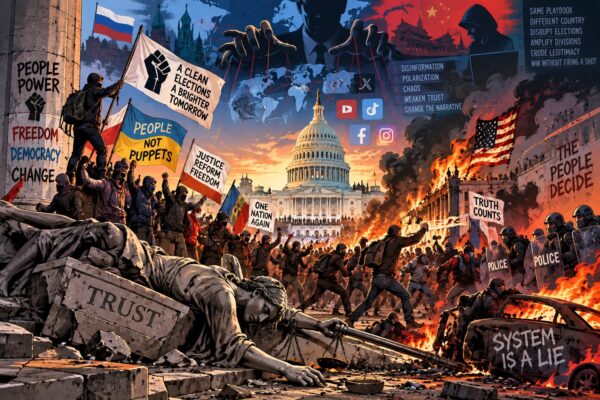
Well, here we are.
Five articles into the Human Domain, and we’ve finally arrived at the nuclear weapon sitting in the middle of the room.
Truth.
Part One argued that the battlefield has moved into the human mind.
Part Two asked what happens when techniques America has used overseas come home.
Part Three asked how we defend the Republic without committing suicide.
Part Four asked what exactly we’re defending—rights, not every privilege, benefit, desire or government program somebody manages to staple the word “right” onto.
Now comes the question that scares me more than all the others.
Who gets to decide what is true?
Because whoever controls that answer doesn’t merely control information.
He controls reality.
And if you haven’t read George Orwell’s 1984 lately, this would be an excellent time to dust it off.
Orwell gave his fictional totalitarian government a Ministry of Truth.
Naturally, its job was lying.
Government records were continually changed so yesterday’s inconvenient facts agreed with today’s official truth.
War with Eurasia?
We’ve always been at war with Eurasia.
Government prediction wrong?
Fix the old newspaper.
Problem solved.
History itself became editable.
That’s wonderfully efficient government.
No congressional investigation required.
The frightening thing is that Orwell didn’t understand smartphones, artificial intelligence, deepfakes, social-media algorithms or a civilization in which Uncle Larry can broadcast his geopolitical analysis from the toilet to 40,000 people before breakfast.
We have improved tremendously upon his nightmare.
Today the Human Domain contains government agencies, foreign intelligence services, corporations, political parties, billionaires, journalists, activists, algorithms, bots, influencers, artificial intelligence and your cousin Randy, who has “done his own research.”
All competing to tell you what’s true.
Good luck.
And here’s the problem.
Somebody really is lying.
Foreign governments really do conduct influence operations.
Politicians really do mislead people.
Corporations really do protect their interests.
Internet rumors really are sometimes complete nonsense.
AI really can manufacture photographs, voices and video.
Propaganda exists.
Conspiracies exist.
And sometimes conspiracy theories are just theories about conspiracies that actually happened.
Welcome to the Human Domain.
Please wear a helmet.
The tempting solution is obvious.
Create an authority that identifies misinformation.
Give experts access to social-media companies.
Flag dangerous narratives.
Suppress foreign propaganda.
Throttle disinformation.
Protect democracy.
It sounds wonderfully reasonable right up until someone asks:
Who watches the experts?
Because government possesses one small defect that has been remarkably consistent throughout recorded history.
It is operated by human beings.
Human beings have careers.
Political beliefs.
Ambitions.
Budgets.
Bosses.
Egos.
And an astonishing ability to conclude that whatever benefits their institution also happens to benefit civilization.
That is why the First Amendment doesn’t say Congress shall make no law abridging freedom of speech “unless Congress has checked with some really smart people first.”
It assumes something much darker and much wiser.
Government can be wrong.
More importantly, government can lie.
The Supreme Court confronted an almost comically perfect example in United States v. Alvarez in 2012.
Xavier Alvarez falsely claimed he’d received the Medal of Honor.
He hadn’t.
It was stolen valor.
It was disgusting.
It was also a lie.
Congress had made such lies criminal.
Seems easy enough.
Bad man lies.
Government punishes liar.
Everybody goes home for dinner.
Except the Supreme Court struck down the law.
Why?
Because allowing government to create an ever-expanding list of subjects about which false statements become crimes creates a terrifying power.
The Court actually invoked Orwell.
America, it said, does not need Oceania’s Ministry of Truth.
Think about how extraordinary that principle is.
The First Amendment sometimes protects people who are wrong.
It sometimes protects idiots.
It sometimes protects liars.
Not fraud.
Not true threats.
Not defamation merely because somebody calls it “speech.”
Not criminal conduct magically transformed into constitutional liberty by attaching a hashtag.
But the government generally doesn’t receive a Truth Button it can press whenever citizens say something officials believe is false.
That’s intentional.
Because yesterday’s “misinformation” can occasionally become tomorrow’s legitimate question.
And yesterday’s accepted wisdom can become tomorrow’s punchline.
Science changes.
Intelligence assessments change.
Journalists make mistakes.
Governments make mistakes.
Experts make mistakes.
I make mistakes.
You make mistakes.
The only people who never seem to make mistakes are people currently explaining why everyone else should be censored.
Funny how that works.
But there’s another side to this.
“Free speech!” cannot become the magical incantation we scream whenever somebody proves we’re full of crap.
Government censorship is one thing.
Someone disagreeing with you isn’t censorship.
A newspaper refusing to print your column isn’t necessarily censorship.
Facebook attaching a warning isn’t automatically a First Amendment violation merely because you don’t like it.
Your neighbor telling you you’re an idiot remains protected by the same Constitution protecting your right to demonstrate why.
Freedom of speech does not include a constitutional right to be believed.
That distinction may be the key to surviving fifth-generation warfare.
We don’t need government deciding truth.
We need citizens better at finding it.
Show your work.
Produce the document.
Release the audit.
Provide the data.
Identify the source.
Explain the methodology.
Let people challenge it.
Let journalists investigate it.
Let scientists argue about it.
Let courts examine evidence under rules.
Let Congress hold hearings.
Let some retired lieutenant colonel in northern Michigan sit at his computer with coffee and ask annoying questions.
Especially that last one.
Transparency is kryptonite to conspiracy theories.
Not because transparency makes conspiracy theories disappear.
Nothing makes conspiracy theories disappear.
There are people who believe the Earth is flat despite the inconvenient existence of the Earth.
But transparent institutions make legitimate questions easier to separate from nonsense.
That is enormously important.
Because censorship produces its own fifth-generation vulnerability.
Ban an idea and somebody immediately asks:
What are they hiding?
Delete the video.
Now everyone wants the video.
Classify the report.
Now everyone assumes the report contains aliens, assassinations, three CIA operations and the Colonel’s secret chicken recipe.
Suppressing information can actually increase its perceived value.
Human beings are irritating that way.
Which brings this entire five-part series back to where we started.
The Human Domain isn’t fundamentally about technology.
It is about us.
Human beings.
Our fears.
Our loyalties.
Our prejudices.
Our anger.
Our faith.
Our tribal instincts.
Our willingness to believe comforting nonsense.
And our ability, occasionally, to overcome all of that and reason.
Fifth-generation warfare exploits the first group.
A republic depends upon the second.
So perhaps the ultimate defense of America isn’t another federal agency.
Maybe it isn’t another billion-dollar weapons system.
Maybe it isn’t an algorithm identifying misinformation seventeen milliseconds faster.
Maybe it’s something embarrassingly old-fashioned.
Educated citizens.
Honest institutions.
Transparent government.
Free speech.
Due process.
Independent courts.
A skeptical press.
Election systems that can demonstrate their integrity.
Parents teaching children how the Republic works.
Citizens capable of hearing something they desperately want to believe and still asking:
“How do you know?”
That’s the weapon.
Because America doesn’t need 340 million people agreeing about everything.
God help us if we ever do.
We need Americans capable of disagreeing without concluding that everyone on the other side is evil, illegitimate or subhuman.
We need institutions willing to earn trust instead of demanding it.
We need government strong enough to defend the country but restrained enough to remember that the country isn’t the government.
We need citizens skeptical enough to question authority without becoming so cynical that nothing can ever be proven to them.
And above all, we need to remember something remarkably simple.
The government doesn’t own the Republic.
Republicans don’t own it.
Democrats don’t own it.
Fox doesn’t own it.
CNN doesn’t own it.
Elon Musk doesn’t own it.
Mark Zuckerberg doesn’t own it.
The CIA doesn’t own it.
Russia doesn’t own it.
China doesn’t own it.
And the algorithm sure as hell doesn’t own it.
We do.
Franklin supposedly handed us a republic if we could keep it.
Lincoln warned that if America ever died, we might become our own author and finisher.
Reagan reminded us that freedom has to be handed successfully from one generation to the next.
And now the Human Domain has become global, instantaneous and digital.
The weapons changed.
Human nature didn’t.
Maybe that’s the final lesson.
America probably won’t end with Soviet tanks parked on the National Mall.
It won’t require Chinese paratroopers landing at Gettysburg.
There may never be a mushroom cloud.
The most dangerous nuclear weapon in fifth-generation warfare might be something much quieter:
Convince Americans that truth doesn’t exist.
Convince them that elections don’t matter.
Convince them that rights belong only to their tribe.
Convince them that their neighbors are enemies.
Convince them that institutions can never be trusted.
Convince them that violence is the only remaining solution.
Then stand back.
Lincoln’s suicide takes care of itself.
So who gets to decide what is true?
Nobody gets that power permanently.
We argue.
We investigate.
We challenge.
We produce evidence.
We expose lies.
We correct ourselves.
We tolerate people being wrong.
And then we argue some more.
It’s messy.
It’s frustrating.
It’s inefficient.
It’s occasionally completely ridiculous.
Good.
That’s what freedom looks like.
The alternative is much more orderly.
They had that in Orwell’s Oceania.
I’ll take the argument.
If you enjoyed this article, then please REPOST or SHARE with others; encourage them to follow AFNN. If you’d like to become a citizen contributor for AFNN, contact us at managingeditor@afnn.us Help keep us ad-free by donating here.
Substack: American Free News Network Substack
Truth Social: @AFNN_USA
Facebook: https://m.facebook.com/afnnusa
Telegram: https://t.me/joinchat/2_-GAzcXmIRjODNh
Twitter: https://twitter.com/AfnnUsa
GETTR: https://gettr.com/user/AFNN_USA
CloutHub: @AFNN_USA