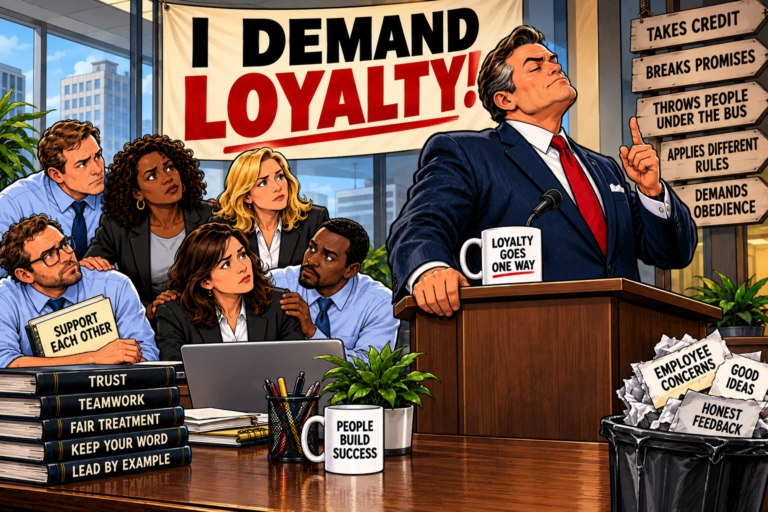
Everybody wants loyal employees.
Business owners want people who will stick with them through difficult times. Managers want team members they can depend on. Military commanders expect loyalty from the men and women under their command.
And politicians? Well, they certainly seem to spend a great deal of time talking about loyalty.
But here’s a question that doesn’t get asked nearly often enough.
What have those leaders done to earn it?
I’ve spent much of my adult life in leadership positions, first in the Army, then in corporate America, and eventually as a small business owner. Along the way, I’ve encountered leaders who inspired tremendous loyalty from the people around them.
I’ve also encountered those who seemed to believe loyalty was something they were entitled to simply because their name appeared at the top of the organizational chart.
There’s a big difference.
Some leaders treat loyalty as a one-way obligation. Employees are expected to work late, accept difficult assignments, support management decisions, and remain committed when times get tough.
But when those same employees need support, understanding, or someone willing to stand up for them, the loyalty suddenly disappears.
That’s not leadership. That’s a double standard.
Consider a manager who demands absolute dedication from his employees but takes credit for their accomplishments. Or a business owner who constantly reminds workers that they’re part of a family, only to treat them as disposable when circumstances change.
People notice those things.
They notice when a leader publicly praises teamwork but privately throws an employee under the bus to protect his own reputation. They notice when promises are made and quietly forgotten. And they certainly notice when the rules seem to apply to everyone except the person in charge.
Eventually, they begin asking themselves a perfectly reasonable question.
Why should I be loyal to someone who isn’t loyal to me?
Now, let’s be clear. Loyalty doesn’t mean protecting someone from the consequences of poor performance or unethical behavior.
A leader who overlooks dishonesty, excuses incompetence, or refuses to address serious problems in the name of loyalty isn’t doing anyone a favor.
In fact, that kind of misplaced loyalty can damage an entire organization.
True loyalty requires honesty, even when the truth is uncomfortable.
During my military service, I learned that loyalty and integrity aren’t competing values. They’re supposed to reinforce each other.
A good subordinate doesn’t demonstrate loyalty by blindly agreeing with every decision. Sometimes the most loyal thing a person can do is respectfully tell a superior that he believes a decision is wrong.
And a good leader should have enough confidence to listen.
Once a decision is made, people are generally expected to carry out lawful orders and fulfill their responsibilities. But that obligation doesn’t eliminate the leader’s responsibility to consider their concerns and treat them fairly.
The same principle applies in civilian organizations.
Employees shouldn’t have to choose between being loyal and being honest.
Nor should loyalty require sacrificing personal integrity to protect a leader’s ego.
Unfortunately, some managers confuse loyalty to the organization with loyalty to themselves. They begin treating disagreement as betrayal and honest criticism as insubordination.
That’s a dangerous mindset.
When people become afraid to question decisions, problems don’t disappear. They simply go unreported until the consequences become impossible to ignore.
And when loyalty is measured by how enthusiastically people agree with the boss, the organization risks becoming an echo chamber.
I’ve always believed that one of the clearest measures of a leader’s character is how he treats people when doing the right thing offers him no personal advantage.
Does he defend an employee who has been unfairly criticized? Does she acknowledge the contributions of others? Does he keep his word when circumstances make doing so inconvenient?
Those actions matter far more than speeches about loyalty.
Because loyalty isn’t something a leader can manufacture with a job title, demand through intimidation, or purchase with an occasional bonus.
It’s built through consistent behavior.
People are far more likely to stand beside a leader during difficult times when they’ve seen that leader stand beside them.
And that brings us back to the question every leader should be willing to ask.
Before demanding loyalty from the people you lead, have you given them a reason to be loyal to you?
Dean Gemberling is a West Point graduate, former U.S. Army officer, small business owner, and author of Servant Leadership Made Simple, a practical guide to building trust, strengthening relationships, and developing more effective leaders. Explore his books and leadership insights at DeanGemberling.com.
If you enjoyed this article, then please REPOST or SHARE with others; encourage them to follow AFNN. If you’d like to become a citizen contributor for AFNN, contact us at managingeditor@afnn.us Help keep us ad-free by donating here.
Substack: American Free News Network Substack
Truth Social: @AFNN_USA
Facebook: https://m.facebook.com/afnnusa
Telegram: https://t.me/joinchat/2_-GAzcXmIRjODNh
Twitter: https://twitter.com/AfnnUsa
GETTR: https://gettr.com/user/AFNN_USA
CloutHub: @AFNN_USA