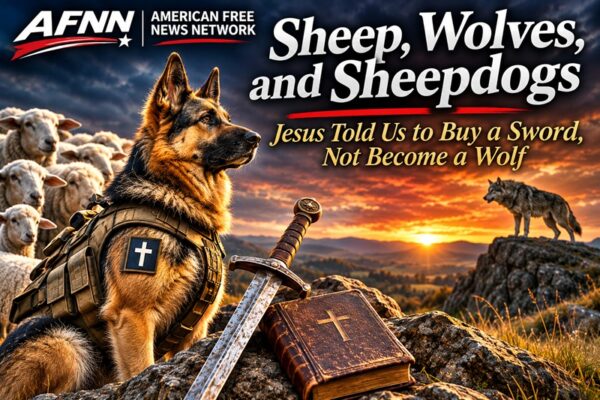
Lieutenant Colonel Dave Grossman, a retired Army officer and author, once explained humanity using an analogy so simple that even a government bureaucrat might understand it. Society consists of sheep, wolves, and sheepdogs. The sheep want to live peacefully. The wolves prey upon them. And the sheepdogs stand between the two, occasionally getting bitten by both.
Grossman estimated that roughly 2% of humanity consists of predatory personalities. Modern psychological research places antisocial personality disorder in roughly that neighborhood, although having the disorder doesn’t automatically make someone violent. Nor does lacking the diagnosis make someone harmless.
Nevertheless, the fundamental observation is difficult to dismiss: A relatively small number of dangerous individuals can inflict extraordinary suffering upon everyone else.
And here’s where Grossman’s thesis gets interesting. Jesus Christ addressed this problem two thousand years before anyone invented a psychological diagnosis, a police academy, or a federal grant to study why wolves eat sheep.
Luke 22:36: “He that hath no sword, let him sell his garment, and buy one.”
That’s Jesus speaking. Not General Patton. Not Charlton Heston. Jesus.
Apparently, the Prince of Peace understood something that modern civilization occasionally forgets: Evil doesn’t disappear simply because decent people refuse to acknowledge it.
Now, before somebody starts polishing a bayonet in Sunday school, let’s examine the context.
Jesus also stopped Peter from using a sword during His arrest. He healed the wounded servant and willingly submitted to His Father’s plan. Christians have debated these passages for centuries, and Luke 22:36 isn’t a blank check for armed confrontation.
But the distinction between preparation and aggression remains worth examining.
Owning a sword doesn’t make you a wolf. Using one irresponsibly might.
Grossman’s sheepdog isn’t someone looking for a fight. He’s someone prepared to confront one when innocent lives are threatened. His defining characteristic isn’t aggression. It’s responsibility.
Jesus offered an even more profound example in John 10:11: “I am the good shepherd: the good shepherd giveth his life for the sheep.”
Notice what the Good Shepherd doesn’t do. He doesn’t conduct a committee meeting with the wolf. He doesn’t declare the pasture a predator-free zone and hope the wolf respects the signage. And He certainly doesn’t abandon the flock because protecting sheep might make somebody uncomfortable.
He lays down His life for them.
That’s sacrifice, not bloodlust.
Of course, the biblical analogy isn’t identical to Grossman’s. Jesus is the Shepherd, not merely another sheepdog, and His mission extends far beyond physical protection. But the moral principle is unmistakable: Love sometimes requires courage in the face of danger.
Romans 13:4 recognizes that legitimate governing authority bears the sword to restrain wrongdoing. Ephesians 6 commands Christians to put on the armor of God. And Matthew 5 reminds us that personal vengeance isn’t the same thing as righteousness.
Taken together, these passages challenge two equally foolish extremes: the belief that violence solves everything and the fantasy that violence disappears when good people refuse to resist it.
The Christian sheepdog must possess something more important than physical strength: moral discipline.
Because here’s the uncomfortable truth Grossman’s analogy reveals.
A sheepdog without restraint eventually becomes indistinguishable from a wolf.
History provides plenty of examples. Revolutions promising protection become dictatorships. Governments claiming to defend citizens become their greatest predators. Armed men supposedly maintaining order discover that power without accountability is intoxicating.
And Christianity adds something Grossman’s three categories cannot fully explain: redemption.
Saul of Tarsus persecuted Christians before becoming the Apostle Paul. The wolf, so to speak, became a defender of the flock. Human beings aren’t permanently assigned to biological categories like characters in a children’s cartoon.
They can change. They can repent. They can also fall.
That’s why a Christian’s ultimate allegiance cannot belong to the sword, the government, or even the sheepdog’s own sense of righteousness.
It belongs to God.
So perhaps the question isn’t whether America needs more sheepdogs. It needs people who understand what a sheepdog is supposed to be.
Strong enough to confront evil. Disciplined enough to reject vengeance. Humble enough to recognize their own capacity for wrongdoing. And courageous enough to protect the vulnerable even when doing so comes at a personal cost.
Jesus never instructed His followers to become wolves.
He did tell them to love their neighbors, prepare for hardship, and recognize the difference between righteousness and retaliation.
And He demonstrated the ultimate standard of protection by sacrificing Himself.
The sheepdog’s greatest virtue isn’t that he’s willing to kill for the flock. It’s that he’s willing to die for it.
That’s a lesson worth remembering before we start arguing about who gets to carry the sword.
If you enjoyed this article, then please REPOST or SHARE with others; encourage them to follow AFNN. If you’d like to become a citizen contributor for AFNN, contact us at managingeditor@afnn.us Help keep us ad-free by donating here.
Substack: American Free News Network Substack
Truth Social: @AFNN_USA
Facebook: https://m.facebook.com/afnnusa
Telegram: https://t.me/joinchat/2_-GAzcXmIRjODNh
Twitter: https://twitter.com/AfnnUsa
GETTR: https://gettr.com/user/AFNN_USA
CloutHub: @AFNN_USA