
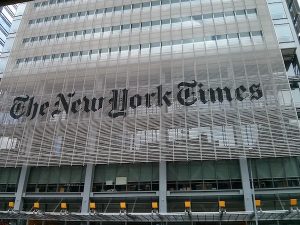
The liberal media has been moving away from the practice of journalism for years. Once Donald Trump arrived on the scene, it was abandoned altogether. The media collectively embraced activism. And the New York Times has led the way.
The extraordinary power of the Times to not only influence events, but to shape events, cannot be denied. Without question the apex predator in the media world today, they can set any narrative, no matter the facts. And when the Democratic Party has a message to get out, they turn to the Gray Lady to do their bidding.
Last month, the Times published an article titled, “Should Biden Run in 2024? Democratic Whispers of ‘No’ Start to Rise.” The widely read piece wasn’t simply the random musings of a couple of writers who consider President Joe Biden too old to serve. It was a nuclear bomb, and it marked a watershed moment in Biden’s presidency.
This was a deliberate, strategic decision made by the editors in cahoots with Democratic Party leaders and it represented the opening salvo in the campaign to oust Biden from office. Suddenly, it was okay to say the President was too old for the job. The writers stopped short of admitting Biden’s obvious cognitive decline. Instead, citing many “Democratic lawmakers and party officials,” they declared him “an anchor that should be cut loose in 2024.”
As always, the rest of the liberal media immediately jumped on board and, one month later, a full court press to replace the President is in place. The attacks have increased in frequency and tone. On Monday, a Times writer compared watching Biden to “seeing someone wobble on a tightrope.”
Last Saturday, a Times columnist wrote that, “At 79, Biden is testing the boundaries of age and the presidency.” Summing up the sentiment of “more than a dozen current and former senior officials and advisers,” the article said: “But they acknowledged Mr. Biden looks older than just a few years ago, a political liability that cannot be solved by traditional White House stratagems like staff shake-ups or new communications plans. His energy level, while impressive for a man of his age, is not what it was, and some aides quietly watch out for him. He often shuffles when he walks, and aides worry he will trip on a wire. He stumbles over words during public events, and they hold their breath to see if he makes it to the end without a gaffe.”
Far from the first time the paper of record has engaged in activist reporting, this is merely the most recent. Other memorable occasions include their collaboration in the Trump/Russia collusion hoax and setting the divisive “systemic racism” narrative.
In her wildest dreams, Hillary Clinton couldn’t have imagined how far her disinformation campaign against then-candidate Trump would go. With the full support of the Times, Christopher Steele’s collection of lies about her opponent would go on to dominate the national news cycle for three years and cripple his presidency.
Unlikely as it may sound, the adoption of racism as a top issue in American discourse was a premeditated decision by the Times’ editors. And it happened long before Americans ever heard of George Floyd.
The occasion was a “crisis employee town-hall” held by executive editor Dean Baquet in August 2019. A recording of his remarks was leaked to and published by Slate. (A full transcript of this meeting can be viewed here.)
At the time, Trump had just delivered a widely praised speech on two mass shootings that had taken place nearly simultaneously in El Paso, Texas, and Dayton, Ohio.
The headline in the Times read, ““TRUMP URGES UNITY VS. RACISM.” Following harsh criticism from the left for their positive take on the speech, they changed the title to “ASSAILING HATE BUT NOT GUNS,” a move that drew widespread criticism.
Baquet opened the meeting with a discussion of the “significant missteps” they had made in handling the “crisis.”
Then he pivoted. “We built our newsroom to cover one story [the Trump/Russia collusion story], and we did it truly well,” Baquet said. “Now we have to regroup, and shift resources and emphasis to take on a different story.”
The story that would drive the news for the next two years, he said, would be race.
Baquet had two goals. The first was to paint President Trump as a racist. The second was to reshape American history putting slavery at the center of the story. This was the introduction of Nikole Hannah-Jones’ 1619 project, for which she has subsequently won a Pulitzer Prize.
Of course, the death of George Floyd handed them an extraordinary opportunity which they seized upon and ran with. However, as preposterous as Baquet may have sounded at the time, to a large extent, the Times achieved both objectives.
When a newspaper can decide a president’s term has expired, legitimize a political candidate’s phony opposition research to the point of undermining a presidency and dictate what topic will dominate the news over the next two years, it has too much power. It has left the purview of the media and become a political organization.
The New York Times has become an adjunct of the Democratic Party and should be regarded as such. Period.
A previous version of this article was published in The Washington Examiner.
Follow AFNN:
Facebook: https://m.facebook.com/afnnusa
Telegram: https://t.me/joinchat/2_-GAzcXmIRjODNh
Twitter: https://twitter.com/AfnnUsa
GETTR: https://gettr.com/user/AFNN_USA
CloutHub: @AFNN_USA
Please follow me on LinkedIn or Twitter