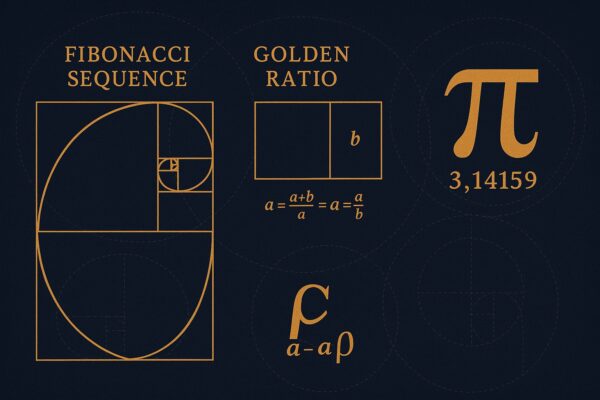
From the spiraling arms of galaxies to the arrangement of sunflower seeds, the universe is replete with patterns that suggest an underlying order. Central to this order are mathematical constants and sequences—such as the Fibonacci sequence, the golden ratio (φ), and pi (π)—which have been recognized and utilized by ancient civilizations long before modern science began to understand their significance.
⸻
Fibonacci Sequence: Nature’s Recurring Blueprint
The Fibonacci sequence (0, 1, 1, 2, 3, 5, 8, 13, …) is a series where each number is the sum of the two preceding ones. This sequence manifests in various natural phenomena: the branching of trees, the arrangement of leaves on a stem, the fruit sprouts of a pineapple, and the flowering of artichoke.
While the sequence is named after Leonardo of Pisa, known as Fibonacci, who introduced it to Western mathematics in his 1202 book Liber Abaci, its origins trace back much further. Indian mathematicians like Pingala (circa 200 BCE) and Virahanka (circa 6th century CE) had described similar sequences in the context of Sanskrit poetry and prosody. These early scholars recognized the sequence’s importance in rhythmic patterns, long before its introduction to Europe.
⸻
The Golden Ratio: A Universal Constant
Closely related to the Fibonacci sequence is the golden ratio, approximately 1.618, denoted by the Greek letter φ (phi). This ratio appears when a line is divided into two parts such that the whole length divided by the long part is also equal to the long part divided by the short part.
Ancient civilizations, including the Egyptians and Greeks, applied the golden ratio in their architectural designs. The Great Pyramid of Giza and the Parthenon in Athens are often cited as structures embodying this proportion. Greek mathematician Euclid referred to it as the “extreme and mean ratio” in his work Elements, highlighting its significance in geometry.
The golden ratio’s aesthetic appeal has made it a staple in art and design, symbolizing balance and harmony. Its prevalence in natural patterns and human-made structures suggests a universal appreciation for this proportion.
⸻
Pi (π): The Circle’s Enigmatic Constant
Pi (π), the ratio of a circle’s circumference to its diameter, is another fundamental constant that has fascinated mathematicians for millennia. Ancient Babylonians approximated π as 3.125, while the Egyptians estimated it as 3.1605, as evidenced by the Rhind Papyrus dating back to around 1650 BCE.
Greek mathematician Archimedes (circa 287–212 BCE) provided one of the earliest theoretical calculations of π by inscribing and circumscribing polygons around a circle, determining that π lies between 3 1/7 and 3 10/71. Chinese mathematician Zu Chongzhi (429–501 CE) later calculated π to be approximately 355/113, a remarkably accurate estimation for the time.
⸻
Pattern Recognition: Humanity’s Innate Ability
Humans possess an inherent ability to recognize patterns, a trait that has been crucial for survival and understanding the environment. This cognitive skill allows us to identify faces, interpret language, and comprehend complex systems.
The consistent appearance of mathematical patterns in nature and ancient architecture suggests that our ancestors not only recognized these patterns but also revered them. The deliberate incorporation of the golden ratio in art and architecture indicates an appreciation for its aesthetic and perhaps even spiritual significance.
⸻
A Universe of Intentional Design
The recurrence of mathematical constants like the Fibonacci sequence, the golden ratio, and pi across natural and human-made structures points to a universe governed by order and precision. These patterns transcend cultural and temporal boundaries, hinting at a universal language of mathematics embedded in the fabric of reality.
As we continue to explore and understand these patterns, we not only gain insight into the workings of the cosmos but also connect with the ancient wisdom that recognized the harmony inherent in the universe.
⸻
A Closing Thought
When we step back and consider the beauty, symmetry, and mathematical consistency of creation, it’s hard not to sense that this wasn’t just random. The order written into nature seems more like poetry than chance.
If creation is this brilliant… then what does that say about the Creator?
Maybe the deeper we understand the universe, the more we are meant to wonder about the One who designed it — and perhaps, as Jesus hinted in the Gospel of Matthew, “Those who have eyes to see” will recognize the patterns not just in nature… but in truth itself.
If you enjoyed this article, then please REPOST or SHARE with others; encourage them to follow AFNN. If you’d like to become a citizen contributor for AFNN, contact us at managingeditor@afnn.us Help keep us ad-free by donating here.
Substack: American Free News Network Substack
Truth Social: @AFNN_USA
Facebook: https://m.facebook.com/afnnusa
Telegram: https://t.me/joinchat/2_-GAzcXmIRjODNh
Twitter: https://twitter.com/AfnnUsa
GETTR: https://gettr.com/user/AFNN_USA
CloutHub: @AFNN_USA