
The parade for the U.S. Army’s 250th birthday went well. It was a great showcase for the U.S. Army. It’s needed greatly because the Army is last among the Services in self-promotion and politics. Even as the Army is the primary service in war. The other Services are needed – to support the Army winning the Land War. [Note: Global nuclear war is a different kind of war.] So, what will take to have a 500th Anniversary parade?
What will it take to make it to the year 2100?
Perhaps we can look forward 75 years by looking at projections from the past 35 years? If they were accurate enough for the past, we might do as well for the future.
Consider the essential assumptions of the Nation. RAND developed this as a methodology called Assumptions-Based Planning.
The slide below is from an unclassified presentation in the late 90’s of the last Army 21 Study for Headquarters, US Army TRADOC (1992). The 1992 Army 21 Study made projections for 2005-2015. They were spot on identifying decision points without making predictions for what decisions would be made.
The slide may require translation. RISTA is Reconnaissance, Intelligence, Surveillance, Target Acquisition and C4ISR is Command, Control, Communications, Computers, Intelligence, Surveillance, Reconnaissance. The acronyms change as capabilities evolve. It’s about what a commander at different levels can “see” on the battlefield, when, and how, etc.
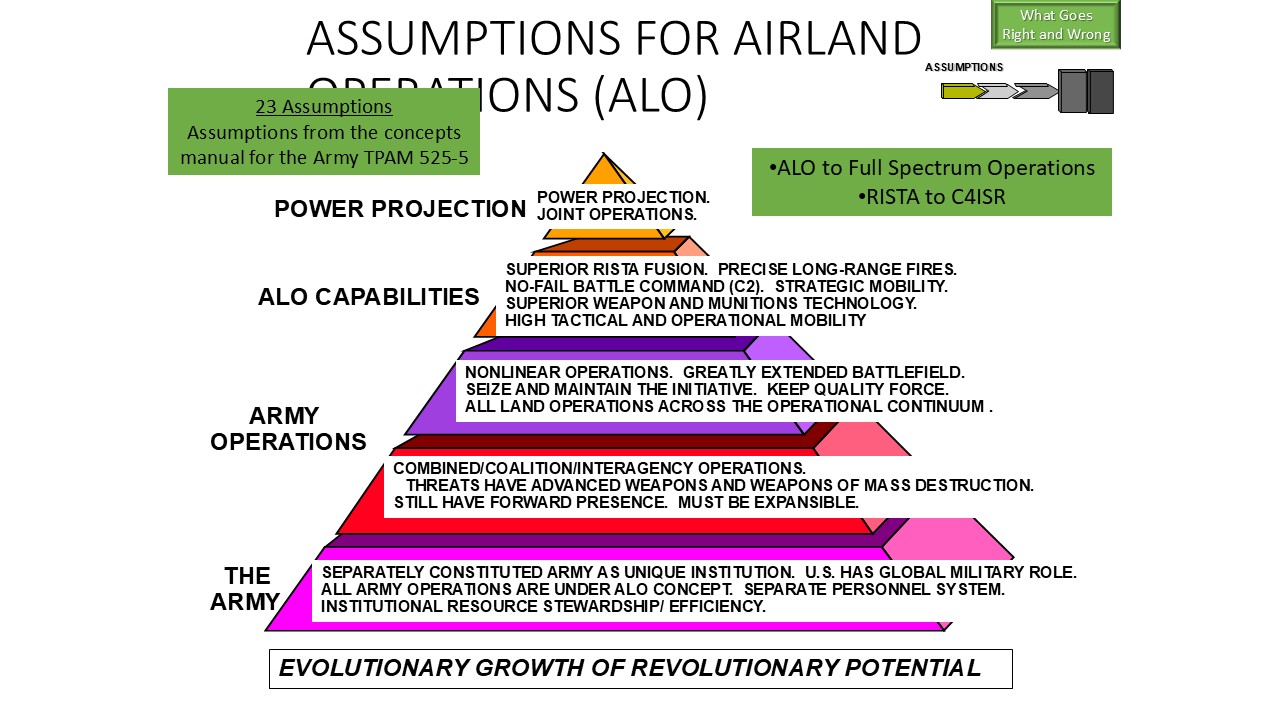
If one of those 23 assumptions changed, then the Army’s operational concept – called Airland Operations then, and now called Multi-Domain Operations – must adapt. Indeed, the assumptions are challenged today.
The same methodology applies to the Government of the United States (GOTUS).
Back to the next 75 years for the Army.
The actual challenges to the Army winning future wars look pretty much the same as below:
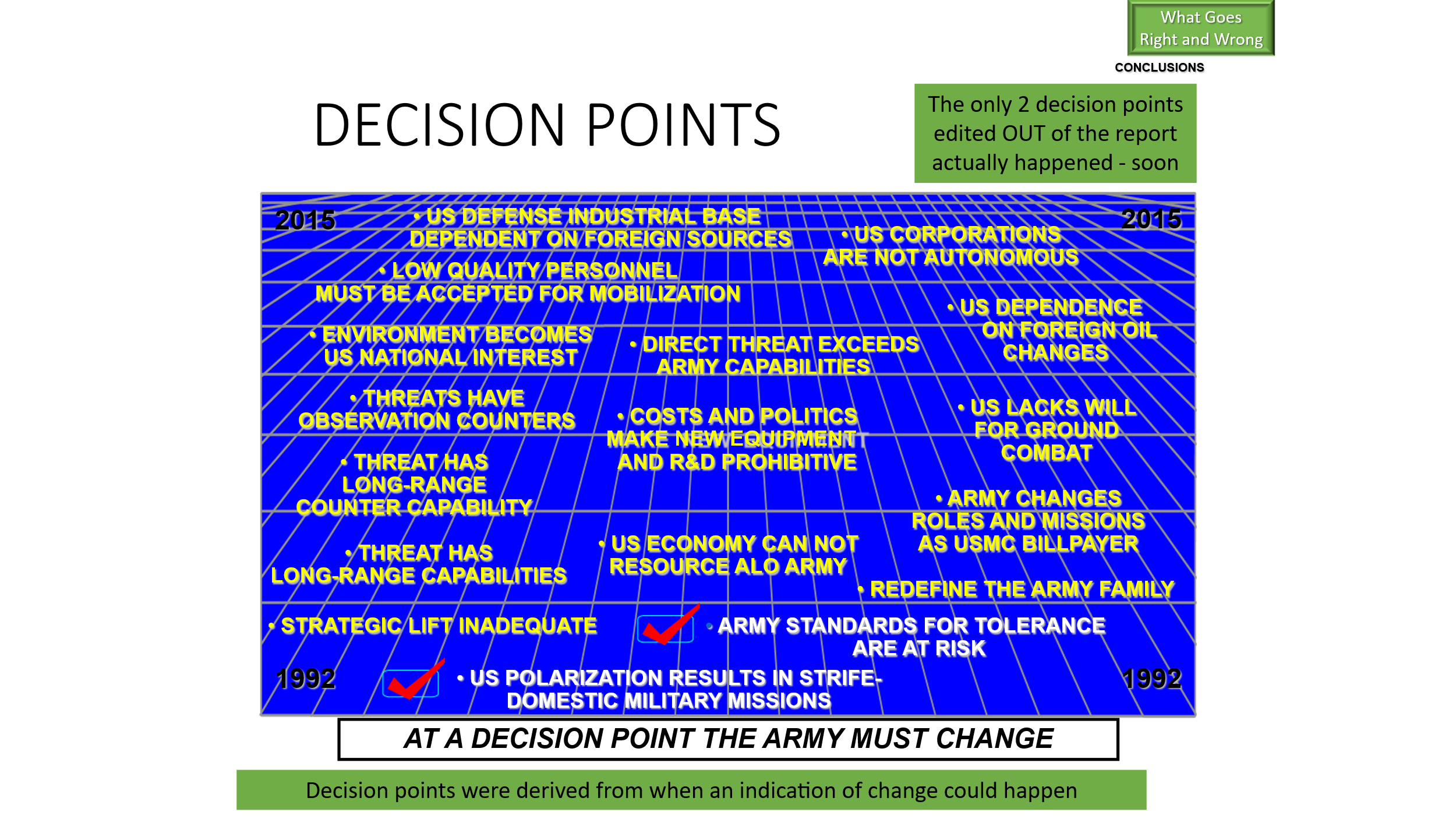
The two points edited out in 1992 came true with the Los Angeles Riots and Don’t Ask, Don’t Tell Homosexual policy change.
I loved being paid to do this kind of analysis.
I’m confident the Army is digesting the savages’ attack on October 7th, the Israeli counter-attack against the barbarians in Gaza, the beeper attack on Hezbollah, the long-distance conflicts across the Middle East, the current Israeli offensive in Iran, and the blood bath in Ukraine. As well as lessons learned in Iraq, Afghanistan, Georgia, Kosovo, the Philippines, the Horn of Africa, and Yemen.
The biggest problem is having enough Army. The reductions in end-strength will prove costly. They could be fatal. It takes 10 to 15 years to grow soldiers who are capable of rapid advancement in the enlisted or commissioned grades. The Army can be expanded only if it has sufficient cadre to do so.
A naval and air defensive war against the CCP may reduce their ability to attack beyond their boundaries. But, it won’t end the war. It won’t create an 80 year or more post-war peace. The Army will be needed to defeat CCP forces in other theaters. Ultimately, the Army can force the CCP to its culminating point. That’s a topic for a series of papers. The alternatives don’t fit on the bumper sticker “Never fight a land war in Asia” – yet include that wisdom. Expeditions are land warfare, but don’t equate to a land war. Think about it.
I trust the Army is preparing to win the next war. The Army has worked hard to do so since the U.S. became an international power after the Spanish-American War.
This we’ll defend.
Facebook: https://m.facebook.com/afnnusa
Telegram: https://t.me/joinchat/2_-GAzcXmIRjODNh
Twitter: https://twitter.com/AfnnUsa
GETTR: https://gettr.com/user/AFNN_+-USA
CloutHub: @AFNN_USA
The parade for the U.S. Army’s 250th birthday went well. It was a great showcase for the U.S. Army. It’s needed greatly because the Army is last among the Services in self-promotion and politics. Even as the Army is the primary service in war. The other Services are needed – to support the Army winning the Land War. [Note: Global nuclear war is a different kind of war.] So, what will take to have a 500th Anniversary parade?
What will it take to make it to the year 2100?
Perhaps we can look forward 75 years by looking at projections from the past 35 years? If they were accurate enough for the past, we might do as well for the future.
Consider the essential assumptions of the Nation. RAND developed this as a methodology called Assumptions-Based Planning.
The slide below is from an unclassified presentation in the late 90’s of the last Army 21 Study for Headquarters, US Army TRADOC (1992). The 1992 Army 21 Study made projections for 2005-2015. They were spot on identifying decision points without making predictions for what decisions would be made.
The slide may require translation. RISTA is Reconnaissance, Intelligence, Surveillance, Target Acquisition and C4ISR is Command, Control, Communications, Computers, Intelligence, Surveillance, Reconnaissance. The acronyms change as capabilities evolve. It’s about what a commander at different levels can “see” on the battlefield, when, and how, etc.
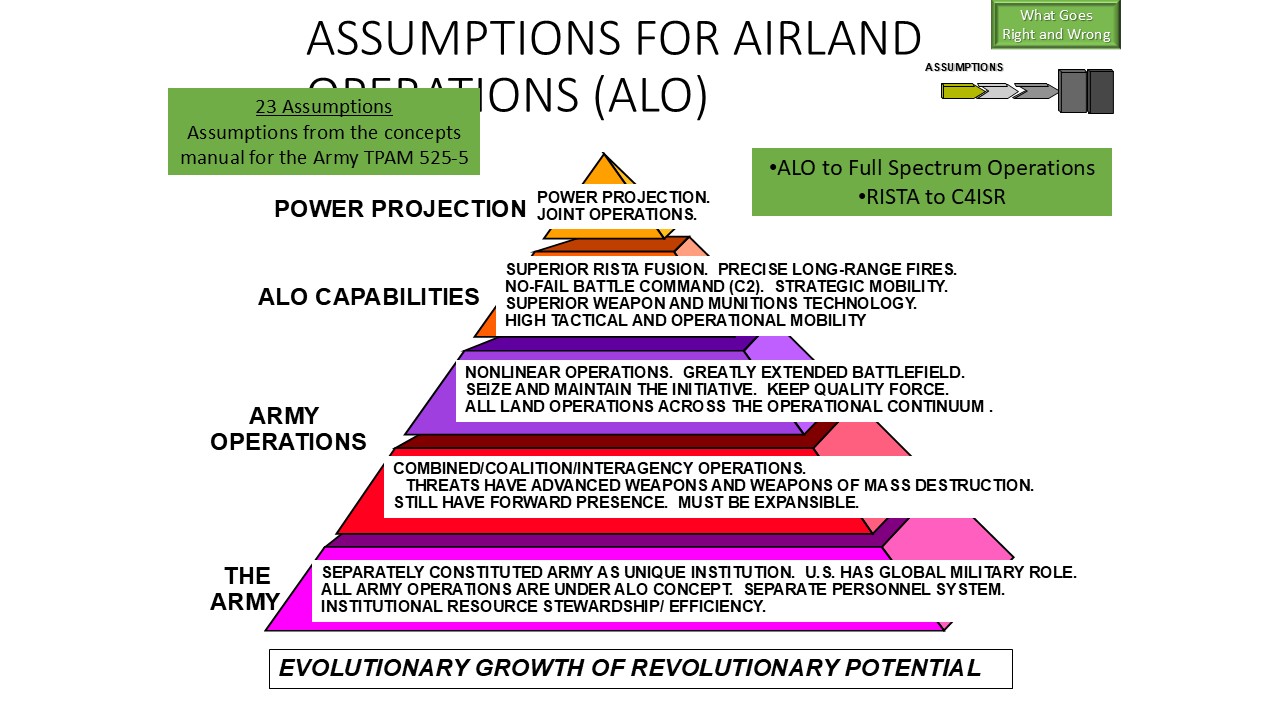
If one of those 23 assumptions changed, then the Army’s operational concept – called Airland Operations then, and now called Multi-Domain Operations – must adapt. Indeed, the assumptions are challenged today.
The same methodology applies to the Government of the United States (GOTUS).
Back to the next 75 years for the Army.
The actual challenges to the Army winning future wars look pretty much the same as below:
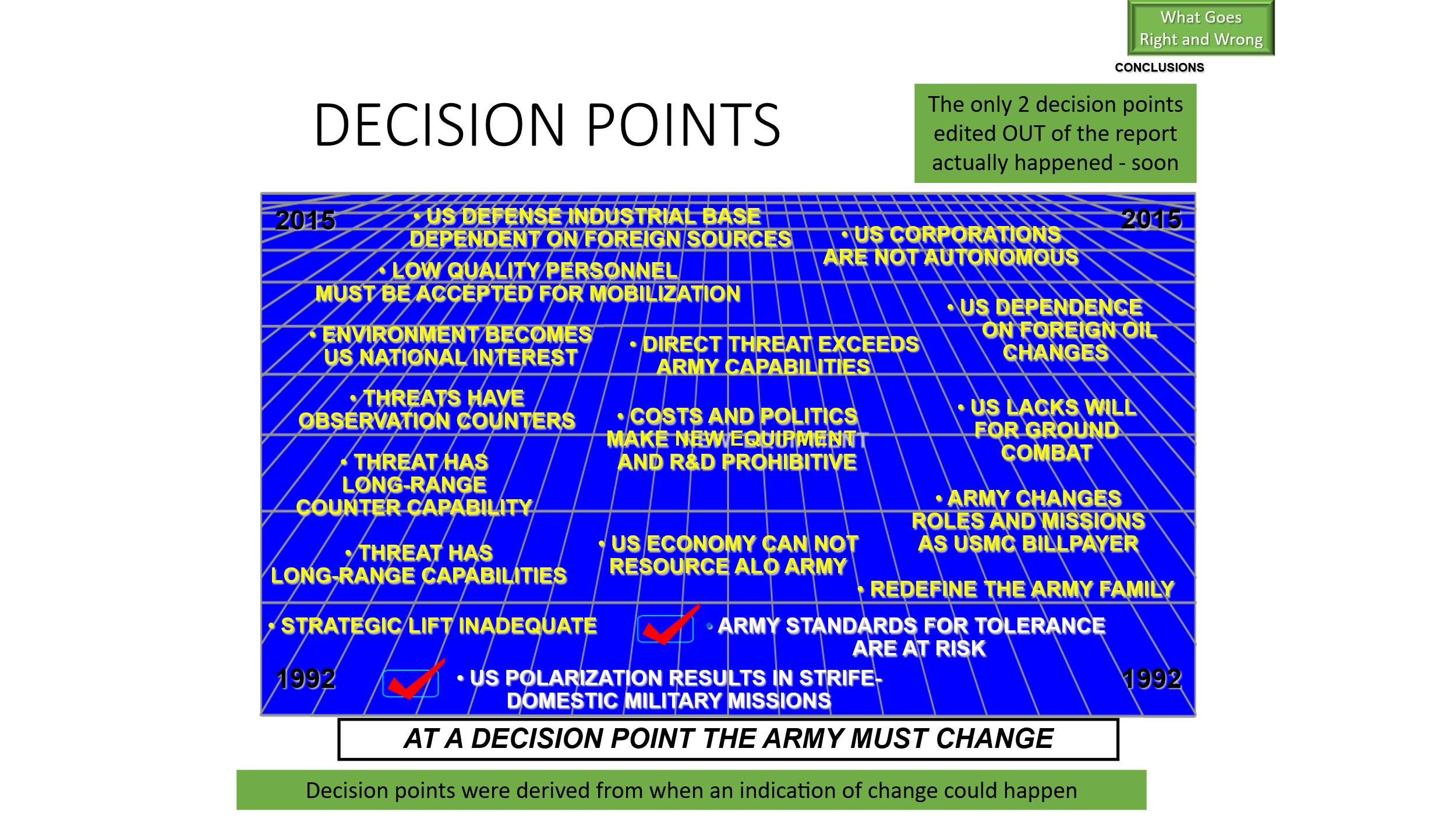
The two points edited out in 1992 came true with the Los Angeles Riots and Don’t Ask, Don’t Tell Homosexual policy change.
I loved being paid to do this kind of analysis.
I’m confident the Army is digesting the savages’ attack on October 7th, the Israeli counter-attack against the barbarians in Gaza, the beeper attack on Hezbollah, the long-distance conflicts across the Middle East, the current Israeli offensive in Iran, and the blood bath in Ukraine. As well as lessons learned in Iraq, Afghanistan, Georgia, Kosovo, the Philippines, the Horn of Africa, and Yemen.
The biggest problem is having enough Army. The reductions in end-strength will prove costly. They could be fatal. It takes 10 to 15 years to grow soldiers who are capable of rapid advancement in the enlisted or commissioned grades. The Army can be expanded only if it has sufficient cadre to do so.
A naval and air defensive war against the CCP may reduce their ability to attack beyond their boundaries. But, it won’t end the war. It won’t create an 80 year or more post-war peace. The Army will be needed to defeat CCP forces in other theaters. Ultimately, the Army can force the CCP to its culminating point. That’s a topic for a series of papers. The alternatives don’t fit on the bumper sticker “Never fight a land war in Asia” – yet include that wisdom. Expeditions are land warfare, but don’t equate to a land war. Think about it.
I trust the Army is preparing to win the next war. The Army has worked hard to do so since the U.S. became an international power after the Spanish-American War.
This we’ll defend.
If you enjoyed this article, then please REPOST or SHARE with others; encourage them to follow AFNN. If you’d like to become a citizen contributor for AFNN, contact us at managingeditor@afnn.us Help keep us ad-free by donating here.
Substack: American Free News Network Substack
Truth Social: https://truthsocial.com/@AFNN_USA
Facebook: https://m.facebook.com/afnnusa
Telegram: https://t.me/joinchat/2_-GAzcXmIRjODNh
Twitter: https://twitter.com/AfnnUsa
GETTR: https://gettr.com/user/AFNN_USA
CloutHub: @AFNN_USA