

Editors Note: The major purpose of American Free News Network, is education; education on American Civics and how our government is supposed to work. John Parillo has put forth a stellar effort to explain not only what the Framers did when they wrote our Constitution, but why.
Ed
In the last papers 47 and 48, Madison argues for the separation of powers that the new constitution provides, the unlikeliness of tyranny due to the turnover designed into the system, and discusses the ultimate remedy of armed citizens correcting gross violations of their rights. In Federalist 49 Madison disagrees a bit with Jefferson who said that all violations of citizen’s rights required intervention by the people.
Madison argues that constantly involving the people to correct flaws or encroachments would have some negative effects, including causing some unease among the population regarding the wisdom of the laws, and pointing out that the people would most likely support the legislative branch as it is designed to be closest to the people. Again, we should remember that Aristotle did not support direct democracy and Madison here is channeling this wise advice. The tendency toward popular referenda is contrary to the original design of our government.
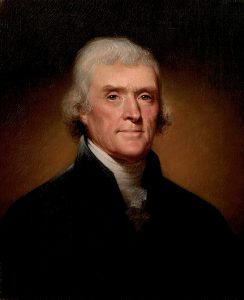
Jefferson, in his Notes on the State of Virginia argued that when there are disagreements among the branches of government, a constitutional convention should be called to correct the issues. His argument flows from the fact that the people are the only legitimate source of government power, so they should be called upon for their opinions. Madison acknowledges there is “certainly great force in this reasoning” [1] and that while an appeal to the people must be kept open, “frequent appeals would, in a great measure, deprive the government of that veneration which time bestows on every thing”.
The government, to function properly, must be able to solve its own problems without constant tweaking. Because a, “nation of philosophers is as little to be expected as the philosophical race of kings wished for by Plato”, it is important for the citizens of the republic to support this new structure and to avoid, “strongly the public passions” that putting issues directly to the people would likely evoke. This is in evidence to us daily. As our legislative branch becomes less and less deliberative in nature, and more and more reflective of the public passions, less and less can get done. As Aristotle advised our founders, politics is the art of the possible, and that compromise and cool heads are a requirement of good governance. Because all governments to this point had been formed in passionate times, they, “stifled the ordinary diversity of opinions on great national questions”.
The issue of resolving differences between the branches of government, if it went to the people, would naturally tend to be resolved in favor of the legislative branch because, “members of the executive and judiciary departments are few in number, and can be personally known to a small part only of the people.” Whereas the legislative branch is naturally closer to the people. Today, few people can rarely name their representatives, while many have strong opinions on the chief executive. It is interesting to contemplate the effect of this change on the character of our Constitution.
Madison cautions against involving citizens directly in disputes about the republic because, “PASSIONS, therefore, not the REASON, of the public would sit in judgment.”
If appealing to the people is the wrong way to avoid encroachments on the branches of the Federal government, what is the right way? In Federalist 50 Madison and Hamilton jointly explore this issue. At the time, Pennsylvania had a process that involved a council of censors whose job it was to identify possible encroachments. The problem was that this council was staffed by people already in government and they uniformly came down on opposite sides of the question meaning that the council was too political to be effective.
The authors consider the idea of a periodic review by the people. The objection here is that, if the interval for these reviews is short, the constitutional issues would be obscured by the various outcomes that people want. A modern example of this would be gerrymandering. While people are generally against the practice, the group in power benefits from the practice and therefore has little incentive to change. If the intervals are too distant, a popular review would have little effect on potential conflicts since the remedy is put off for another time.
In another shout out to us today, the authors mention the possibility of a non-elected group exploring this issue, the non-partisan task force if you will. To this Publius responds,
“The important task would probably devolve on men, who, with inferior capacities, would in other respects be little better qualified,” than an elected body. And further, even though, “they might not have been personally concerned in the administration, and therefore not immediately agents in the measures to be examined, they would probably have been involved in the parties connected with these measures, and have been elected under their auspices.”
Indeed.
To read all of John Parillo’s work on the Federalist Papers, check here.
If you enjoyed this article, then please REPOST or SHARE with others; encourage them to follow AFNN. If you’d like to become a citizen contributor for AFNN, contact us at managingeditor@afnn.us Help keep us ad-free by donating here.
Substack: American Free News Network Substack
Truth Social: @AFNN_USA
Facebook: https://m.facebook.com/afnnusa
Telegram: https://t.me/joinchat/2_-GAzcXmIRjODNh
Twitter: https://twitter.com/AfnnUsa
GETTR: https://gettr.com/user/AFNN_USA
CloutHub: @AFNN_USA
- All quotes are from https://guides.loc.gov/federalist-papers/text-41-50#s-lg-box-wrapper-25493411 ↑
The Originalist Court is in fact returning power to the Legislature, both Federal and State, while limiting the Court’s interference and Executive Agency power.
It’s hard to give power back to the Legislatures when so many of them are feeding at the federal teat.