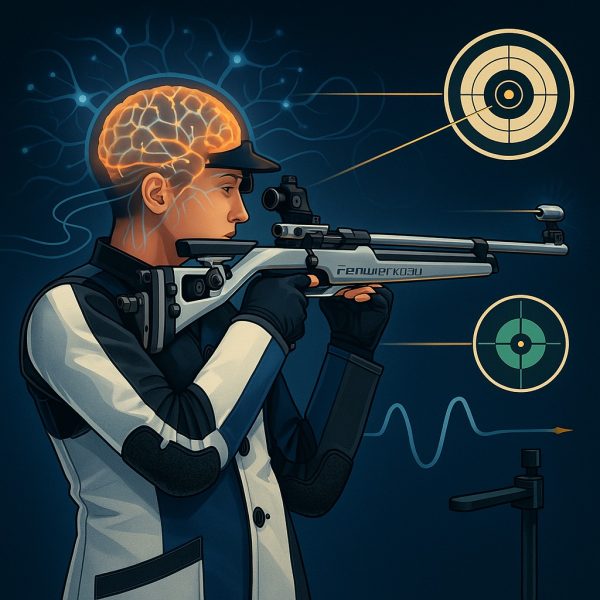
There’s a moment every great athlete eventually discovers — a flash so brief it hides between heartbeats.
The pitcher’s arm moves before the thought of “throw.”
The archer releases before deciding to.
The shooter breaks the shot without intending it.
It feels like magic, but it isn’t. It’s the highest form of motor control: the point where training replaces thinking. And it’s something every young athlete can learn — if they understand what they’re really training.
1. Muscles Don’t Win — Nervous Systems Do
The biggest misunderstanding in youth sports is that repetition builds muscles.
It doesn’t.
It builds neural circuits.
Every time an athlete performs a movement — a swing, a trigger press, a stride — neurons fire together in a precise pattern. Fire that pattern enough times, and it becomes a neural highway. The body no longer waits for step-by-step instructions from the brain; it knows the routine.
That’s why elite shooters talk about trusting the process. They’re not trusting a superstition — they’re trusting the system their nervous system has already built.
2. Repetition Builds Memory, Not Boredom
Young athletes often think repetition is punishment.
In truth, it’s programming.
The brain doesn’t learn in leaps — it learns in loops.
When you repeat the same motion with precision, you’re teaching the body what “right” feels like. The cerebellum — your built-in autopilot — uses that information to predict the future.
That’s why coaches emphasize consistent form over fast improvement. Sloppy reps don’t just waste time — they teach the nervous system to repeat errors.
3. Focus on Feeling, Not Thinking
Here’s the paradox: the harder you try to control a motion, the less control you have.
Thinking uses the slow part of the brain — the prefrontal cortex.
Feeling uses the fast part — the sensory-motor network.
That’s why top shooters say things like, “Let it happen.”
They don’t mean be careless. They mean: trust what’s already programmed in your 7 pound meat computer between your ears.
Young athletes should practice noticing sensations — the feel of the trigger, the rhythm of breath, the moment the sights settle — rather than reciting mental checklists.
The goal isn’t more thought; it’s clean relaxation and enjoyment of feeling in the moment.
4. Embrace the Boring
There’s a reason elite performance looks effortless: it’s built on thousands of quiet, uneventful repetitions. Thousands of good deep center shots.
Neuroscientists call this myelination — the process where neural pathways are wrapped in insulation so signals travel faster and cleaner.
Every correct repetition lays down another layer of myelin.
Every distraction, sloppy break or shortcut breaks it down.
“The boring consist work is the secret work. Every perfect rep rewires your brain for greatness and perfection.”
5. Visualization is Real Training
The brain can’t tell the difference between a vividly imagined repetition and a real one — the same neurons fire.
That’s why visualization is a cornerstone of Olympic and military marksmanship. It “tricks” your brain into thinking you’ve already shot a a thousand 10.9s, you’ve already shot “clean” a few times before. This is just routine and normal to the meat computer on autopilot.
Before practice or competition, encourage athletes to mentally fire 10.9 perfect repetitions — slow, calm, detailed in their imaginations.
They’ll strengthen the same neural circuits without fatigue, and enter real competition already neurologically primed to shoot 10.9s.
6. Master Calm Under Tension
This state only works when the nervous system is calm.
Fear, tension, and overthinking dump adrenaline into the system, which hijacks motor control and forces erratic movement — “flinching” is a worse case scenario.
Teaching athletes to breathe, relax their grip, relax their support hand and mentally “float” in the moment restores neural synchronization.
When calm returns, the shot happens on time, not too soon, not too late. Just perfect.
7. The Goal: Effortless Precision
Every athlete wants to be “in the zone,” but the zone isn’t a mystical place — it’s a neural state of trust.
The young athlete who trains this way learns a truth most never grasp:
“You don’t force the perfect shot — you just become a ten-machine who always breaks them in the middle.”
When the body, mind, and timing finally align, the act feels effortless.
And that’s when the real work begins — maintaining that level of performance for a lifetime.
If you enjoyed this article, then please REPOST or SHARE with others; encourage them to follow AFNN. If you’d like to become a citizen contributor for AFNN, contact us at managingeditor@afnn.us Help keep us ad-free by donating here.
Substack: American Free News Network Substack
Truth Social: @AFNN_USA
Facebook: https://m.facebook.com/afnnusa
Telegram: https://t.me/joinchat/2_-GAzcXmIRjODNh
Twitter: https://twitter.com/AfnnUsa
GETTR: https://gettr.com/user/AFNN_USA
CloutHub: @AFNN_USA