I am not Carl von Clausewitz, and I do not pretend to be Antoine-Henri Jomini with a sharper haircut. I have never diagrammed decisive points on vellum. I have, however, watched the last several years unfold and noticed something mildly inconvenient to our tidy “generations of warfare” PowerPoint slides: the future looks an awful lot like the past, just with better batteries.
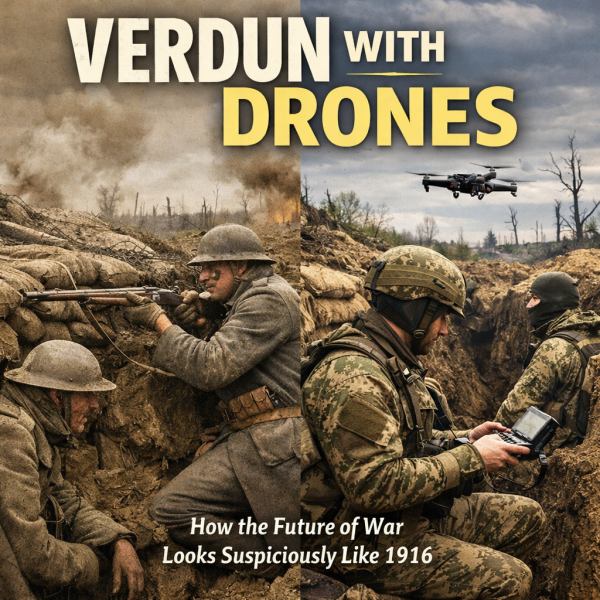
We were promised glide paths into a frictionless era of war. Precision would replace mass. Networks would replace mud. Information dominance would compress decision cycles so tightly that victory would arrive before the coffee cooled. Instead, the war in Ukraine settled into trenches, minefields, artillery duels, and casualty math that feels uncomfortably familiar to anyone who’s ever read about 1916. The aesthetic is pure World War I, except now every trench has a charging cable.
The irony is thick enough to fortify.
For three decades, Western doctrine assumed that maneuver, speed, and airpower would keep wars short and decisive. But when two industrially capable actors collide under persistent surveillance, movement becomes hazardous to your health. Drones hover like mechanical vultures. Thermal optics erase darkness. Satellites observe from orbit. If you mass forces, someone sees it. If you reposition armor, someone posts it before the dust settles. Detection has outrun mobility, and when lethality plus visibility exceeds speed, trenches reappear as if summoned by physics itself.
That’s not regression. That’s equilibrium.
In 1914, generals believed rail timetables and elan would carry the day. By late 1914, they were digging. In 2022, bold armored thrusts were supposed to reshape maps in weeks. By 2023, defensive belts hardened and attrition took center stage. The pattern is less evolutionary ladder and more pendulum swing. When mobility dominates, you get blitzkrieg. When firepower and detection dominate, you get mud.
And now we add a 21st-century twist: orbital infrastructure.
When Elon Musk deployed Starlink terminals across the battlefield environment, connectivity became more than convenience. It became nervous tissue. Command and control, targeting data, drone feeds, logistics coordination, encrypted communications—all of it rode on bandwidth. In earlier wars, cutting telegraph lines disrupted a division. In this one, altering satellite connectivity can ripple across entire sectors. When access expands, tempo accelerates. When it contracts, confusion creeps in. Units accustomed to real-time awareness suddenly feel like they’re fighting with mittens on.
Clausewitz did not include “private-sector orbital toggle switch” in his taxonomy of friction, but here we are.
The uncomfortable truth is that industrial capacity still matters enormously. Shell production rates. Replacement cycles. Repair depots. Mobilization depth. None of that disappeared just because we invented cloud computing. What has changed is that information amplifies firepower. A well-connected artillery unit corrects faster. A networked drone swarm identifies targets quicker. A disrupted network slows everything down, even if the guns are still loaded.
So no, we did not graduate into a clean fifth-generation utopia where cyber replaces steel. We layered cyber on top of steel. We stacked orbital routers above trenches. We combined mud with megabytes.
There’s dark comedy in the contrast. Somewhere, a 21st-century infantryman crouches in a zigzag trench design recognizable to a French sergeant from 1916, while overhead a constellation of satellites beams encrypted data to a tablet that adjusts artillery in seconds. The geometry of the trench is antique. The bandwidth is futuristic. The attrition is timeless.
What this war suggests—without needing a Prussian accent—is that warfare oscillates between movement and stalemate depending on the balance between mobility and lethality. When detection is cheap and precision is accessible, exposure is deadly. When exposure is deadly, maneuver slows. When maneuver slows, endurance becomes strategy. And endurance is not glamorous. It is measured in factory output, recruitment numbers, and whether your networks stay online when someone tries very hard to turn them off.
The generational warfare charts promised tidy progressions. First generation, second generation, third. But reality looks less like a straight staircase and more like sedimentary layers. Industrial artillery never left; it just got GPS. Trenches never vanished; they just gained Wi-Fi. Political will and economic stamina never stopped mattering; we just renamed them resilience.
I am not Clausewitz. I have no grand unified field theory of conflict. But I can observe that war stubbornly refuses to behave like software updates. It does not eliminate previous versions. It compiles them together.
Right now, the pendulum sits closer to Verdun than Desert Storm, closer to attrition than maneuver. And the battlefield reminder is sobering: technology changes tools, but it does not repeal physics, geography, or human endurance.
The future of war may not be sleek, decisive, and short.
It may be trenches—with orbiting routers overhead.
If you enjoyed this article, then please REPOST or SHARE with others; encourage them to follow AFNN. If you’d like to become a citizen contributor for AFNN, contact us at managingeditor@afnn.us Help keep us ad-free by donating here.
Substack: American Free News Network Substack
Truth Social: @AFNN_USA
Facebook: https://m.facebook.com/afnnusa
Telegram: https://t.me/joinchat/2_-GAzcXmIRjODNh
Twitter: https://twitter.com/AfnnUsa
GETTR: https://gettr.com/user/AFNN_USA
CloutHub: @AFNN_USA