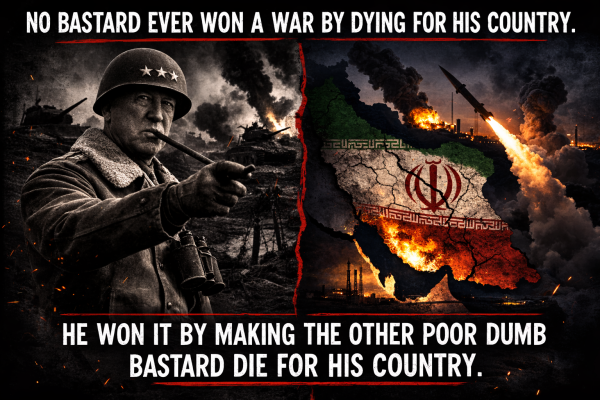
There are generals, there are famous generals, and then there is George S. Patton — a man so aggressive, so profane, and so obsessed with winning that modern bureaucratic leadership culture still doesn’t quite know what to do with him. Patton did not believe in safe careers, consensus management, or PowerPoint slides. He believed in movement, violence of action, and the simple idea that wars are won by killing the enemy faster than he can kill you. In an age where leadership often means managing perceptions, Patton practiced leadership that meant closing with and destroying the enemy. That difference alone explains why he remains both admired and quietly avoided in professional military circles today.
Patton’s most famous line, delivered to the Third Army in 1944, captured his philosophy better than any manual ever written: “No bastard ever won a war by dying for his country. He won it by making the other poor dumb bastard die for his country.” That was not just colorful language. It was a direct rejection of the romantic nonsense that had gotten an entire generation slaughtered in World War I. Patton had seen that war. He had been wounded in it. He understood that modern industrial warfare was not a stage for heroic poetry. It was a contest of logistics, speed, firepower, and will. His job was not to produce martyrs. His job was to produce victory.
Unlike many modern leaders, Patton was not afraid of being disliked. In fact, he seemed to assume that if everyone was comfortable, something was wrong. He demanded discipline, demanded aggression, and demanded results. He believed that fear existed in every soldier, but that leadership meant giving men confidence in themselves and in the mission. His speeches were not polite because war is not polite. He used profanity, humor, and blunt truth because those things cut through fear faster than motivational slogans ever could. Patton understood something many leaders forget: men will follow someone who sounds like he actually intends to win.
Patton’s leadership also came from an almost obsessive study of history. He read constantly, studied Napoleon, Caesar, and the campaigns of ancient and modern armies, and believed deeply that war had patterns that repeated across centuries. He did not think technology changed human nature. Tanks and airplanes might replace horses and swords, but courage, confusion, pride, fear, and momentum were still the deciding factors. That belief made him dangerous to the enemy and uncomfortable to bureaucracies, because history teaches that victory rarely comes from committees.
One of Patton’s greatest strengths was speed. During World War II, his forces moved faster than almost anyone thought possible, not because he had better equipment, but because he refused to let friction stop him. When others waited for perfect plans, Patton attacked with imperfect ones. When supply lines stretched thin, he kept moving anyway. When higher headquarters hesitated, he pushed forward until someone told him to stop, and sometimes even after that. He believed that bold action created opportunities that cautious planning never would. In modern language, he understood initiative long before it became a buzzword.
That same aggressiveness made him controversial, both then and now. He slapped a soldier suffering from combat fatigue and was nearly relieved of command. He spoke his mind in ways that embarrassed politicians. He did not understand the modern instinct to say one thing publicly and another privately. But even his critics admitted one thing: when the shooting started, Patton was the man you wanted in charge. He did not freeze, he did not waffle, and he did not wait for permission to win.
Modern leadership culture often prefers managers to warriors, consensus to decisiveness, and safety to victory. That is one reason Patton still feels out of place in the twenty-first century. His style reminds us that war is not a corporate retreat, and leadership is not about being liked. It is about responsibility for lives, responsibility for results, and the willingness to make decisions when the cost of hesitation is measured in blood.
Patton was not perfect. No real commander ever is. But he understood something timeless that every generation has to relearn the hard way: wars are not won by slogans, by theory, or by carefully worded statements. They are won by leaders who move faster, hit harder, and refuse to accept defeat as an option. That is why his words still get quoted, why his speeches still get watched, and why his example still makes comfortable people uneasy.
In the end, Patton’s legacy is simple. He did not try to make war sound noble. He tried to make his soldiers survive it — and win it. And in a world that still likes to pretend conflict can be managed politely, that kind of leadership will always sound a little dangerous, a little offensive, and absolutely necessary.
If you enjoyed this article, then please REPOST or SHARE with others; encourage them to follow AFNN. If you’d like to become a citizen contributor for AFNN, contact us at managingeditor@afnn.us Help keep us ad-free by donating here.
Substack: American Free News Network Substack
Truth Social: @AFNN_USA
Facebook: https://m.facebook.com/afnnusa
Telegram: https://t.me/joinchat/2_-GAzcXmIRjODNh
Twitter: https://twitter.com/AfnnUsa
GETTR: https://gettr.com/user/AFNN_USA
CloutHub: @AFNN_USA
Ahh Patton. He would never have survived in todays Army. Independently wealthy, he showed up at Ft. Bliss and eventually brought enough of his own horses to field polo events. Designed the Army saber named for him. He went on leave to join later General of the Armies (a six star equivalent rank) Black Jack Pershing to pursue Pancho Villa. He volunteered to lead an effort to master tank tactics in the California desert under inhospitable conditions, writing Army doctrine which revolutionized tactics that paid off in WWII. He advocated to continue fighting to chase the Soviets back to their own borders while we had the forces in Europe to do so. Politically incorrect before it was fashionable, he was relegated to England for his behavior where he would serve as a disinformation campaign drawing attention off Normandy. A magnificent tactician and irrepressible personality born to fight who gave no quarter and never expected any in return. VMI and West Point grad. He was 60 when he died in a truck accident at the close of WWII.
Reading “Patton: Ordeal and Triumph” by Ladislas Farago, after Germany’s surrender, Ike, Bradley and Marshall wondered about the “Patton matter.” He knew this was his last war and Patton said to get a Pacific command he would take a rank reduction to Major General, but MacArthur did not want him. They both knew from WW I, a theater was not big enough for the two of them. Fait took care of the issue, but no question, he would not have survived in the modern Army.
There was also the lingering issue between the two men that had not been resolved when MacArthur as Chief of Staff zealously overstepped his orders from the president, personally involved himself in overseeing the mayhem that followed against the so-called Bonus Expeditionary Army demonstrations in DC in July 1932 that his aide Eisenhower tried to persuade him to stay out of and allow the men to do their jobs. While a reticent Patton-leading the cavalry- did his duty but would regard this action as the most “distasteful form of service,” regarding the Bonus men as “poor ignorant men without hope, desperate, but with no evil intent.” Patton would later find out that a man who saved his life 14 years earlier when he pulled the wounded Patton from a foxhole-Joseph Angelo-was among the marchers. There was no theater big enough to contain those two egos: and Patton never gave a hoot about rank…
There was also the lingering issue between the two men that had not been resolved when MacArthur as Chief of Staff zealously overstepped his orders from the president, personally involved himself in overseeing the mayhem that followed against the so-called Bonus Expeditionary Army demonstrations in DC in July 1932 that his aide Eisenhower tried to persuade him to stay out of and allow the men to do their jobs. While a reticent Patton-leading the cavalry- did his duty but would regard this action as the most “distasteful form of service,” regarding the Bonus men as “poor ignorant men without hope, desperate, but with no evil intent.” Patton would later find out that a man who saved his life 14 years earlier when he pulled the wounded Patton from a foxhole-Joseph Angelo-was among the marchers. There was no theater big enough to contain those two egos: and Patton never gave a hoot about rank…