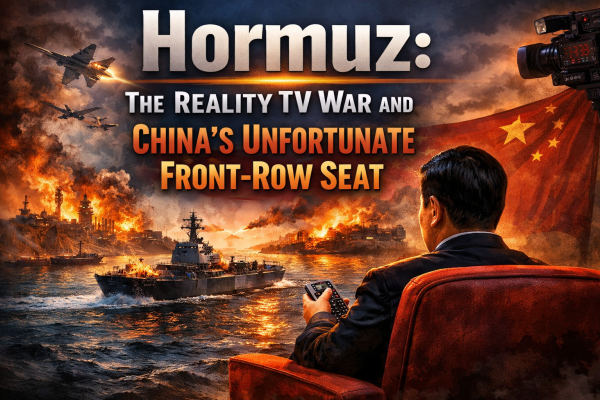
Modern war has acquired an odd new feature. It now comes with graphics, dramatic music, and a nightly highlight reel. Precision bombs streak across the screen. Drones glide in cinematic slow motion. Social media fills with grainy infrared footage of things exploding in the desert while commentators nod gravely and say phrases like “escalation dynamics” and “rules-based order.”
In other words, modern conflict increasingly looks like a reality TV show with better explosives.
But as the cameras pan across the Persian Gulf and the world watches the latest episode of “War in the Middle East: Season Whatever-We’re-On-Now,” there’s a small geographical detail that keeps quietly hijacking the plot.
It’s called the Strait of Hormuz.
This narrow maritime hallway—barely 21 miles wide at its tightest point—handles roughly a quarter of the world’s traded oil. Every day, massive tankers creep through it like nervous elephants in a very small doorway, carrying crude oil, liquefied natural gas, petrochemicals, and fertilizer feedstocks to the rest of the planet.
If Hormuz shuts down, the global economy doesn’t politely slow down.
It hiccups violently.
But here’s the interesting part: the biggest loser in a Hormuz crisis probably isn’t the country most people assume.
Twenty years ago the obvious answer would have been the United States. Back then America was deeply dependent on Middle Eastern oil. But the shale boom changed the game. The U.S. still cares about global oil prices—everyone does—but it’s far less exposed than it used to be.
The real vulnerability now sits across the Pacific.
China.
China is the world’s largest oil importer, sucking in somewhere around 11–12 million barrels of crude per day to keep its massive industrial engine humming. A huge chunk of that oil originates in the Persian Gulf and must travel directly through the Strait of Hormuz before beginning the long journey toward Chinese refineries.
That means every time tensions rise in the Gulf, Beijing’s strategic planners suddenly remember that their economic lifeline passes through a narrow maritime chokepoint located suspiciously close to Iran.
Not ideal.
China has tried to reduce this vulnerability. Pipelines from Russia and Central Asia help. Strategic petroleum reserves have been built. Coal still carries a large share of the electricity load. But none of those measures fully replace the sheer volume of Gulf oil flowing east through Hormuz.
In other words, while the world watches the Middle East crisis unfold like a Netflix series, China may be the next contestant forced onto the stage.
If this geopolitical reality show keeps escalating, the next episode could easily be titled:
“China Discovers Geography.”
India isn’t far behind on the vulnerability scale either. The country imports more than 85 percent of the oil it consumes, and a large share of that comes from Gulf producers such as Saudi Arabia, Iraq, and the UAE. Much of it also sails straight through Hormuz. If shipping disruptions intensify, India’s fuel prices could spike quickly.
Then there are Japan and South Korea, two industrial powerhouses that also depend heavily on Middle Eastern oil. The difference is that these countries plan ahead like obsessive engineers. They maintain massive strategic petroleum reserves and diversified energy systems that include nuclear power and liquefied natural gas. They’re exposed, but they have cushions.
And even distant countries like Australia aren’t immune. Australia imports most of its liquid fuels, and much of that fuel is refined in Asian refineries that rely on Gulf crude. The tanker that eventually reaches Australia may have started its trip in Singapore—but the oil inside probably passed through Hormuz earlier in the supply chain.
So yes, geography still runs the show.
In an age of drones, cyber warfare, and satellite surveillance, the fate of global energy markets still depends on whether tankers can squeeze through a narrow stretch of water between Iran and Oman.
It’s a stubborn reminder that for all our technological wizardry, the world economy still hinges on a few pieces of terrain that haven’t changed since the age of sail.
And if this geopolitical reality show keeps rolling, the biggest plot twist might not happen in the Middle East at all.
It might happen in Beijing—when China realizes the global economy’s most important doorway is only 21 miles wide, and everyone is watching to see who controls it.
If you enjoyed this article, then please REPOST or SHARE with others; encourage them to follow AFNN. If you’d like to become a citizen contributor for AFNN, contact us at managingeditor@afnn.us Help keep us ad-free by donating here.
Substack: American Free News Network Substack
Truth Social: @AFNN_USA
Facebook: https://m.facebook.com/afnnusa
Telegram: https://t.me/joinchat/2_-GAzcXmIRjODNh
Twitter: https://twitter.com/AfnnUsa
GETTR: https://gettr.com/user/AFNN_USA
CloutHub: @AFNN_USA