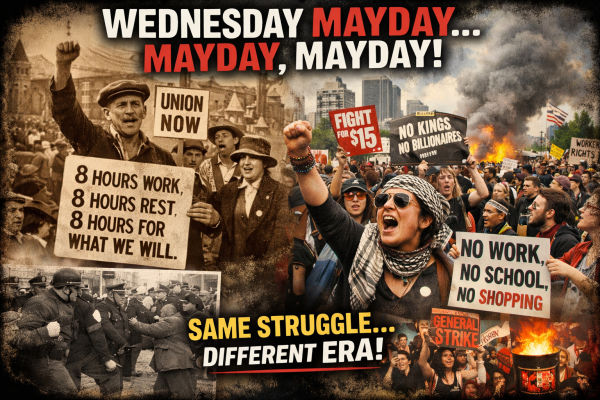
May Day—May 1—has always been less about flowers and spring and more about pressure. It’s a day built on friction, born out of industrial tension, and carried forward by generations who believe the only language power understands is disruption.
The roots go back to the late 19th century, when American labor was less “9 to 5” and more “sunup to collapse.” The rallying cry was simple: eight hours for work, eight for rest, eight for life. In 1886, that demand erupted into nationwide strikes, culminating in the infamous Haymarket Affair in Chicago. A bomb, gunfire, dead police, dead civilians, and a trial that still sparks debate today. It was messy, chaotic, and deeply human—exactly the kind of event that leaves a permanent scar on history.
Ironically, while May Day was born in the United States, it was largely exported. Europe embraced it. Socialist and communist movements elevated it. The Soviet Union turned it into a parade of state power. Meanwhile, America—never fond of anything that smelled too much like collectivism—shifted its official Labor Day to September. But the original DNA never disappeared. It just went underground, waiting for moments of economic stress to resurface.
Fast forward to 2026, and here we are again.
A loose coalition of activist networks, including groups like May Day Strong, are calling for a national “day without” participation—no work, no school, no shopping. It’s the modern version of an old tactic: demonstrate how much the system relies on the average person by briefly withdrawing that participation. In theory, it’s leverage. In practice, it’s a stress test.
Their goals are layered. At the surface level, it’s about wages, cost of living, and worker protections. Inflation has outpaced paychecks, housing costs have climbed into the stratosphere, and the gig economy has replaced stability with flexibility—depending on your perspective, that’s either liberation or exploitation. May Day organizers are betting that enough Americans feel the latter.
Underneath that sits a broader political aspiration. This isn’t just about hourly wages or benefits packages. It’s about signaling—showing visible, collective dissatisfaction with the direction of the country. It’s about influencing narratives heading into election cycles, pressuring policymakers, and reminding institutions that legitimacy ultimately rests on public consent.
And then there’s the cultural layer. America, unlike France or parts of Europe, doesn’t have a modern tradition of mass, coordinated labor strikes. We don’t instinctively shut things down when we’re unhappy. We argue online, we vote, we complain—but we rarely walk out in unison. Movements like this are trying to rebuild that muscle memory, to prove that collective action is still possible in a fragmented, hyper-individualized society.
Now for the reality check.
For a true general strike to work, you need scale and structure. You need major unions fully committed, industries aligned, logistics in place, and enough participation to create real economic friction. That’s a high bar. As of now, there’s little indication that the kind of institutional backing required for a nationwide shutdown is in place.
What we’re more likely to see is uneven participation. Urban areas will host protests and marches. Some students will walk out. Certain workplaces—especially those already sympathetic to the cause—may see reduced staffing. Social media will amplify it all, giving the impression of something larger than it may actually be on the ground.
That doesn’t mean it’s meaningless. Visibility matters. Narrative matters. Even a partially successful demonstration can shape public discourse, influence media coverage, and signal to politicians where energy is building. But it’s unlikely to produce immediate, tangible policy change on its own.
And that brings us to the First Amendment.
Whatever one thinks of the goals, the grievances, or the strategy, this is a textbook example of Americans exercising their constitutional rights—speech, assembly, and protest. That’s not a bug in the system; it’s a feature. The same framework that protects causes you agree with also protects the ones you think are misguided, unrealistic, or even counterproductive.
Some will view the 2026 May Day effort as a necessary pushback against economic imbalance. Others will see it as performative activism—more noise than impact, more symbolism than substance. Both perspectives can exist at the same time, because that’s the nature of a free society.
In the end, May Day has always been a mirror. It reflects the tensions of its time—industrial in 1886, ideological in the 20th century, economic and cultural today. Whether this year’s effort fizzles into a footnote or builds into something more enduring depends on one simple question:
How many people actually show up—and what they’re willing to risk when they do.
If you enjoyed this article, then please REPOST or SHARE with others; encourage them to follow AFNN. If you’d like to become a citizen contributor for AFNN, contact us at managingeditor@afnn.us Help keep us ad-free by donating here.
Substack: American Free News Network Substack
Truth Social: @AFNN_USA
Facebook: https://m.facebook.com/afnnusa
Telegram: https://t.me/joinchat/2_-GAzcXmIRjODNh
Twitter: https://twitter.com/AfnnUsa
GETTR: https://gettr.com/user/AFNN_USA
CloutHub: @AFNN_USA