Forget the timeline arguments for a minute. Set aside the academic cage match over dates, carbon curves, and who’s got the better spreadsheet of ancient dust. Start instead with something far more obvious—there was a world before everything went sideways, and there was a world after.
Call it the Younger Dryas. Call it the Flood. Call it the great reset nobody can quite agree on without throwing chairs. Doesn’t matter. What matters is this: something hit the system hard enough that both humans and animals had to regroup, reorganize, and relearn how to survive in a harsher, leaner world.
And in that world, man made one of the most consequential decisions in human history.
He kept the wolf.
Not all of them, of course. The big, aggressive, eat-your-face wolves didn’t get invited into the campfire circle. Those got driven off or killed. But the ones that lingered just close enough—bold but not stupid, cautious but not useless—those started hanging around. At first, it was a convenience. They cleaned up scraps. They barked when something moved in the dark. Early warning systems with teeth.
But convenience has a way of becoming strategy.
Humans figured out quickly that these animals were more than background noise. They were force multipliers. A man alone can hunt. A man with a semi-trained canid suddenly has reach, tracking ability, and persistence that borders on unfair. That’s not companionship. That’s capability.
So what did humans do? The same thing we’ve always done when we find something useful—we refined it.
No lab coats. No gene editing. Just brutal, consistent selection. Keep the useful ones. Remove the ones that don’t fit. Repeat. Over and over. Generation after generation.
And here’s where it gets uncomfortable for people who like their timelines neat and slow: that process works fast. Really fast. You don’t need millions of years to turn a wolf into something else when you’re applying constant pressure with a clear objective. We’ve seen it in modern breeding. We can take one line and push it into radically different outcomes in what amounts to a blink.
Small, compliant, human-focused animals become companions. Larger, more aggressive lines become guardians. Hyper-focused, high-drive lines become herders or trackers. You didn’t just get “a dog.” You got categories. Functions. Specializations.
You got a system.
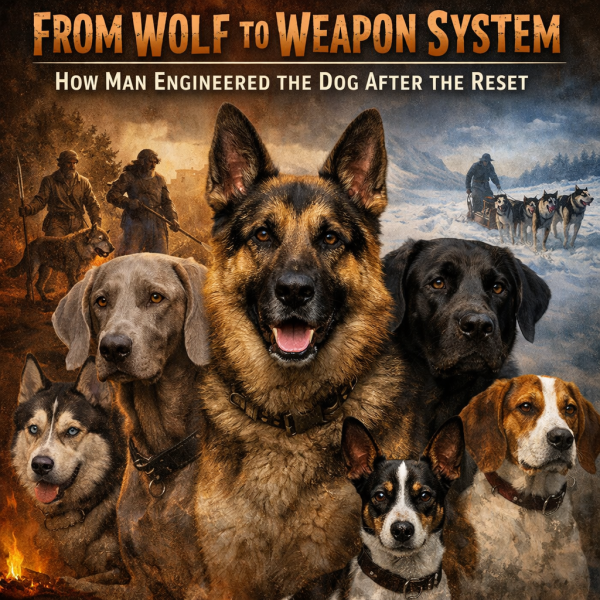
And that’s the point most people miss. The dog wasn’t just domesticated—it was engineered, within its created bounds, into roles that served human needs. Long before silicon chips and robotics, mankind built its first scalable technology out of muscle, instinct, and selective pressure.
A sheepdog isn’t just a pet. It’s a distributed livestock management system. A sled dog isn’t just an animal. It’s a cold-weather logistics platform. A protection dog is a mobile security asset that doesn’t need batteries and doesn’t hesitate when things get ugly.
We like to think we invented machines first and only later got smart about biology. The reality is the opposite. The first “machine” we ever built was alive.
Now here’s where the evolutionary and Biblical frameworks stop arguing and start overlapping.
From a scientific perspective, what you’re looking at is selection pressure—environment plus human influence driving rapid change. From a Biblical perspective, this lines up cleanly with the mandate in Genesis to exercise dominion over living things. Not domination in the cartoon-villain sense, but ordered authority—taking what is wild and aligning it toward purpose.
The dog is that principle in motion.
A predator becomes a partner. Chaos becomes cooperation. Instinct gets bent—just enough—to serve something higher up the chain. And here’s the kicker: it’s mutually beneficial. The dog trades independence for stability—steady food, protection, longer life. Humans trade a small amount of effort for a massive gain in capability.
That’s not exploitation. That’s structured dependence. It’s a system where both sides win, but one side clearly directs.
And not every culture bought into it.
In some regions, dogs stayed what they always were—scavengers, disease risks, unpredictable liabilities. Those cultures labeled them unclean, pushed them to the margins, or ignored them entirely. In others—especially where survival depended on efficiency—dogs became indispensable.
That divide tells you something important. Humans don’t assign meaning to animals randomly. They assign value based on utility. If the animal solves problems, it gets integrated. If it creates problems, it gets rejected.
Simple as that.
But across the cultures that leaned in, one thing becomes undeniable: dogs didn’t just change because of humans—they changed toward humans. They read us. They anticipate us. They sync with our behavior in a way no other species quite matches.
That’s not accidental. That’s proximity shaping biology.
So step back and look at what you’re actually seeing.
After a world-level disruption—whatever you believe caused it—humans didn’t just survive. They reorganized. They took a dangerous, unpredictable animal and turned it into one of the most versatile tools ever created. Not cold steel. Not circuits. Something better.
Something that thinks. Moves. Adapts.
And stays.
The dog isn’t just man’s best friend. It’s proof of concept.
Proof that when pressure hits, humans don’t just endure chaos.
We bring order to it.
If you enjoyed this article, then please REPOST or SHARE with others; encourage them to follow AFNN. If you’d like to become a citizen contributor for AFNN, contact us at managingeditor@afnn.us Help keep us ad-free by donating here.
Substack: American Free News Network Substack
Truth Social: @AFNN_USA
Facebook: https://m.facebook.com/afnnusa
Telegram: https://t.me/joinchat/2_-GAzcXmIRjODNh
Twitter: https://twitter.com/AfnnUsa
GETTR: https://gettr.com/user/AFNN_USA
CloutHub: @AFNN_USA