In recent months, Pope Leo XIV has taken a number of direct swipes at Trump administration policies, and after absorbing a good deal of this without response, President Trump himself responded on TruthSocial, essentially reminding the Pope that political issues don’t occur in a vacuum; peaceful platitudes may sound nice, but they are no response to the genuine problems that governments are duty-bound to address.
What are the issues in question?
- Immigration law and the dangerous mix of good workers, indigents, and criminals whose border-jumping must all somehow be addressed by border enforcement.
- Unemployment, poverty, and the challenges of one nation’s economy that’s being impossibly stretched in an effort to care for the entire world.
- Finally responding to 47 years of Iranian aggression in the only way that we could – by working to terminate the demonic regime militarily.
These are all legitimate issues for politicians to discuss; here in the United States, politicians of both parties have talked about them, and even held the same public positions, for decades. Both Republicans and Democrats have verbally advocated border enforcement, restraining the welfare state, encouraging economic growth, and dealing with Iran, even if President Trump was the first one in quite a while to seriously follow through.
And there are other heads of state – in France and Italy, Britain and Germany, Mexico and Canada – who’ve addressed these issues too, in public and in their respective parliaments, without anyone thinking it odd.
The only odd thing about it is the special nature of the Vatican.
We think of Pope Leo XIV as a holy man, as a preacher and administrator of a church. And that’s fair, since the Catholic Church is in fact the world’s largest single organized denomination, and its pope is always going to be well known.
But that’s not his only role.
What we tend to forget – perhaps by intent, and perhaps because so many pundits don’t even know the subjects they’re addressing – is that Pope Leo XIV is also a head of state himself. He and Donald Trump, and Giorgia Meloni and Emanuel Macron for that matter, along with the other kings and dictators and presidents and prime ministers of the world – are equals at the table, in the political arena.
While Vatican City is one of the world’s smallest nations (less than a square mile in area, with less than a thousand permanent residents), the Vatican is nevertheless one of the most significant countries on earth, with adherents in every country, and with automatic allies and a huge diplomatic presence across the globe.
The Vatican holds a unique position in the family of nations, and its leader holds an even more unique position in the family of world leaders.
History students sometimes notice with shock how, on rare occasion, foreigners have ascended to the crown of another country, here and there.
George I of the United Kingdom was born and raised in Hanover (in modern day Germany), and didn’t even speak English. Catherine the Great of Russia was born in Prussia (also a German) and spoke Russian with a heavy German accent. William of Normandy was French, but ruled England after winning the Battle of Hastings.
And the ruler of the Vatican is almost always a citizen of some other country (usually Italy, but not always), all his life, right up until his election to the Papacy.
The Vatican’s last five rulers have in fact been from five different countries. Pope Leo XIV was raised in the USA, though he spent enough time in Peru to gain dual citizenship there, before being elevated to the papacy last year.
His predecessor as head of the Vatican was Cardinal Bergoglio of Argentina. Bergoglio’s predecessor was Cardinal Josef Ratzinger of Germany. His predecessor was Cardinal Karol Wojtyla of Poland. We have to go back almost 50 years, to Pope John Paul I – Cardinal Albino Luciani – the last Italian to lead the Vatican.
It’s worth spending a moment on Cardinal Luciani, since one could argue that he’s a major reason the Pope is viewed differently today than he used to be.
Since the Catholic Church has had its own country for over a thousand years (however small it may be!), the Catholic Church considers its pope to hold multiple, distinct roles: as head of the church hierarchy, as representative of Christ on earth, and as the monarch of this tiny nation.
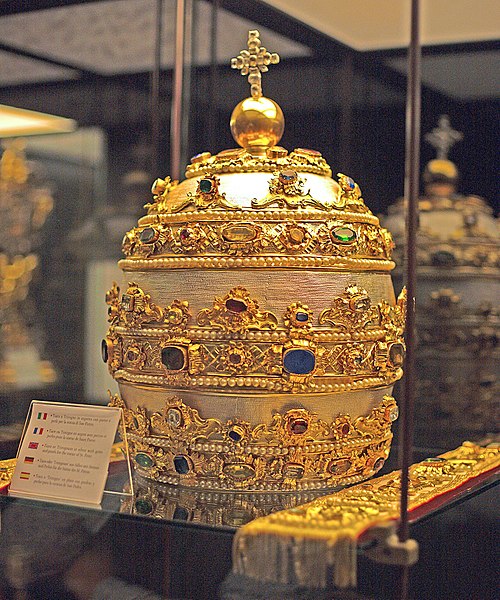
For half a millenium, popes wore a triple crown – the Triregnum – to symbolize this union of both Heavenly and Earthly offices. Cardinal Luciani, upon his election as pope, chose to have an “inauguration” instead of a “coronation” in order to renounce the trappings of earthly monarchy – and he renounced the triple crown – but that doesn’t change the fact that the role is still that of a head of state.
So when we hear Pope Leo XIV make public statements condemning the actions of an American administration – or of any other country’s administration, for that matter – we should take it as the opinion of a foreign leader, that’s all. Pope Leo has every right to make such comments, and others have every right to agree or disagree with them.
What makes this a challenge is that when any pope speaks, it’s difficult for the listener to tell whether he is speaking as a religious leader or as a head of state. This is made more complicated by the common assumption that Catholics believe their pope to be infallible in his public pronouncements (a complete misunderstanding, as the Catholic doctrine of infallibility is in fact extremely limited).
Similarly, our administration is necessarily uncomfortable in crafting a response to him, since many high-ranking members of the Trump administration are Catholic, and therefore don’t feel right going to the press and punching back at the head of their church.
One could argue that Pope Leo is abusing his power, making political points, while being protected from the typical back-and-forth political debate between equals that would follow any other leader’s remarks on such matters.
None of the issues at hand are simple, clear, black-and-white matters of morality, and Pope Leo is being unfair in presenting them as if they were. While a pastor may feel compassion for all sides in a conflict, a government has an obligation to protect its own citizens from invaders and attackers, and would be guilty of treason if it treated such enemies more generously than it treated its own citizens.
This isn’t to say that Pope Leo is necessarily aware of his unfairness. While numerous popes have come up through the diplomatic ranks, with experience dealing with world leaders and the captains of industry, Pope Leo ascended to the office severely unprepared for a world of press conferences and global news coverage.
One can hope that he finds his way; it’s only been a year, and this is one of the toughest positions to have to learn on the job, as it were.
But for the time being, one hopes that Pope Leo will find a way to appreciate the different sides of his position. Just as a pastor needs to try to put himself in the shoes of his congregation when delivering a sermon, a head of state needs to try to put himself in the shoes of his fellow rulers before criticizing their policies.
There is nothing new under the sun; the Catholic Church has had to deal with all the same problems over the centuries that the Trump administration is facing today. Italy has had to contend with the mafia, just as today’s America contends with the cartels. The Church has had to try to spur economic growth to help the poor, just as America tries to revitalize its manufacturing sector to help those left behind by global sourcing. And the Church has organized many a response to islamic land-lust over the centuries, from the Crusades to the Battles of Lepanto and Vienna, just as America today is responding to the brutality of the Twelver mullahs in Tehran.
The Vatican has often been on the side of right in such matters in the past; we hope and pray that Divine Providence will guide Pope Leo XIV and his administration to be eloquent supporters of the side of right today as well.
But either way, the government of these United States must do the right thing, for itself and for the world, whether Pope Leo XIV has the grace to understand the need to support us or not.
Copyright 2026 John F Di Leo
John F. Di Leo is a Chicagoland-based international transportation and trade compliance trainer, speaker, and consultant. A President of the Ethnic American Council in the 1980s and Chairman of the Milwaukee County Republican Party in the 1990s, his book on vote fraud (The Tales of Little Pavel), his political satires on the Biden-Harris administration (Evening Soup with Basement Joe, Volumes I, II, and III), and his first nonfiction book, “Current Events and the Issues of Our Age,” are all available in either eBook or paperback, only on Amazon. His trade compliance training practice is available either in person or by webinar.
If you enjoyed this article, then please REPOST or SHARE with others; encourage them to follow AFNN. If you’d like to become a citizen contributor for AFNN, contact us at managingeditor@afnn.us Help keep us ad-free by donating here.
Substack: American Free News Network Substack
Truth Social: @AFNN_USA
Facebook: https://m.facebook.com/afnnusa
Telegram: https://t.me/joinchat/2_-GAzcXmIRjODNh
Twitter: https://twitter.com/AfnnUsa
GETTR: https://gettr.com/user/AFNN_USA
CloutHub: @AFNN_USA