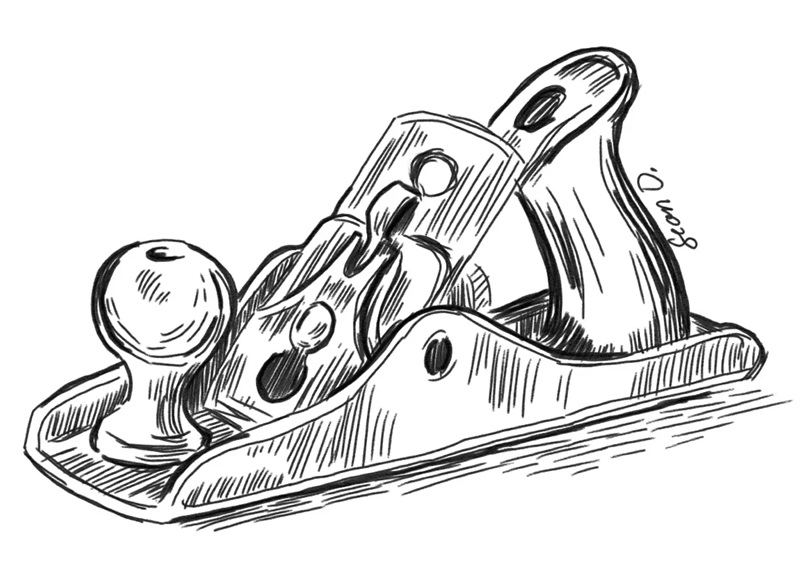
Fulton, New York. The year was 1940. The gray-haired man was behind his woodworking bench, clad in an apron. He was feeling around for his spokeshave. He was blind and deaf. His name was Tommy Stringer.
The 18-year-old girl beside him was his assistant for the day. She was lovely and helpful. Her name was Mari. She was deaf.
She noticed Tommy grasping for a tool, so she tried to help him. Tommy could feel her hands furiously searching his bench.
He gripped her wrist.
“What do you think you’re doing?” he signed into her palm.
She replied, “Looking for your spokeshave.”
“I didn’t ask for your help,” he spelled rapidly. His fingers moved so fast she could hardly follow.
“If you truly want to teach blind-deaf students someday,” he spelled, “you must resist the urge to step in and do a task for them.”
The 54-year-old master craftsman was no amateur. He was adept with his tools. To watch him work quickly and comfortably in his shop was like watching a sculptor work with clay.
Mari was not blind, but born mostly deaf. She was learning manual sign language to become an interpreter and teacher for the deaf-blind someday. The Perkins School for the Blind sent her here to Tommy’s shop to learn from him. Tommy was one of Perkins’ most notable alumni.
He was a gifted artist. An expert with numbers, capable of conceiving and calculating complicated engineering equations in his head.
Tommy’s hands finally found the spokeshave. He placed the shave into one of Mari’s hands and spelled into her other:
“Do you want to try?”
“Yes.”
Tommy stood behind her. He guided her young hands with his own. Mari had never done a thing with wood before. She found enormous pleasure seeing the spokeshave blade remove curls of white wood, like long ribbons, as though peeling a carrot.
“How did you start woodworking?” she signed.
Tommy smiled. He spelled into her upturned palm. “It all started when a dog died.”
“A dog?”
He nodded. “Her name was Lioness. She was a Mastiff.”
“How did she die?”
“She wandered into the street and a policeman mistook her for a rabid animal. He shot her. It was a horrible, horrible day.”
Mari didn’t know how to respond, so she simply signed: “I’m sorry.”
“Don’t be,” spelled Tommy. “The dog wasn’t even mine.”
“Whose was it?”
“It belonged to a little girl.”
Mari signed that she was confused. Tommy made rapid shapes into her hand and put the story together.
“My parents were poor when I got sick, which left me deaf and blind. Things got worse. When I recovered, my mother died. Then my father abandoned me. I grew up in a hospital bed. I was too atrophied to even walk. Unable to feed myself or use the bathroom on my own. They said I would be an invalid.”
Mari tried to keep up with his quick fingerspelling gestures.
“I was an orphan, bound for the almshouse. Things were looking bad for me. My life was over. But then that poor dog died, and everything changed.”
“I don’t understand,” spelled Mari.
Tommy removed his leather apron, then brushed wood chips from his shirt.
“The story of the little girl’s dog made national newspapers. And soon, people from all over the United States were donating money for a new dog. Envelopes filled with cash arrived on the little girl’s doorstep, from all over the nation.
“But as fate would have it, it was around that same time the girl learned of me, a blind-deaf toddler in Pennsylvania. She decided she did not want a new dog. She wanted to send all her money to me.”
“Heavens,” Mari spelled into his hand. “How generous.”
“But the little girl was just getting started,” he shot back. “She took it upon herself to write letters to wealthy people, benefactors, philanthropists, celebrities, famous actors, celebrated authors, poets, politicians, and anyone who had a dime to spare.
“Then, the girl wrote local newspapers, and begged editors to sound the alarm to drum up donations for me to attend Perkins School for the Blind. The newspapers published her letters and raised piles of money. Then, the girl threw fundraiser tea parties for my benefit. She raised thousands.”
“Amazing,” replied Mari.
Tommy’s empty eyes were moist. He used a sleeve to wipe them.
“She raised enough money to send me to Perkins. And she did not stop there. She kept pleading for money throughout the years. She found a way to get my life’s education funded. Enough donations to earn me a stipend for the rest of my life, so I can live independently. I still receive $1,000 per year from a trust fund because of her work.”
“The work of a little girl?” remarked Mari.
“She was only ten.”
“So then what happened?”
He shrugged. “I learned to walk, learned to feed myself, learned a trade. I was at Perkins School for 20 years, working maintenance and carpentry. I have a rich, full life. All because of a child who had the worst day of her life, but transformed it into the best day of mine.”
Now it was Mari who was wiping her eyes. “Did you ever meet this little girl?” she asked.
“Oh, yes. Many times over the years.”
“What’s she like?”
He smiled. “Helen Keller is beautiful.”
Questions: SeanDietrich@gmail.co
Visit the Sean of the South Website
Find out where you can see Sean live.
Originally published on Sean’s website. Republished here with permission.
If you enjoyed this article, then please REPOST or SHARE with others; encourage them to follow AFNN. If you’d like to become a citizen contributor for AFNN, contact us at managingeditor@afnn.us Help keep us ad-free by donating here.
Substack: American Free News Network Substack
Truth Social: @AFNN_USA
Facebook: https://m.facebook.com/afnnusa
Telegram: https://t.me/joinchat/2_-GAzcXmIRjODNh
Twitter: https://twitter.com/AfnnUsa
GETTR: https://gettr.com/user/AFNN_USA
CloutHub: @AFNN_USA