
I have never believed the leftist maxim that insists diversity is “our strength.” Instead, I see it as divisive, with our nation being split into cultural, ethnic, racial, religious, and political tribes who are essentially at war with one another.
How is that a “strength?” How can we be a united country if we are constantly at each other’s throats? How can a nation unite when large swaths of the population see themselves as victims or outsiders?
To make matters worse, the concept of assimilation by immigrants—both legal and illegal—is anathema today. I have always believed in the nation’s motto: “E Pluribus Unum”–from many, one. Unfortunately, the zealous momentum toward diversity via DEI may be too far along to reverse.

The socialists and communists who hijacked the Democratic Party of my parents have done what all socialists and communists seeking power do: they have divided us, thereby making it easier to destroy the Democratic Republic in which I grew up.
The core tension of the modern American experiment today is the balance between the “Pluribus” (the many) and the “Unum” (the one). The shift from a “melting pot” model of assimilation to a “mosaic” or “salad bowl” model of diversity is well underway, and it is one of the most debated transitions in recent history.
Let’s take a few minutes to examine the arguments in that debate, i.e., “diversity as strength” versus “diversity as division,” and the current state of assimilation.
Proponents of the “Diversity as Strength” argument are typically referring to economic and cognitive diversity rather than just demographic variety.:
- Research in organizational psychology suggests that teams with diverse backgrounds avoid “groupthink” and are better at problem-solving because they approach challenges from different angles.
- In a globalized economy, which is what socialists and communists want, having a workforce that understands different languages, cultures, and markets is seen as a strategic advantage for American companies.
- From a purely mathematical standpoint, as the native-born population ages, diversity is seen as a “strength” because it provides the younger labor force necessary to sustain the economy.
On the other hand, the Argument for “Diversity as Division” holds that diversity can lead to “tribalism” and is supported by several sociological theories, most notably by researchers such as Robert Putnam.
- In his famous study, E Pluribus Unum: Diversity and Community in the Twenty-first Century, Putnam found that in the short term, high levels of diversity can actually cause people to “hunker down”—reducing trust not just between different groups, but even within their own groups.

- When “E Pluribus Unum” is discarded in favor of identity politics, the “Unum” (the shared American identity) can weaken. If citizens view themselves primarily as members of a sub-group rather than as Americans, the “common ground” required for a functioning democracy begins to erode.
Add to those arguments the decline of assimilation by today’s immigrants and the shift in how institutions approach the issue.
Modern policy often favors integration (participating in society while keeping one’s original culture) over assimilation (absorbing into the dominant culture). Critics of assimilation argue that it forced people to abandon their heritage. However, I think traditional assimilation is the “glue” that prevented the tribalism we see now.
Then, there is the rise of multilingualism in government and education. While meant to be inclusive, it can lead to a sense that a unified national language—a key component of the “Unum”—is being lost.
So, my question is quite simple. Can a Divided Nation Stand?
The political viciousness we see on leftist platforms like Bluesky, Mastodon, Means TV, and Lemmy in the daily news is a symptom of this struggle to find a shared narrative.
We are currently seeing a divide between those who believe the American Dream is rooted in a universal set of values (hard work, merit, individual liberty) and those who believe the system is fundamentally flawed and must be restructured through DEI and equity-based lenses.
When traditional American symbols (the flag, national holidays, and historical figures) become points of contention rather than points of unity, the “Unum” becomes harder to maintain.
It is worth noting that these concerns are shared by a significant portion of the country, especially older generations such as baby boomers. Many older Americans feel that the rapid pace of change has outstripped our ability to integrate and find common ground.
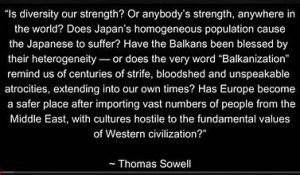
The “warring tribes” feeling often results from a society that has focused so much on the “Many” that it has forgotten how to cultivate the “One.”
So, what is the most important “American value” that newcomers to America should be required to adopt to ensure that we remain one nation?
From a historical and civic perspective, I would argue that the cornerstone of this requirement is individual liberty tempered by the rule of law.
America is not bound together by a single religion, race, or ancient ancestry, but by an adherence to a legal document, the Constitution. Accepting that the Constitution is the “supreme law of the land” ensures that disputes are settled in courtrooms rather than through violence, and that rights are protected by systems rather than the whims of leaders.
This reflects the idea of civic integration. It suggests that while individuals can and should maintain their cultural heritage, they must also adopt a primary identity as “American.” Doing so involves a commitment to the common good and the success of the republic above sectarian or old-world allegiances.
I am aware that the belief that “all men are created equal” doesn’t guarantee equal outcomes, but it mandates an equal starting line. Adopting this value means rejecting rigid class or caste systems and embracing a culture where merit, hard work, and individual initiative are the primary drivers of success—that thing called the “American Dream.”
Sadly, in today’s America, the very values that I was taught to emulate and pursue (merit, hard work, and individual initiative) are called “racist” by the socialists and communists who would rip our nation to pieces.
For that reason, in a nation with such vast ideological differences, mutual forbearance—the agreement to disagree while still respecting the rights of others to exist and speak—is a functional necessity. Without a shared commitment to free speech and religious freedom, a diverse society risks fracturing into tribalism.
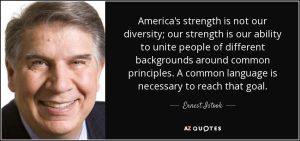
Sound familiar?
It’s worth noting that “American values” are often aspirational. As a former journalist who has covered global conflicts and the complexities of American history, I’ve seen firsthand that our strength often comes from the tension between these ideals and our efforts to live up to them.
I never gave much thought to these things when I was younger. I just assumed that America would always be the same exceptional nation that it has always been—warts and struggles notwithstanding.
But today, with the unfettered and illegal migration of millions of mostly minority immigrants during the four years of the feckless and treacherous Biden administration, our nation is inhabited by people who have zero concept of American history and culture, or what it means to be “American.”
Their view of America means a place to accumulate wealth by any means possible—even fraud, as in Minnesota and California, where such schemes are rampant and proliferating. The common denominator among such people is to achieve wealth by any means possible while maintaining their own culture, language, and religion. The idea of assimilation and “becoming American” is about the furthest thing from their minds.
During the late 19th and early 20th centuries, there was a heavy emphasis on the “Melting Pot.” Public schools and civic organizations were explicitly designed to teach American history, the English language, and democratic republican values. The goal was to ensure that while people came from different places, they shared a common national identity—America and being an American.
In recent decades, many institutions have shifted toward “Multiculturalism,” which encourages the maintenance of distinct cultural identities. This has come at the expense of a unified civic culture. When combined with high volumes of migration, the concern is that the “social glue” that binds the nation together becomes dangerously thin.
Some argue that it is naturally easier for individuals from nations with shared Western roots (the Enlightenment, common law, Greco-Roman traditions) to understand the “American” blueprint. From this view, rapid demographic shifts by those from non-Western cultures pose a steeper hurdle to national unity.
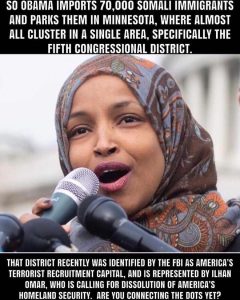
Once again, as someone who reported on the revolutions in El Salvador, Guatemala, and Nicaragua, I saw how deep-seated political and cultural history shapes a person’s worldview. It is a significant challenge for any nation to integrate millions of people who may be coming from environments where the Rule of Law or individual liberty were non-existent or suppressed.
So here we are today. I believe the U.S. has lost its “assimilationist muscles.” Even a high volume of migrants flooding into the country would be manageable if our institutions were still committed to the traditional model of integration. But they aren’t.
As I mentioned previously, the goal of the traditional “Melting Pot” was to turn immigrants into Americans through rigorous civic instruction. Today, many institutions have shifted toward a “Mosaic” model that prioritizes preserving the original culture over adopting the American one.
The primary sources of information (media, universities, and government) no longer project a unified or positive American narrative, leaving today’s migrants without a clear cultural “north star” to follow. So who can blame them when they fall back on old customs, traditions, and habits?
I can see parallels to the “Mass Migration” era of the late 19th and early 20th centuries (1880–1920). The volume then was also immense, but it was met with an aggressive institutional effort to “Americanize” the uninformed newcomers. Today, the volume is high, but the institutional demand for assimilation has reached an all-time low.
Ultimately, a high volume of legal and illegal immigration makes the institutional task harder, while institutional failure makes even a moderate volume of immigration feel like an existential threat.
And there we are. A nation that is ever divided by a new class of immigrants who are content to create linguistic, cultural, racial, ethnic, and religious enclaves without embracing the idea or traditional construct of America and what it means to be an American citizen.
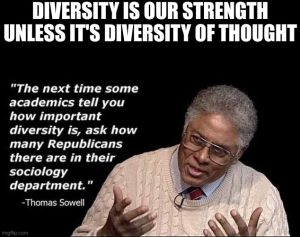
I don’t think this is what the Founding Fathers had in mind when they were creating our nation.
For example, in the Federalist Papers, James Madison warned that “factions” (today’s tribalism) were the greatest threat to a popular government. For those who may have forgotten, the Federalist Papers were a collection of 85 articles and essays written between 1787 and 1788 by Alexander Hamilton, James Madison, and John Jay under the pseudonym “Publius” to promote the ratification of the Constitution of the United States.
The founders believed that if citizens began to prioritize their specific “tribe” or party over the common good, the result would be a “mortal disease of instability, injustice, and confusion.”
I may be going out on a limb here, but I believe they would likely see the current digital fragmentation and ideological sorting as the “mortal disease” they feared.
George Washington’s Farewell Address specifically warned that hyper-partisanship would lead to “frightful despotism” as citizens sought a “strongman” to protect them from the opposing tribe.
Thomas Jefferson expressed concern that immigrants from “absolute monarchies” might bring with them political principles incompatible with a free republic. He believed that for a nation to remain “one,” newcomers had to be imbued with the “principles of our government.”

Today, I think he would be just as concerned by those who invaded our country from renegade nations such as Somalia, or communist dictatorships such as China, North Korea, or Cuba.
I have no doubt that the Founders would likely be stunned by the volume and lack of legal order in America. To the Founders, the “Rule of Law” was THE substitute for a King.
A system in which laws are bypassed or left unenforced, as they are by the Democratic Party today when it comes to illegal immigration and soft-on-crime blue states, would strike the Founders as a breakdown of the social contract itself.
The Founders viewed the press and education as the primary tools for maintaining a “common culture.” They would be alarmed over America’s loss of a “common national sentiment” and shared civic principles.
I am sure the Founders would be shocked that the “Free Press” they so valued has transitioned from its role as a civic educator to a driver of partisan outrage.
Finally, the Founders believed that if the institutions of the press and the schools failed to teach the “science of government” and an accurate shared history, the Republic would naturally dissolve into the very tribalism we see today.
So, I will end with the same question I began with: Is Diversity Our Strength, or Our Weakness?
–30—
(Ronald E. Yates is a U.S. Army veteran, an author, a former Chicago Tribune foreign correspondent, and Professor and Dean Emeritus of Journalism at the University of Illinois.)
His website: http://www.ronaldyatesbooks.com/
If you enjoyed this article, then please REPOST or SHARE with others; encourage them to follow AFNN. If you’d like to become a citizen contributor for AFNN, contact us at managingeditor@afnn.us Help keep us ad-free by donating here.
Substack: American Free News Network Substack
Truth Social: @AFNN_USA
Facebook: https://m.facebook.com/afnnusa
Telegram: https://t.me/joinchat/2_-GAzcXmIRjODNh
Twitter: https://twitter.com/AfnnUsa
GETTR: https://gettr.com/user/AFNN_USA
CloutHub: @AFNN_USA