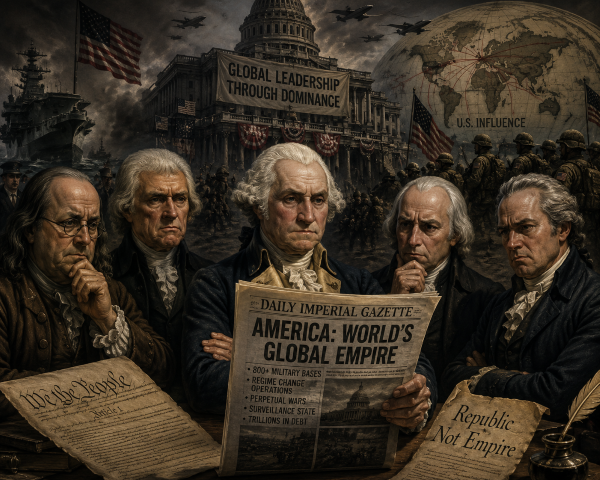
For most of its history, the United States has insisted it was not an empire. Empires wore crowns, planted flags, and taxed distant subjects. America, by contrast, claimed to export liberty, democracy, and occasionally cruise missiles. Yet from a military and strategic standpoint, the distinction has always been more cosmetic than substantive. When a nation maintains a global network of alliances, commands expeditionary forces on every continent, controls the dominant reserve currency, and can ruin an adversary with either an aircraft carrier or a spreadsheet, it is functioning as an empire whether it admits it or not. The only real difference is that Roman legions wore sandals, while modern empires arrive with PowerPoint slides and precision-guided munitions.
Empires rarely collapse because they lose one decisive battle. They decay when the cost of maintaining the system exceeds the political will, economic capacity, and moral cohesion required to sustain it. Fall of the Western Roman Empire was not a single bad day at the office. Roman Empire hollowed itself out through debt, corruption, overextended borders, demographic strain, and a ruling class more interested in preserving privilege than solving structural problems. The barbarians merely kicked in a door that was already hanging from one hinge.
The United States exhibits many of the same strategic warning signs. Its military remains the most capable force in history, but capability is not the same as sustainability. United States Department of Defense can still project overwhelming power, yet it does so while drawing from a shrinking pool of qualified recruits, relying on increasingly expensive platforms, and operating within an industrial base that would struggle to sustain a prolonged great-power war. Building a fifth-generation fighter now costs enough to make a Roman emperor choke on his grapes.
Debt is the empire killer hiding in plain sight. Great powers can borrow their way through crises for a long time—until creditors and arithmetic stage a coup. The United States dollar remains the cornerstone of global finance, allowing Washington to fund deficits and enforce sanctions with extraordinary reach. But reserve currency status is not a law of nature. It is a confidence game backed by economic productivity, military credibility, and political stability. If those pillars erode, the imperial credit card eventually gets declined at the geopolitical checkout counter.
Strategically, the United States now confronts simultaneous challenges from China, Russia, Iran, and numerous non-state actors. During the Cold War, Washington could focus on one primary peer competitor. Today, it is juggling multiple theaters while domestic political factions treat one another as greater threats than any foreign adversary. That is a poor foundation for strategic endurance. Nations can survive external enemies; they struggle when internal cohesion dissolves into perpetual tribal combat.
Military power ultimately rests on something more fundamental than tanks and aircraft. It depends on national purpose. Soldiers fight effectively when they believe the society behind them is worth defending. When a population loses faith in its institutions, history, and common identity, combat power becomes a shell of itself. The weapons remain polished, but the cultural software that animates them begins to crash. Empires die first in the mind, then in the treasury, and only later on the battlefield.
The information domain accelerates this process. In earlier eras, empires were defeated by invading armies. In the twenty-first century, they can be weakened by narrative warfare, social fragmentation, cyberattacks, and economic disruption. A nation whose citizens no longer agree on basic reality becomes strategically vulnerable. If people cannot distinguish between truth and propaganda, they become easy prey for adversaries and domestic opportunists alike. The empire starts arguing over pronouns while its rivals build ships, missiles, and semiconductor foundries.
None of this means imminent collapse. The United States retains immense strengths: favorable geography, abundant resources, innovative capacity, powerful alliances, and a military that remains unmatched in global reach. But history offers no permanent exemptions. Every empire eventually discovers that debt compounds, institutions corrode, and hubris is not a renewable resource.
The fall of the American empire, if it comes, will likely not resemble the dramatic sack of Rome. There may be no flaming capital and no barbarian king posing for selfies in the ruins. Instead, decline would look like gradual loss of influence, shrinking strategic options, chronic fiscal weakness, eroding public trust, and a slow recognition that the world no longer waits for Washington’s permission. The eagle will still be on the seal, the bands will still play, and politicians will still promise greatness. But behind the ceremony, the center will have loosened, and the empire will discover that history collects all debts—usually with interest.
If you enjoyed this article, then please REPOST or SHARE with others; encourage them to follow AFNN. If you’d like to become a citizen contributor for AFNN, contact us at managingeditor@afnn.us Help keep us ad-free by donating here.
Substack: American Free News Network Substack
Truth Social: @AFNN_USA
Facebook: https://m.facebook.com/afnnusa
Telegram: https://t.me/joinchat/2_-GAzcXmIRjODNh
Twitter: https://twitter.com/AfnnUsa
GETTR: https://gettr.com/user/AFNN_USA
CloutHub: @AFNN_USA